







Question: Please provide simulations for all matlab code required, DO NOT SIMPLY WRITE IT OUT!!! It is all one part of a single problem, which is
Please provide simulations for all matlab code required, DO NOT SIMPLY WRITE IT OUT!!! It is all one part of a single problem, which is why I cannot post this in parts
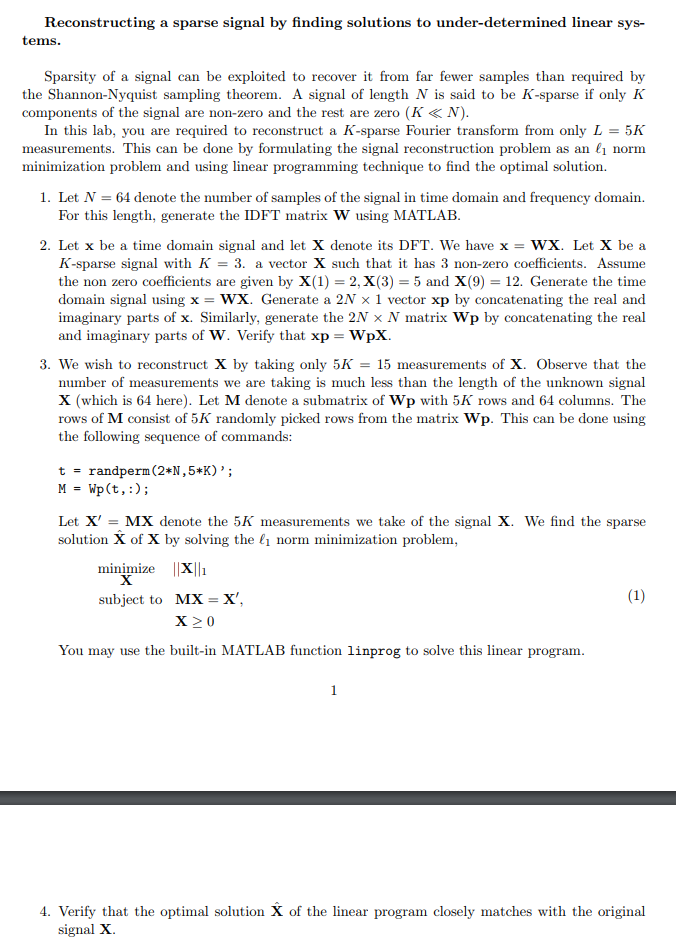
Reconstructing a sparse signal by finding solutions to under-determined linear sys- tems. Sparsity of a signal can be exploited to recover it from far fewer samples than required by the Shannon-Nyquist sampling theorem. A signal of length N is said to be K-sparse if only K components of the signal are non-zero and the rest are zero (K N) In this lab, you are required to reconstruct a K-sparse Fourier transform from only L -5K measurements. This can be done by formulating the signal reconstruction problem as an 1 norm minimization problem and using linear programming technique to find the optimal solution. 1. Let N 64 denote the number of samples of the signal in time domain and frequency domain. For this length, generate the IDFT matrix W using MATLAB 2. Let x be a time domain signal and let X denote its DFT. We have x - WX. Let X be a Assume the non zero coefficients are given by X(1) 2, X(3) 5 and X(9)-12. Generate the time domain signal using x -WX. Generate a 2N x 1 vector xp by concatenating the real and imaginary parts of x. Similarly, generate the 2N x N matrix Wp by concatenating the real K-sparse signal with K-3. a vector X such that it has 3 non-zero c and imaginary parts of W. Verify that xp -WpX. 3. We wish to reconstruct X by taking only 5K-15 measurements of X. Observe that the number of measurements we are taking is much less than the length of the unknown signal X (which is 64 here). Let M denote a submatrix of Wp with 5K rows and 64 columns. The rows of M consist of 5K randomly picked rows from the matrix Wp. This can be done using the follow ing sequence of commands t-randperm (2*N,5*K)'; Let X'-MX denote the 5K measurements we take of the signal X. We find the sparse solution X of X by solving the 1 norm minimization problem minimize subject to MX X' X 20 You may use the built-in MATLAB function linprog to solve this linear program. 4. Verify that the optimal solution X of the linear program closely matches with the original signal X Reconstructing a sparse signal by finding solutions to under-determined linear sys- tems. Sparsity of a signal can be exploited to recover it from far fewer samples than required by the Shannon-Nyquist sampling theorem. A signal of length N is said to be K-sparse if only K components of the signal are non-zero and the rest are zero (K N) In this lab, you are required to reconstruct a K-sparse Fourier transform from only L -5K measurements. This can be done by formulating the signal reconstruction problem as an 1 norm minimization problem and using linear programming technique to find the optimal solution. 1. Let N 64 denote the number of samples of the signal in time domain and frequency domain. For this length, generate the IDFT matrix W using MATLAB 2. Let x be a time domain signal and let X denote its DFT. We have x - WX. Let X be a Assume the non zero coefficients are given by X(1) 2, X(3) 5 and X(9)-12. Generate the time domain signal using x -WX. Generate a 2N x 1 vector xp by concatenating the real and imaginary parts of x. Similarly, generate the 2N x N matrix Wp by concatenating the real K-sparse signal with K-3. a vector X such that it has 3 non-zero c and imaginary parts of W. Verify that xp -WpX. 3. We wish to reconstruct X by taking only 5K-15 measurements of X. Observe that the number of measurements we are taking is much less than the length of the unknown signal X (which is 64 here). Let M denote a submatrix of Wp with 5K rows and 64 columns. The rows of M consist of 5K randomly picked rows from the matrix Wp. This can be done using the follow ing sequence of commands t-randperm (2*N,5*K)'; Let X'-MX denote the 5K measurements we take of the signal X. We find the sparse solution X of X by solving the 1 norm minimization problem minimize subject to MX X' X 20 You may use the built-in MATLAB function linprog to solve this linear program. 4. Verify that the optimal solution X of the linear program closely matches with the original signal X
Step by Step Solution
There are 3 Steps involved in it

Get step-by-step solutions from verified subject matter experts
 Study Help