







Question: Please provide solution for part b and part c Consider a firm whose current market value is $150 million at the beginning of the first
Please provide solution for part b and part c
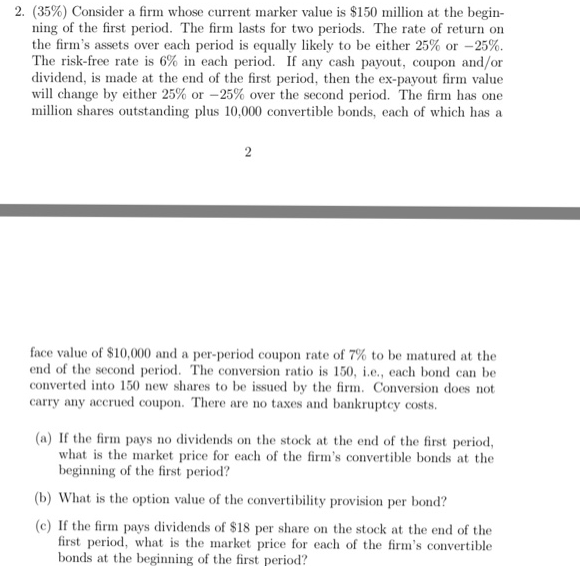
Consider a firm whose current market value is $150 million at the beginning of the first period. The firm lasts for two periods. The rate of return on the firm's assets over each period is equally likely to be either 25% or -25%. The risk-free rate is 6% in each period. If any cash payout, coupon and/or dividend, is made at the end of the first period, then the ex-payout firm value will change by either 25% or - 25% over the second period. The firm has one million shares outstanding plus 10.000 convertible bonds. each of which has a face value of $10.000 and a per-period coupon rate of 7% to be matured at the end of the second period. The conversion ratio is 150, i.e., each bond can be converted into 150 new shares to be issued by the firm. Conversion does not carry any accrued coupon. There are no taxes and bankruptcy costs. (a) If the firm pays no dividends on the stock at the end of the first period, what is the market price for each of the firm's convertible bonds at the beginning of the first period? (b) What is the option value of the convertibility provision per bond? (c) If the firm pays dividends of $18 per share on the stock at the end of the first period. what is the market price for each of the firm's convertible bonds at the beginning of the first period? Consider a firm whose current market value is $150 million at the beginning of the first period. The firm lasts for two periods. The rate of return on the firm's assets over each period is equally likely to be either 25% or -25%. The risk-free rate is 6% in each period. If any cash payout, coupon and/or dividend, is made at the end of the first period, then the ex-payout firm value will change by either 25% or - 25% over the second period. The firm has one million shares outstanding plus 10.000 convertible bonds. each of which has a face value of $10.000 and a per-period coupon rate of 7% to be matured at the end of the second period. The conversion ratio is 150, i.e., each bond can be converted into 150 new shares to be issued by the firm. Conversion does not carry any accrued coupon. There are no taxes and bankruptcy costs. (a) If the firm pays no dividends on the stock at the end of the first period, what is the market price for each of the firm's convertible bonds at the beginning of the first period? (b) What is the option value of the convertibility provision per bond? (c) If the firm pays dividends of $18 per share on the stock at the end of the first period. what is the market price for each of the firm's convertible bonds at the beginning of the first period
Step by Step Solution
There are 3 Steps involved in it

Get step-by-step solutions from verified subject matter experts
 Study Help