







Question: Please provide step - by - step calculations with explanation. The one - dimensional linear wave equation can be written as d e l 2
Please provide stepbystep calculations with explanation.
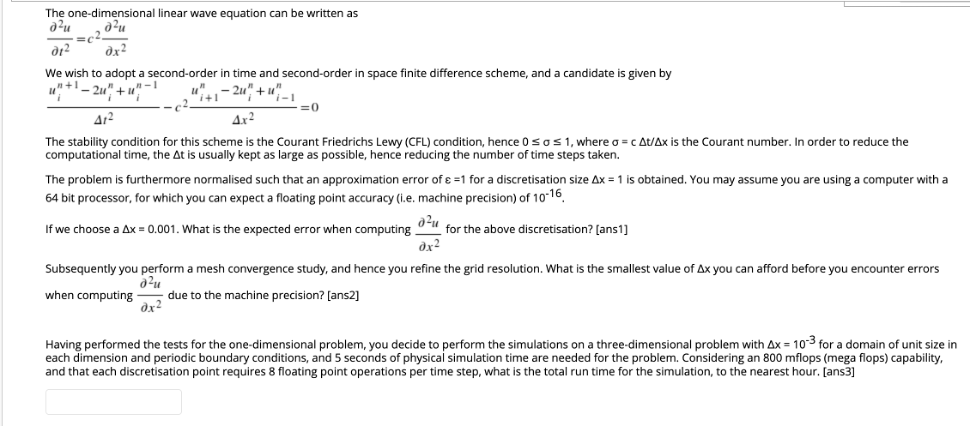
The onedimensional linear wave equation can be written as
We wish to adopt a secondorder in time and secondorder in space finite difference scheme, and a candidate is given by
The stability condition for this scheme is the Courant Friedrichs Lewy CFL condition, hence where is the Courant number. In order to reduce the
computational time, the is usually kept as large as possible, hence reducing the number of time steps taken.
The problem is furthermore normalised such that an approximation error of for a discretisation size is obtained. You may assume you are using a computer with a
bit processor, for which you can expect a floating point accuracy ie machine precision of
If we choose a What is the expected error when computing for the above discretisation? ans
Subsequently you perform a mesh convergence study, and hence you refine the grid resolution. What is the smallest value of you can afford before you encounter errors
when computing due to the machine precision? ans
Having performed the tests for the onedimensional problem, you decide to perform the simulations on a threedimensional problem with for a domain of unit size in
each dimension and periodic boundary conditions, and seconds of physical simulation time are needed for the problem. Considering an mflops mega flops capability,
and that each discretisation point requires floating point operations per time step, what is the total run time for the simulation, to the nearest hour. ans
Step by Step Solution
There are 3 Steps involved in it
1 Expert Approved Answer
Step: 1 Unlock

Question Has Been Solved by an Expert!
Get step-by-step solutions from verified subject matter experts
Step: 2 Unlock
Step: 3 Unlock
 Study Help