







Question: Please provide the answer for the following questions When two elastic cylinders are pressed against one another, they make contact over a strip of width
Please provide the answer for the following questions
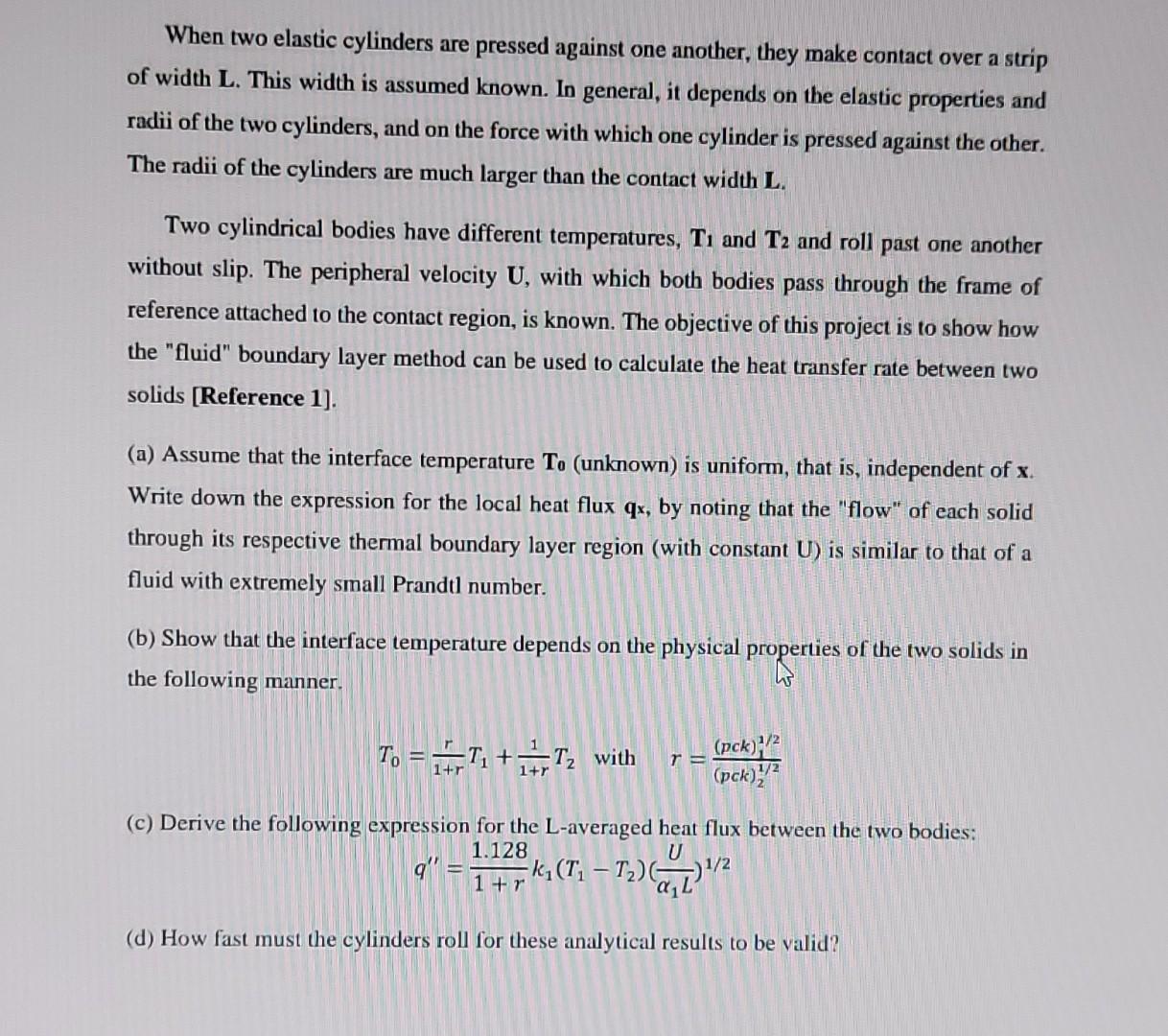
When two elastic cylinders are pressed against one another, they make contact over a strip of width L. This width is assumed known. In general, it depends on the elastic properties and radii of the two cylinders, and on the force with which one cylinder is pressed against the other. The radii of the cylinders are much larger than the contact width L. Two cylindrical bodies have different temperatures, T1 and T2 and roll past one another without slip. The peripheral velocity U, with which both bodies pass through the frame of reference attached to the contact region, is known. The objective of this project is to show how the "fluid" boundary layer method can be used to calculate the heat transfer rate between two solids [Reference 1 ]. (a) Assume that the interface temperature T0 (unknown) is uniform, that is, independent of x. Write down the expression for the local heat flux qx, by noting that the "flow" of each solid through its respective thermal boundary layer region (with constant U ) is similar to that of a fluid with extremely small Prandtl number. (b) Show that the interface temperature depends on the physical properties of the two solids in the following manner. T0=1+rrT1+1+r1T2withr=(pck)21/2(pck)11/2 (c) Derive the following expression for the L-averaged heat flux between the two bodies: q=1+r1.128k1(T1T2)(1LU)1/2 (d) How fast must the cylinders roll for these analytical results to be valid? When two elastic cylinders are pressed against one another, they make contact over a strip of width L. This width is assumed known. In general, it depends on the elastic properties and radii of the two cylinders, and on the force with which one cylinder is pressed against the other. The radii of the cylinders are much larger than the contact width L. Two cylindrical bodies have different temperatures, T1 and T2 and roll past one another without slip. The peripheral velocity U, with which both bodies pass through the frame of reference attached to the contact region, is known. The objective of this project is to show how the "fluid" boundary layer method can be used to calculate the heat transfer rate between two solids [Reference 1 ]. (a) Assume that the interface temperature T0 (unknown) is uniform, that is, independent of x. Write down the expression for the local heat flux qx, by noting that the "flow" of each solid through its respective thermal boundary layer region (with constant U ) is similar to that of a fluid with extremely small Prandtl number. (b) Show that the interface temperature depends on the physical properties of the two solids in the following manner. T0=1+rrT1+1+r1T2withr=(pck)21/2(pck)11/2 (c) Derive the following expression for the L-averaged heat flux between the two bodies: q=1+r1.128k1(T1T2)(1LU)1/2 (d) How fast must the cylinders roll for these analytical results to be valid
Step by Step Solution
There are 3 Steps involved in it

Get step-by-step solutions from verified subject matter experts
 Study Help