







Question: please provide the answer in Python language only with output.... are N apple trees in the orchard. The apple trees are arranged in a row
please provide the answer in Python language only with output....
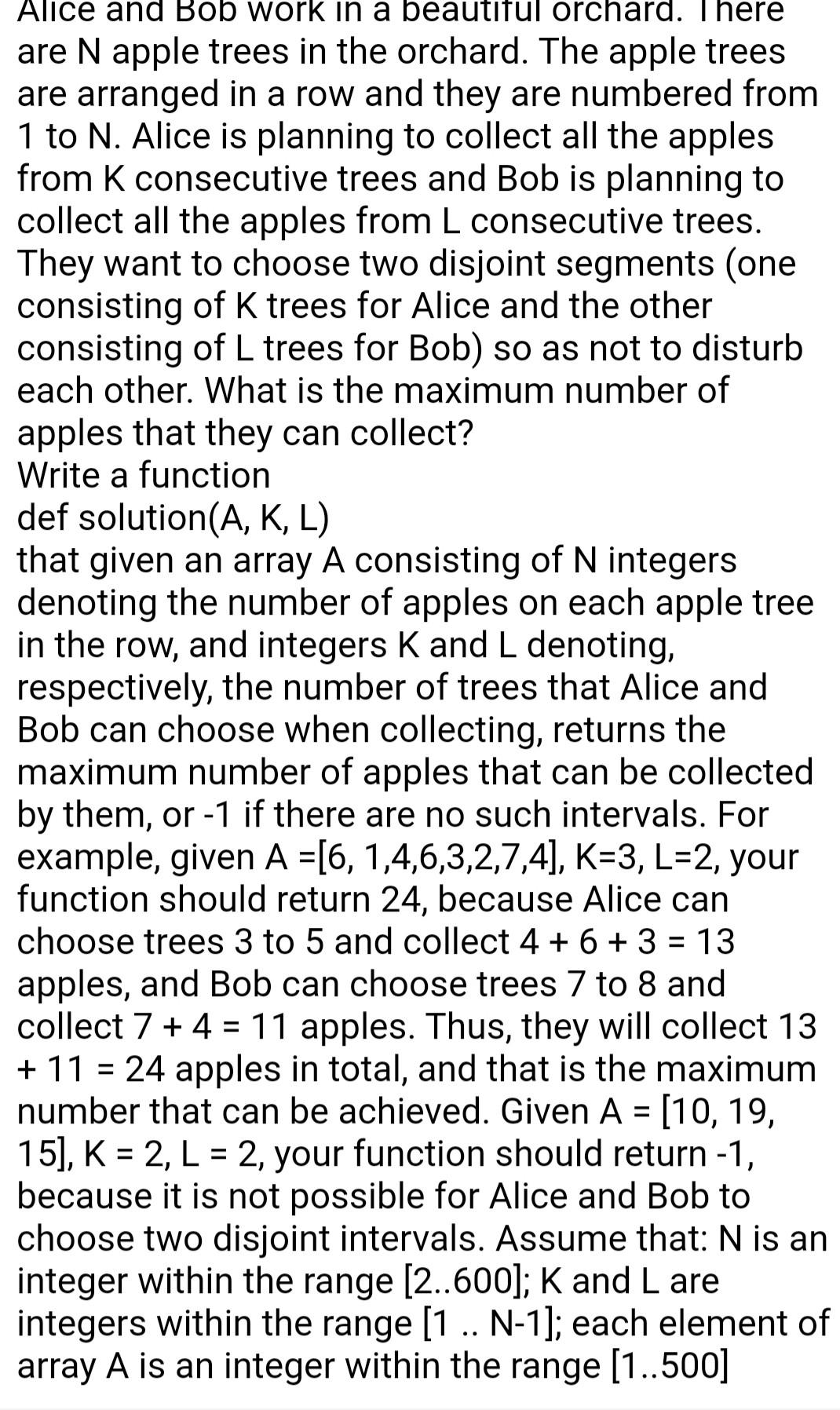
are N apple trees in the orchard. The apple trees are arranged in a row and they are numbered from 1 to N. Alice is planning to collect all the apples from K consecutive trees and Bob is planning to collect all the apples from L consecutive trees. They want to choose two disjoint segments (one consisting of K trees for Alice and the other consisting of L trees for Bob) so as not to disturb each other. What is the maximum number of apples that they can collect? Write a function def solution (A,K,L) that given an array A consisting of N integers denoting the number of apples on each apple tree in the row, and integers K and L denoting, respectively, the number of trees that Alice and Bob can choose when collecting, returns the maximum number of apples that can be collected by them, or 1 if there are no such intervals. For example, given A=[6,1,4,6,3,2,7,4],K=3,L=2, your function should return 24 , because Alice can choose trees 3 to 5 and collect 4+6+3=13 apples, and Bob can choose trees 7 to 8 and collect 7+4=11 apples. Thus, they will collect 13 +11=24 apples in total, and that is the maximum number that can be achieved. Given A=[10,19, 15 ], K=2,L=2, your function should return 1, because it is not possible for Alice and Bob to choose two disjoint intervals. Assume that: N is an integer within the range [2..600]; K and L are integers within the range [1 .N1]; each element of array A is an integer within the range [1..500]Step by Step Solution
There are 3 Steps involved in it
1 Expert Approved Answer
Step: 1 Unlock

Question Has Been Solved by an Expert!
Get step-by-step solutions from verified subject matter experts
Step: 2 Unlock
Step: 3 Unlock
 Study Help