







Question: Please provide the code and the explanation for Question 1.1 and 1.2. Thank you. A researcher conducted a randomized field experiment assessing the extent to
Please provide the code and the explanation for Question 1.1 and 1.2. Thank you.
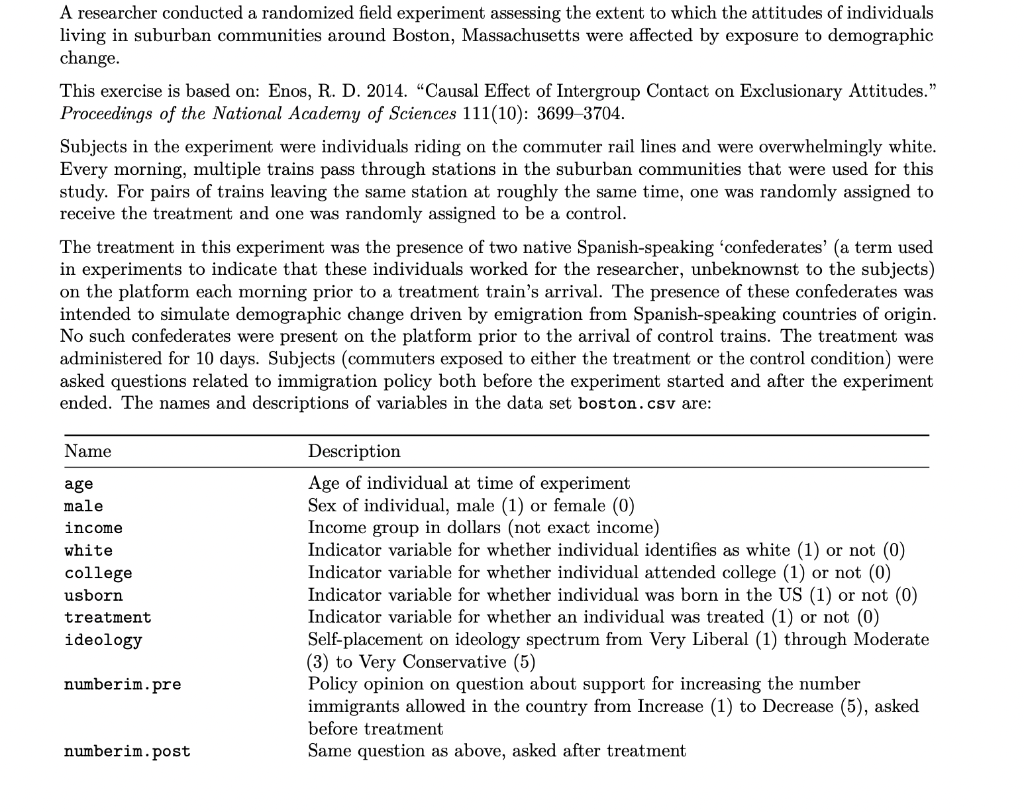
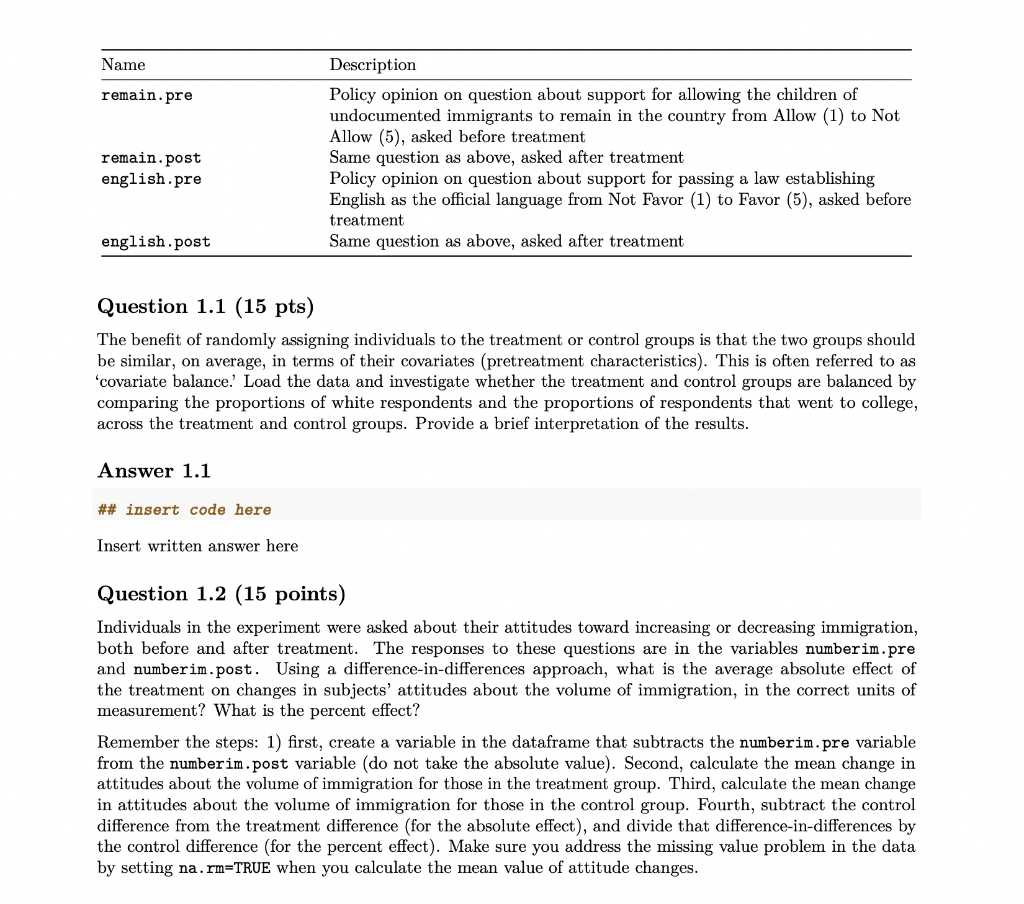
A researcher conducted a randomized field experiment assessing the extent to which the attitudes of individuals living in suburban communities around Boston, Massachusetts were affected by exposure to demographic change. This exercise is based on: Enos, R. D. 2014. "Causal Effect of Intergroup Contact on Exclusionary Attitudes." Proceedings of the National Academy of Sciences 111(10): 3699-3704. Subjects in the experiment were individuals riding on the commuter rail lines and were overwhelmingly white. Every morning, multiple trains pass through stations in the suburban communities that were used for this study. For pairs of trains leaving the same station at roughly the same time, one was randomly assigned to receive the treatment and one was randomly assigned to be a control. The treatment in this experiment was the presence of two native Spanish-speaking 'confederates' (a term used in experiments to indicate that these individuals worked for the researcher, unbeknownst to the subjects) on the platform each morning prior to a treatment train's arrival. The presence of these confederates was intended to simulate demographic change driven by emigration from Spanish-speaking countries of origin. No such confederates were present on the platform prior to the arrival of control trains. The treatment was administered for 10 days. Subjects (commuters exposed to either the treatment or the control condition) were asked questions related to immigration policy both before the experiment started and after the experiment ended. The names and descriptions of variables in the data set boston.csv are: Question 1.1 (15 pts) The benefit of randomly assigning individuals to the treatment or control groups is that the two groups should be similar, on average, in terms of their covariates (pretreatment characteristics). This is often referred to as 'covariate balance.' Load the data and investigate whether the treatment and control groups are balanced by comparing the proportions of white respondents and the proportions of respondents that went to college, across the treatment and control groups. Provide a brief interpretation of the results. Answer 1.1 \#\# insert code here Insert written answer here Question 1.2 (15 points) Individuals in the experiment were asked about their attitudes toward increasing or decreasing immigration, both before and after treatment. The responses to these questions are in the variables numberim.pre and numberim.post. Using a difference-in-differences approach, what is the average absolute effect of the treatment on changes in subjects' attitudes about the volume of immigration, in the correct units of measurement? What is the percent effect? Remember the steps: 1) first, create a variable in the dataframe that subtracts the numberim.pre variable from the numberim.post variable (do not take the absolute value). Second, calculate the mean change in attitudes about the volume of immigration for those in the treatment group. Third, calculate the mean change in attitudes about the volume of immigration for those in the control group. Fourth, subtract the control difference from the treatment difference (for the absolute effect), and divide that difference-in-differences by the control difference (for the percent effect). Make sure you address the missing value problem in the data by setting na.rm=TRUE when you calculate the mean value of attitude changes
Step by Step Solution
There are 3 Steps involved in it

Get step-by-step solutions from verified subject matter experts
 Study Help