







Question: Please provide the correct answer i will surely upvote your solution ASAP ASAP ASAP ASAP ASAP ASAP ASAP ASAP Speedup and Amdahl's Law You have
Please provide the correct answer i will surely upvote your solution ASAP
ASAP ASAP ASAP ASAP ASAP ASAP ASAP
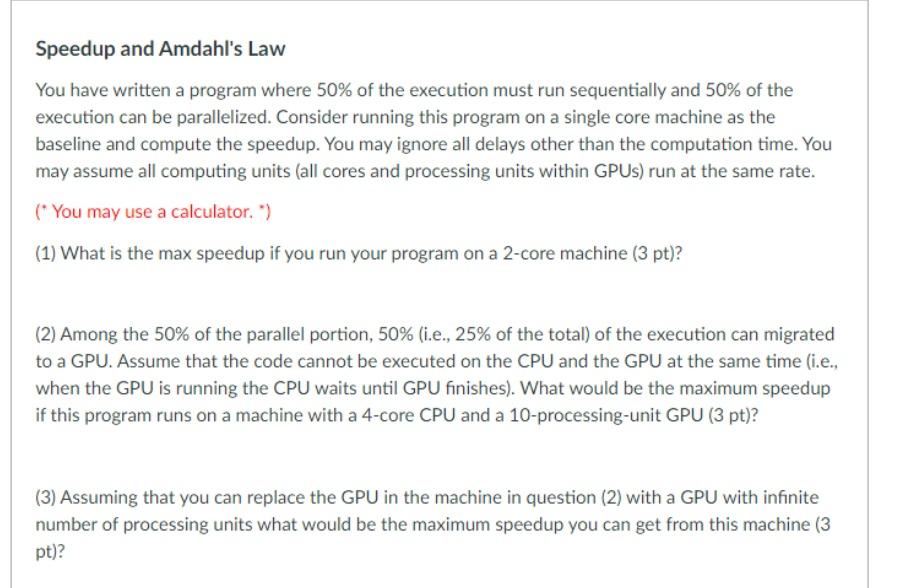
Speedup and Amdahl's Law You have written a program where 50% of the execution must run sequentially and 50% of the execution can be parallelized. Consider running this program on a single core machine as the baseline and compute the speedup. You may ignore all delays other than the computation time. You may assume all computing units (all cores and processing units within GPUs) run at the same rate. (* You may use a calculator.) (1) What is the max speedup if you run your program on a 2-core machine (3 pt)? (2) Among the 50% of the parallel portion, 50% (i.e., 25% of the total) of the execution can migrated to a GPU. Assume that the code cannot be executed on the CPU and the GPU at the same time (i.e., when the GPU is running the CPU waits until GPU finishes). What would be the maximum speedup if this program runs on a machine with a 4-core CPU and a 10-processing-unit GPU (3 pt)? (3) Assuming that you can replace the GPU in the machine in question (2) with a GPU with infinite number of processing units what would be the maximum speedup you can get from this machine (3 pt)
Step by Step Solution
There are 3 Steps involved in it

Get step-by-step solutions from verified subject matter experts
 Study Help