Question: please put answer with excel solver and steps i added a clearer image of the table in case it wasnt showing Colonial Furniture produces hand-crafted
please put answer with excel solver and steps
i added a clearer image of the table in case it wasnt showing
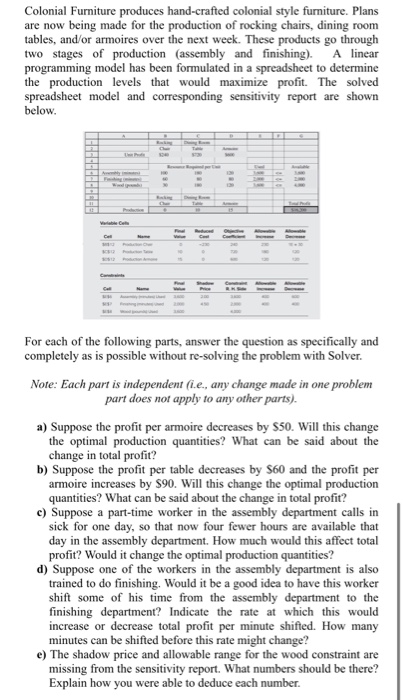
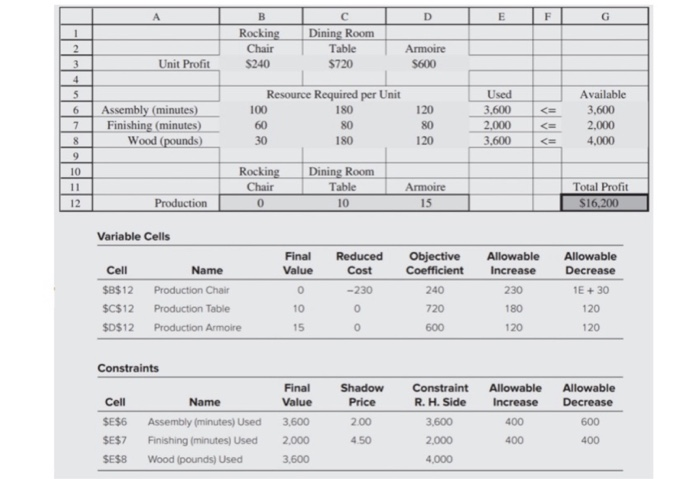
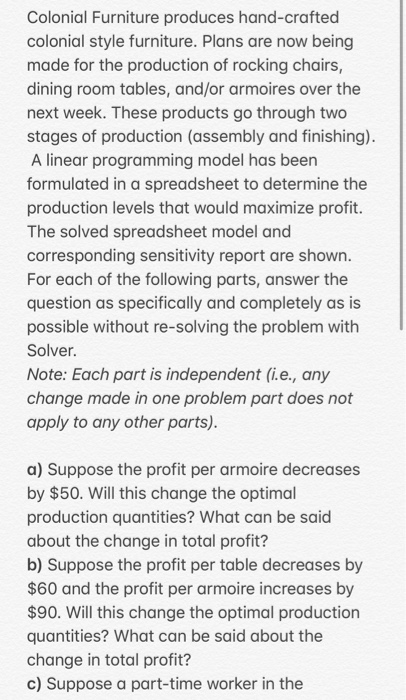
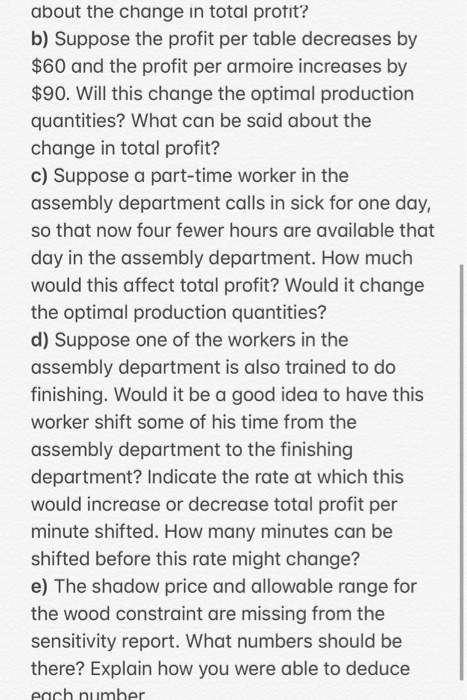
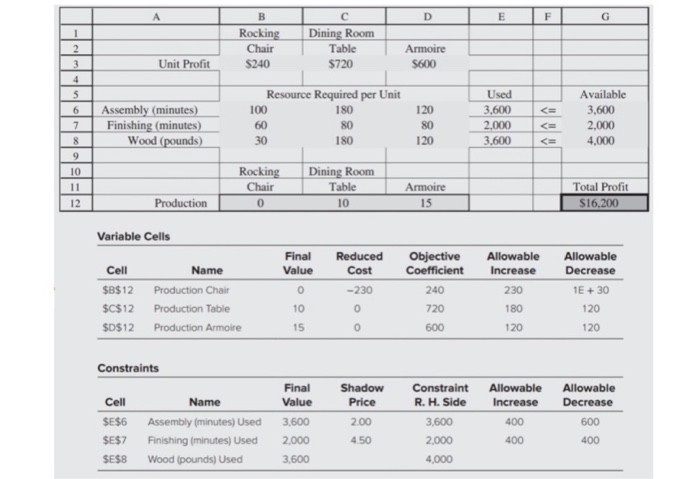
Colonial Furniture produces hand-crafted colonial style furniture. Plans are now being made for the production of rocking chairs, dining room tables, and/or armoires over the next week. These products go through two stages of production (assembly and finishing). A linear programming model has been formulated in a spreadsheet to determine the production levels that would maximize profit. The solved spreadsheet model and corresponding sensitivity report are shown below. BB 2010 III For each of the following parts, answer the question as specifically and completely as is possible without re-solving the problem with Solver. Note: Each part is independent (i.e., any change made in one problem part does not apply to any other parts). a) Suppose the profit per armoire decreases by $50. Will this change the optimal production quantities? What can be said about the change in total profit? b) Suppose the profit per table decreases by $60 and the profit per armoire increases by S90. Will this change the optimal production quantities? What can be said about the change in total profit? c) Suppose a part-time worker in the assembly department calls in sick for one day, so that now four fewer hours are available that day in the assembly department. How much would this affect total profit? Would it change the optimal production quantities? d) Suppose one of the workers in the assembly department is also trained to do finishing. Would it be a good idea to have this worker shift some of his time from the assembly department to the finishing department? Indicate the rate at which this would increase or decrease total profit per minute shifted. How many minutes can be shifted before this rate might change? e) The shadow price and allowable range for the wood constraint are missing from the sensitivity report. What numbers should be there? Explain how you were able to deduce each number. A D E F G 1 2 3 4 B Rocking Chair $240 Dining Room Table $720 Armoire 5600 Unit Profit 5 Assembly (minutes) Finishing (minutes) Wood (pounds) Resource Required per Unit 100 180 60 80 30 180 120 80 120 Used 3,600 2.000 3,600 6 7 8 9 10 11 Available 3,600 2,000 4.000 Rocking Chair 0 Dining Room Table 10 Armoire 15 Total Profit S16,200 12 Production Variable Cells Final Value 0 Reduced Cost -230 Cell $B$12 $C$12 $0$12 Name Production Chair Production Table Production Armoire Objective Coefficient 240 720 600 Allowable Increase 230 180 120 Allowable Decrease 1E + 30 120 120 10 0 15 0 Constraints Cell $E$6 $E$7 Name Assembly (minutes) Used Finishing (minutes) Used Wood (pounds) Used Final Value 3,600 2.000 Shadow Price 200 4.50 Constraint Allowable Allowable R. H. Side Increase Decrease 3,600 400 600 2.000 400 400 4,000 SE$8 3.600 Colonial Furniture produces hand-crafted colonial style furniture. Plans are now being made for the production of rocking chairs, dining room tables, and/or armoires over the next week. These products go through two stages of production (assembly and finishing). A linear programming model has been formulated in a spreadsheet to determine the production levels that would maximize profit. The solved spreadsheet model and corresponding sensitivity report are shown. For each of the following parts, answer the question as specifically and completely as is possible without re-solving the problem with Solver. Note: Each part is independent (i.e., any change made in one problem part does not apply to any other parts). a) Suppose the profit per armoire decreases by $50. Will this change the optimal production quantities? What can be said about the change in total profit? b) Suppose the profit per table decreases by $60 and the profit per armoire increases by $90. Will this change the optimal production quantities? What can be said about the change in total profit? c) Suppose a part-time worker in the about the change in total protit? b) Suppose the profit per table decreases by $60 and the profit per armoire increases by $90. Will this change the optimal production quantities? What can be said about the change in total profit? c) Suppose a part-time worker in the assembly department calls in sick for one day, so that now four fewer hours are available that day in the assembly department. How much would this affect total profit? Would it change the optimal production quantities? d) Suppose one of the workers in the assembly department is also trained to do finishing. Would it be a good idea to have this worker shift some of his time from the assembly department to the finishing department? Indicate the rate at which this would increase or decrease total profit per minute shifted. How many minutes can be shifted before this rate might change? e) The shadow price and allowable range for the wood constraint are missing from the sensitivity report. What numbers should be there? Explain how you were able to deduce each number A D E F G 1 2 3 4 B Rocking Chair $240 Dining Room Table $720 Armoire 5600 Unit Profit 5 6 7 8 9 10 Assembly (minutes) Finishing (minutes) Wood (pounds) Resource Required per Unit 100 180 60 80 30 180 120 80 120 Used 3,600 2.000 3,600 Available 3,600 2,000 4,000 Rocking Chair 0 Dining Room Table 10 Armoire 15 Total Profit S16,200 12 Production Variable Cells Reduced Cost -230 Cell $B$12 $C$12 $D$12 Final Value 0 10 15 Name Production Chair Production Table Production Armoire Objective Coefficient 240 720 600 Allowable Increase 230 180 120 Allowable Decrease 1E + 30 120 120 0 0 Constraints Cell Name $E$6 Assembly (minutes) Used $E$7 Finishing (minutes) Used SE$8 Wood (pounds) Used Final Value 3,600 2.000 Shadow Price 2.00 4.50 Constraint Allowable Allowable R. H. Side Increase Decrease 3,600 400 600 2.000 400 400 4,000 3,600









 Study Help