







Question: Please Python! LAB: Fixing DNA Mutations Instructor note: Skills Reinforced: Built-In String functions Computers have given us the ability to analyze human DNA sequences. Analyzing
Please Python!
LAB: Fixing DNA Mutations
Instructor note:
Skills Reinforced:
- Built-In String functions
Computers have given us the ability to analyze human DNA sequences. Analyzing DNA has allowed us to solve cold cases that have been unsolved for years! A, C, G, and T are the "letters" of the DNA code; they stand for the chemicals adenine (A), cytosine (C), guanine (G), and thymine (T), respectively, that make up the nucleotide bases of DNA.
Genetic abnormalities are fixed and vaccinations are created by modifying existing DNA patterns. The goal of this program is to find mutations in an existing DNA sequence, and replace mutations with a new pattern. To accomplish this you must:
1) Receive as input the:
- DNA_sequence
- mutation_pattern
- replacement_pattern
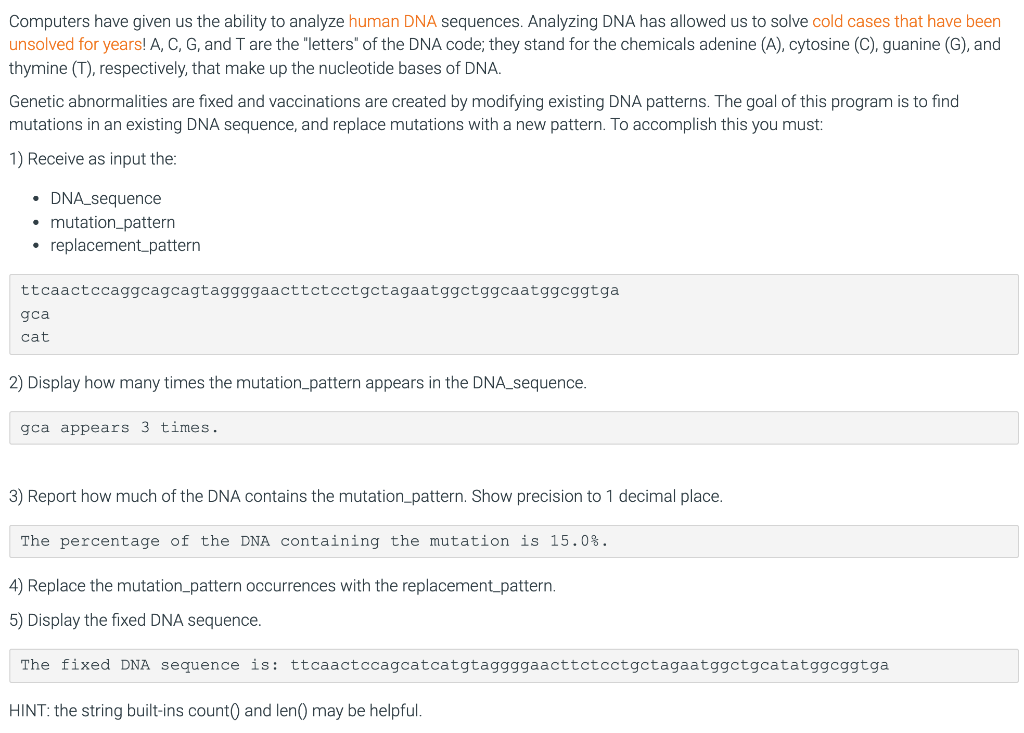
ttcaactccaggcagcagtaggggaacttctcctgctagaatggctggcaatggcggtga gca cat
2) Display how many times the mutation_pattern appears in the DNA_sequence.
gca appears 3 times.
3) Report how much of the DNA contains the mutation_pattern. Show precision to 1 decimal place.
The percentage of the DNA containing the mutation is 15.0%.
4) Replace the mutation_pattern occurrences with the replacement_pattern.
5) Display the fixed DNA sequence.
The fixed DNA sequence is: ttcaactccagcatcatgtaggggaacttctcctgctagaatggctgcatatggcggtga
HINT: the string built-ins count() and len() may be helpful.
Computers have given us the ability to analyze human DNA sequences. Analyzing DNA has allowed us to solve cold cases that have been unsolved for years! A, C, G, and T are the "letters" of the DNA code; they stand for the chemicals adenine (A), cytosine (C), guanine (G), and thymine (T), respectively, that make up the nucleotide bases of DNA. Genetic abnormalities are fixed and vaccinations are created by modifying existing DNA patterns. The goal of this program is to find mutations in an existing DNA sequence, and replace mutations with a new pattern. To accomplish this you must: 1) Receive as input the: . DNA sequence mutation_pattern replacement pattern . ttcaactccaggcagcagtaggggaacttctcctgctagaatggctggcaatggcggtga gca cat 2) Display how many times the mutation_pattern appears in the DNA sequence. gca appears 3 times. 3) Report how much of the DNA contains the mutation_pattern. Show precision to 1 decimal place. The percentage of the DNA containing the mutation is 15.08. 4) Replace the mutation_pattern occurrences with the replacement_pattern. 5) Display the fixed DNA sequence. The fixed DNA sequence is: ttcaactccagcatcatgtaggggaacttctcctgctagaatggctgcatatggcggtga HINT: the string built-ins count() and len() may be helpful
Step by Step Solution
There are 3 Steps involved in it

Get step-by-step solutions from verified subject matter experts
 Study Help