Question: Please read and answer 4 questions below To better understand the situational variables affectint the Cher very culture surrounding not only nuclear reactors but the
Please read and answer 4 questions below
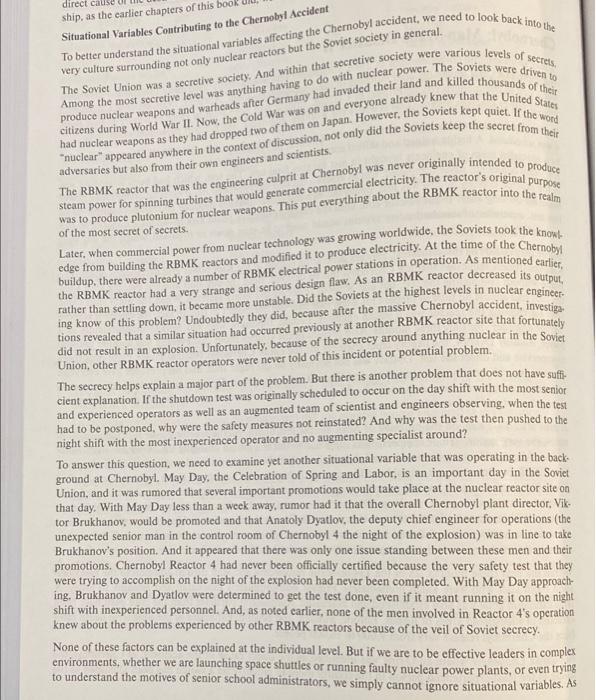
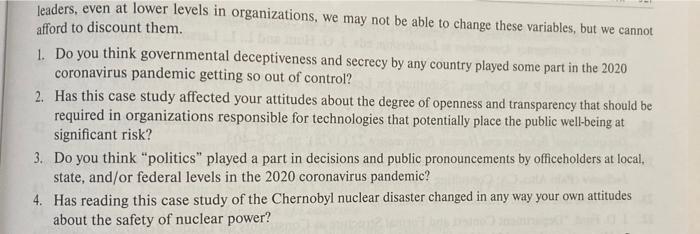
To better understand the situational variables affectint the Cher very culture surrounding not only nuclear reactors but the Sovict society in general The Soviet Union was a secretive society. And within that secretive society were var Among the most secretive level was anything having to do with nuclear power. The Soviets were drecres produce nuclear weapons and warheads after Germany had invaded their land and killed thousands of to citizens during World War II. Now, the Cold War was on and everyone already knew that the United Statey had nuclear weapons as they had dropped two of them on Japan. However, the Soviets kept quiet. If the word "nuclear" appeared anywhere in the context of discussion, not only did the Soviets keep the secret from their The RBMK reactor that west the engineering eulprit at Chernot The RBMK reactor that was the engineering culprit at Chernobyl was never originally intended to produce was to produce plutonium for nuclear weapons. This put everything about the RBMK reactor into the realm of the most secret of secrets. Later, when commercial power from nuclear technology was growing worldwide, the Soviets took the knowbedge from building the RBMK reactors and modified it to produce electricity. At the time of the Chernobyl buildup, there were already a number of RBMK electrical power stations in operation. As mentioned earlier, the RBMK reactor had a very strange and serious design flaw. As an RBMK reactor decreased its output, rather than settling down, it became more unstable. Did the Soviets at the highest levels in nuclear engineering know of this problem? Undoubiedly they did, because after the massive Chernobyl accident, investigations revealed that a similar situation had occurred previously at another KBMK reactor site that fortunately did not result in an explosion. Unfortunately, because of the secrecy around anything naclear i problem. The secrecy helps explain a major part of the problem. But there is another problem that does not have sufficient explanation. If the shutdown test was originally scheduled to occur on the day shift with the most senior and experienced operators as well as an augmented team of scientist and engineers observing, when the test had to be postponed, why were the safety measures not reinstated? And why was the test then pushed to the night shift with the most inexperienced operator and no augmenting specialist around? To answer this question, we need to examine yet another situational variable that was operating in the back. ground at Chernobyl. May Day, the Celebration of Spring and Labor, is an important day in the Soviet Union, and it was rumored that several important promotions would take place at the nuclear reactor site on that day. With May Day less than a week away, rumor had it that the overall Chernobyl plant director. Viktor Brukhanov, would be promoted and that Anatoly Dyatlov, the deputy chief engineer for operations (the unexpected senior man in the control room of Chernobyl 4 the night of the explosion) was in line to take Brukhanov's position. And it appeared that there was only one issue standing between these men and their promotions. Chernobyl Reactor 4 had never been officially certified because the very safety test that they were trying to accomplish on the night of the explosion had never been completed. With May Day approaching. Brukhanov and Dyatlov were determined to get the test done, even if it meant running it on the night shift with inexperienced personnel. And, as noted earlier, none of the men involved in Reactor 4 's operation knew about the problems experienced by other RBMK reactors because of the veil of Soviet secrecy. None of these factors can be explained at the individual level. But if we are to be effective leaders in complex environments, whether we are launching space shuttles or running faulty nuclear power plants, or even trying to understand the motives of senior school administrators, we simply cannot ignore situational variables. As leaders, even at lower levels in organizations, we may not be able to change these variables, but we cannot afford to discount them. 1. Do you think governmental deceptiveness and secrecy by any country played some part in the 2020 coronavirus pandemic getting so out of control? 2. Has this case study affected your attitudes about the degree of openness and transparency that should be required in organizations responsible for technologies that potentially place the public well-being at significant risk? 3. Do you think "politics" played a part in decisions and public pronouncements by officeholders at local, state, and/or federal levels in the 2020 coronavirus pandemic? 4. Has reading this case study of the Chernobyl nuclear disaster changed in any way your own attitudes about the safety of nuclear power









 Study Help