Question: please read and answer the quistions Scene 1: Possible Need for an EA Program The Danforth Manufacturing Company (DMC) develops, produces, and sells sical lines
please read and answer the quistions
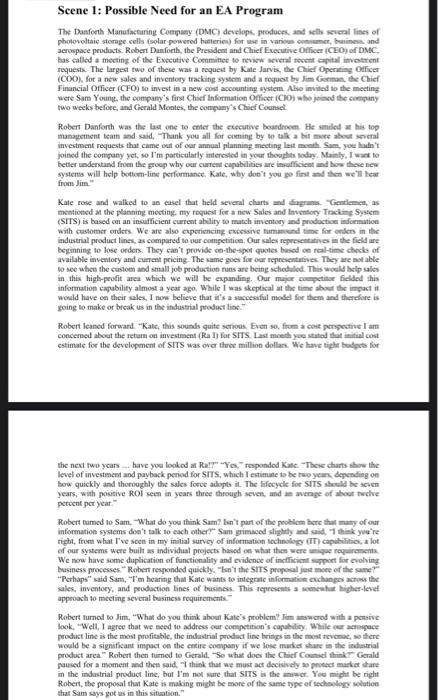
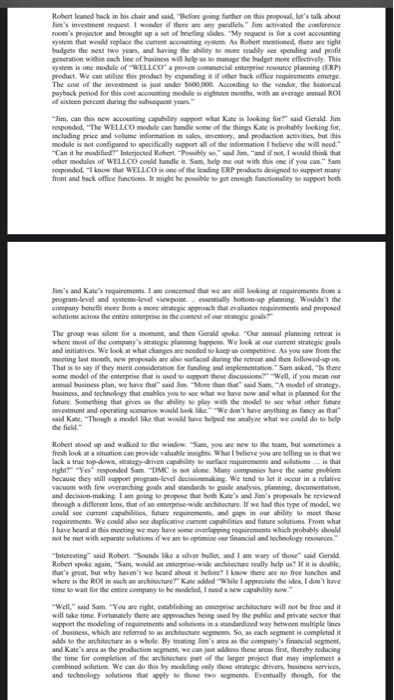
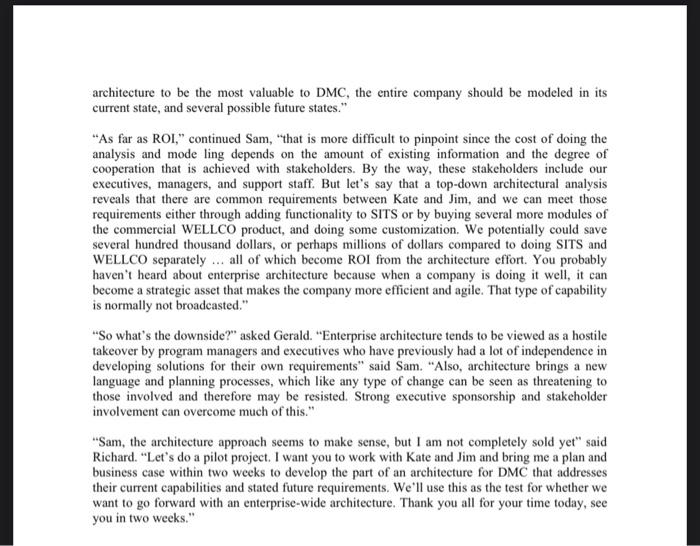
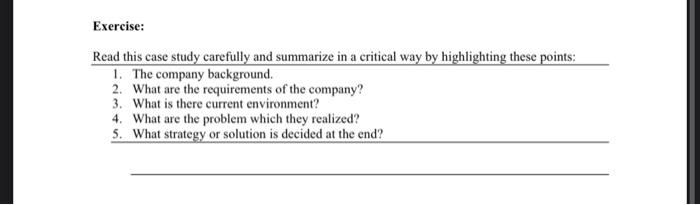
Scene 1: Possible Need for an EA Program The Danforth Manufacturing Company (DMC) develops, produces, and sells sical lines of photovoltaic storage cells (solar powered here for use in various commer, bulines, and aerospace products. Robert Dunforth, the President and Chief Executive Officer (CEO of DMC has called a meeting of the Executive Committee to review several recent capital investment requests. The largest two of these was a request by Kate Jarvis, the Chief Operating Officer (000). for a new sales and inventory tracking system and a request by Jim German, the Chief Financial Officer (CFO) to invest in a new cost accounting system. Also invited to the meeting were Sam Young, the company's first Chief Information Officer (CIO) who joined the company two weeks before, and Gerald Montes, the company's Chief Counsel Robert Danforth was the last one to enter the executive boardroom. He smiled this top management team and said, "Thank you all for coming by to talk a bit more about several investment requests that came out of our annual planning meeting last month. Som you hadn't joined the company yet, so I'm particularly interested in your thoughts today, Mainly. I want to better understand from the group why our current capabilities are insicient and how these ne systems will help bottom-line performance, Kate, why don't you po first and then we'l tea from Jim." Kate rose and walked to an easel that held several charts and diagrams. "Gentlemen, as mentioned at the planning meeting, my request for a new Sales and inventory Tracking System (SITS) is based on an insufficient current ability to match inventory and production information with customer orders. We are also experiencing excessive turamand time for orders in the industrial product lines, as compared to our competition. Our sales representatives in the field are beginning to lose orders. They can't provide co-the-spot quotes based on real-time checks of available inventory and current pricing. The same goes for our representatives. They are not able to see when the custom and small job production mans are being scheduled. This would help sales in this high-profit arce which we will be expanding. Our major competite fielded this information capability almost a year ago. While I was skeptical at the time about the impact it would have on their sales, I now believe that it's a successful model for them and therefore is going to make or break us in the industrial product line Robert leaned forward. "Kate, this sounds quite serious Even so, from a cost perspective I am concerned about the return on investment (Ra) for SITS. Last month ye stated that initial cost estimate for the development of SITS was over three million dollars. We have tight budget for the next two years have you looked at Ram Yes responded Kate. These charts show the level of investment and payback period for SITS, which I estimate to be you, depending on how quickly and thoroughly the sales force adopts it. The lifecycle for SITS seuld be seen years, with positive ROI seen in years three through seven, and wemage of about twelve percent per year Robert tumed to Sam. What do you think Sam? Isn't part of the problem here that many of our information systems don't talk to cach other Sam grimaced slightly and said think yuere right, from what I've seen in my initial survey of information technology (IT) capabilities, a lot of our systems were built as individual projects based on what the were que requirements We now have some duplication of functionality and evidence of inefficient opport for evolving business processes. Robert responded quickly. "Isn't the SITS proposal just more of the same "Perhaps" said Sam, "I'm hearing that Kate wants to integrate information exchanges to the sales, inventory, and production lines of business. This represents a somewhat higher level approach to meeting several business requirements. Robert Turned to Jim, "What do you think about Kate's problem wred with a persive look. "Well, I agree that we need to address our competition's capability. While pece product line is the most profitable, the industrial product line brings in the most revest, so there would be a significant impact on the entire company if we lose market share in the industrial product area Robert then tumed to Gerald. So what does the Chief Cose Gerald paused for a moment and then said, "I think that we must act decisively protect market share in the industrial product line, but I'm not sure that SITS is the mer. You might be right Robert, the proposal that Kate is making might be more of the same type of technology solution that Sam says got us in this situation." Robert leaned hack in his chair and said there in further on this proposal, let's talk about Ji's investment request. I wonder of these peale. Tim stated the conference room's project and brought up of hineing slides "My request is for a cost accounting system that would replace the contacte As Robert mentioned there are tight budgets the next two years, and having the ability to readily se spending and profit peration within cache line of business will helps the best more effectively. This systems is one module of "WELL.COprovemei enterprise mere planning (ERT) product. We can utilize this product by ending it foder hack office requirements emerge The cost of the invece jenter S.Accoming to event, the diste.cal payback period for this cost accounting modules gammonths, with an average atual ROI of sixteen percent during the questa "Jim, can this new accounting capability pet Kate is looking for said Gerald. Jim repreded. "The WELLCO module can handle of the things Kate is probably looking for including price and volume information en alty and production activities, but is module is not configured to specifically support all of the information I believe she will need." "Can it be modified Integeted Robert Pyn if not, I would think that other modules of WELLCO could handle i samme out with this one if you can Sam reponded know that WELLCO sonho ERP product dood to support many front and back office functions. It might be posible to neoph functionality to support both Jim's and Kate's requirement. I am comcome looking at requirements from program-level systemsled viewpomy boom-up planning. Wouldn't the company bence from more the evaluates requirements and proposed solutions across the entire sterre in the context of steps The group was silent for a moment, and the Goldeke. Our annual planning retreat is where most of the company's strategic plug We look at our current strategic pls and initiative. We look at what changes rencoded spes competitive. As you saw from the meeting last month now proposals are also faced during the retreat and the follow-up on That is to say if they merit consideration for ting and implementatie. Sam asked, "Is there some model of the enterprise that is used to part these discWell if you mean our amal business plan, we have the said the said Sammodel of sexy business, and technology that enables you to see what we have now and what is planned for the future Something that gives the while play with the model to see what other future investment and operating series would look e-Wedet have anything as fancy as that said Kate "Though a model like that will be emale hat we could do to help the field Robert stood up and waited to the wind. Sy we new to the team, but sometimes freshlook wastation can provide valuable that believe you are selling is that we lack a true top-down, strategy driven by to equirements and solution is that right"Yes responded Sam DMC is loc. Many companies have the same problem because they still support program-level dig. We tend to let it occur in relative vacuum with few onerarching and se pode analyses, planning documentation and decision-making. I am going to prope that be Kate's m's propouls be reviewed through a different lens, that of an enterprised when I we had this type of model. we could see current capabilities, future red in our silty to meet ose requirements. We could be see duplicatie curent capabilities and future solutions. From what Tlave heard the meeting we may havements which probably should not be met with separate solutions if we are to financial and technology rescore "Interesting said Robert Sounds like a bullet tam wary of those said Gerald Robert spoke again. Sum, would an emersecte really help us fit in double that's great, but why haven't we bead about I know there we to free lunches and where is the ROI in charchitecture Kated While I appreciate the idea. I don't have time to wait for the entire company to be modeled. I need a new capability." "Well," said Sam. "You are tightestablice architecture will not be free and it will take time. Fortunately there are proces being used by the public and private sector that support the modeling of requirements and standardidway between multiple lines of business, which are seemed to as architecture scom So, as each segment is is completed it add to the architecture as a whole. By the company financial segment and Kate's ca as the production sont des the first, thereby reducing the time for completion of the architecture of the target project that may implement combined solution. We can do this by cingly these strategic driven business services and technology solutions that apply to how the woments. Eventually though for the architecture to be the most valuable to DMC, the entire company should be modeled in its current state, and several possible future states." "As far as ROI," continued Sam, "that is more difficult to pinpoint since the cost of doing the analysis and mode ling depends on the amount of existing information and the degree of cooperation that is achieved with stakeholders. By the way, these stakeholders include our executives, managers, and support staff. But let's say that a top-down architectural analysis reveals that there are common requirements between Kate and Jim, and we can meet those requirements either through adding functionality to SITS or by buying several more modules of the commercial WELLCO product, and doing some customization. We potentially could save several hundred thousand dollars, or perhaps millions of dollars compared to doing SITS and WELLCO separately ... all of which become ROI from the architecture effort. You probably haven't heard about enterprise architecture because when a company is doing it well, it can become a strategic asset that makes the company more efficient and agile. That type of capability is normally not broadcasted." "So what's the downside?" asked Gerald. "Enterprise architecture tends to be viewed as a hostile takeover by program managers and executives who have previously had a lot of independence in developing solutions for their own requirements" said Sam. "Also, architecture brings a new language and planning processes, which like any type of change can be seen as threatening to those involved and therefore may be resisted. Strong executive sponsorship and stakeholder involvement can overcome much of this." "Sam, the architecture approach seems to make sense, but I am not completely sold yet" said Richard. "Let's do a pilot project. I want you to work with Kate and Jim and bring me a plan and business case within two weeks to develop the part of an architecture for DMC that addresses their current capabilities and stated future requirements. We'll use this as the test for whether we want to go forward with an enterprise-wide architecture. Thank you all for your time today, see you in two weeks." Exercise: Read this case study carefully and summarize in a critical way by highlighting these points: 1. The company background. 2. What are the requirements of the company? 3. What is there current environment? 4. What are the problem which they realized? 5. What strategy or solution is decided at the end? Scene 1: Possible Need for an EA Program The Danforth Manufacturing Company (DMC) develops, produces, and sells sical lines of photovoltaic storage cells (solar powered here for use in various commer, bulines, and aerospace products. Robert Dunforth, the President and Chief Executive Officer (CEO of DMC has called a meeting of the Executive Committee to review several recent capital investment requests. The largest two of these was a request by Kate Jarvis, the Chief Operating Officer (000). for a new sales and inventory tracking system and a request by Jim German, the Chief Financial Officer (CFO) to invest in a new cost accounting system. Also invited to the meeting were Sam Young, the company's first Chief Information Officer (CIO) who joined the company two weeks before, and Gerald Montes, the company's Chief Counsel Robert Danforth was the last one to enter the executive boardroom. He smiled this top management team and said, "Thank you all for coming by to talk a bit more about several investment requests that came out of our annual planning meeting last month. Som you hadn't joined the company yet, so I'm particularly interested in your thoughts today, Mainly. I want to better understand from the group why our current capabilities are insicient and how these ne systems will help bottom-line performance, Kate, why don't you po first and then we'l tea from Jim." Kate rose and walked to an easel that held several charts and diagrams. "Gentlemen, as mentioned at the planning meeting, my request for a new Sales and inventory Tracking System (SITS) is based on an insufficient current ability to match inventory and production information with customer orders. We are also experiencing excessive turamand time for orders in the industrial product lines, as compared to our competition. Our sales representatives in the field are beginning to lose orders. They can't provide co-the-spot quotes based on real-time checks of available inventory and current pricing. The same goes for our representatives. They are not able to see when the custom and small job production mans are being scheduled. This would help sales in this high-profit arce which we will be expanding. Our major competite fielded this information capability almost a year ago. While I was skeptical at the time about the impact it would have on their sales, I now believe that it's a successful model for them and therefore is going to make or break us in the industrial product line Robert leaned forward. "Kate, this sounds quite serious Even so, from a cost perspective I am concerned about the return on investment (Ra) for SITS. Last month ye stated that initial cost estimate for the development of SITS was over three million dollars. We have tight budget for the next two years have you looked at Ram Yes responded Kate. These charts show the level of investment and payback period for SITS, which I estimate to be you, depending on how quickly and thoroughly the sales force adopts it. The lifecycle for SITS seuld be seen years, with positive ROI seen in years three through seven, and wemage of about twelve percent per year Robert tumed to Sam. What do you think Sam? Isn't part of the problem here that many of our information systems don't talk to cach other Sam grimaced slightly and said think yuere right, from what I've seen in my initial survey of information technology (IT) capabilities, a lot of our systems were built as individual projects based on what the were que requirements We now have some duplication of functionality and evidence of inefficient opport for evolving business processes. Robert responded quickly. "Isn't the SITS proposal just more of the same "Perhaps" said Sam, "I'm hearing that Kate wants to integrate information exchanges to the sales, inventory, and production lines of business. This represents a somewhat higher level approach to meeting several business requirements. Robert Turned to Jim, "What do you think about Kate's problem wred with a persive look. "Well, I agree that we need to address our competition's capability. While pece product line is the most profitable, the industrial product line brings in the most revest, so there would be a significant impact on the entire company if we lose market share in the industrial product area Robert then tumed to Gerald. So what does the Chief Cose Gerald paused for a moment and then said, "I think that we must act decisively protect market share in the industrial product line, but I'm not sure that SITS is the mer. You might be right Robert, the proposal that Kate is making might be more of the same type of technology solution that Sam says got us in this situation." Robert leaned hack in his chair and said there in further on this proposal, let's talk about Ji's investment request. I wonder of these peale. Tim stated the conference room's project and brought up of hineing slides "My request is for a cost accounting system that would replace the contacte As Robert mentioned there are tight budgets the next two years, and having the ability to readily se spending and profit peration within cache line of business will helps the best more effectively. This systems is one module of "WELL.COprovemei enterprise mere planning (ERT) product. We can utilize this product by ending it foder hack office requirements emerge The cost of the invece jenter S.Accoming to event, the diste.cal payback period for this cost accounting modules gammonths, with an average atual ROI of sixteen percent during the questa "Jim, can this new accounting capability pet Kate is looking for said Gerald. Jim repreded. "The WELLCO module can handle of the things Kate is probably looking for including price and volume information en alty and production activities, but is module is not configured to specifically support all of the information I believe she will need." "Can it be modified Integeted Robert Pyn if not, I would think that other modules of WELLCO could handle i samme out with this one if you can Sam reponded know that WELLCO sonho ERP product dood to support many front and back office functions. It might be posible to neoph functionality to support both Jim's and Kate's requirement. I am comcome looking at requirements from program-level systemsled viewpomy boom-up planning. Wouldn't the company bence from more the evaluates requirements and proposed solutions across the entire sterre in the context of steps The group was silent for a moment, and the Goldeke. Our annual planning retreat is where most of the company's strategic plug We look at our current strategic pls and initiative. We look at what changes rencoded spes competitive. As you saw from the meeting last month now proposals are also faced during the retreat and the follow-up on That is to say if they merit consideration for ting and implementatie. Sam asked, "Is there some model of the enterprise that is used to part these discWell if you mean our amal business plan, we have the said the said Sammodel of sexy business, and technology that enables you to see what we have now and what is planned for the future Something that gives the while play with the model to see what other future investment and operating series would look e-Wedet have anything as fancy as that said Kate "Though a model like that will be emale hat we could do to help the field Robert stood up and waited to the wind. Sy we new to the team, but sometimes freshlook wastation can provide valuable that believe you are selling is that we lack a true top-down, strategy driven by to equirements and solution is that right"Yes responded Sam DMC is loc. Many companies have the same problem because they still support program-level dig. We tend to let it occur in relative vacuum with few onerarching and se pode analyses, planning documentation and decision-making. I am going to prope that be Kate's m's propouls be reviewed through a different lens, that of an enterprised when I we had this type of model. we could see current capabilities, future red in our silty to meet ose requirements. We could be see duplicatie curent capabilities and future solutions. From what Tlave heard the meeting we may havements which probably should not be met with separate solutions if we are to financial and technology rescore "Interesting said Robert Sounds like a bullet tam wary of those said Gerald Robert spoke again. Sum, would an emersecte really help us fit in double that's great, but why haven't we bead about I know there we to free lunches and where is the ROI in charchitecture Kated While I appreciate the idea. I don't have time to wait for the entire company to be modeled. I need a new capability." "Well," said Sam. "You are tightestablice architecture will not be free and it will take time. Fortunately there are proces being used by the public and private sector that support the modeling of requirements and standardidway between multiple lines of business, which are seemed to as architecture scom So, as each segment is is completed it add to the architecture as a whole. By the company financial segment and Kate's ca as the production sont des the first, thereby reducing the time for completion of the architecture of the target project that may implement combined solution. We can do this by cingly these strategic driven business services and technology solutions that apply to how the woments. Eventually though for the architecture to be the most valuable to DMC, the entire company should be modeled in its current state, and several possible future states." "As far as ROI," continued Sam, "that is more difficult to pinpoint since the cost of doing the analysis and mode ling depends on the amount of existing information and the degree of cooperation that is achieved with stakeholders. By the way, these stakeholders include our executives, managers, and support staff. But let's say that a top-down architectural analysis reveals that there are common requirements between Kate and Jim, and we can meet those requirements either through adding functionality to SITS or by buying several more modules of the commercial WELLCO product, and doing some customization. We potentially could save several hundred thousand dollars, or perhaps millions of dollars compared to doing SITS and WELLCO separately ... all of which become ROI from the architecture effort. You probably haven't heard about enterprise architecture because when a company is doing it well, it can become a strategic asset that makes the company more efficient and agile. That type of capability is normally not broadcasted." "So what's the downside?" asked Gerald. "Enterprise architecture tends to be viewed as a hostile takeover by program managers and executives who have previously had a lot of independence in developing solutions for their own requirements" said Sam. "Also, architecture brings a new language and planning processes, which like any type of change can be seen as threatening to those involved and therefore may be resisted. Strong executive sponsorship and stakeholder involvement can overcome much of this." "Sam, the architecture approach seems to make sense, but I am not completely sold yet" said Richard. "Let's do a pilot project. I want you to work with Kate and Jim and bring me a plan and business case within two weeks to develop the part of an architecture for DMC that addresses their current capabilities and stated future requirements. We'll use this as the test for whether we want to go forward with an enterprise-wide architecture. Thank you all for your time today, see you in two weeks." Exercise: Read this case study carefully and summarize in a critical way by highlighting these points: 1. The company background. 2. What are the requirements of the company? 3. What is there current environment? 4. What are the problem which they realized? 5. What strategy or solution is decided at the end









 Study Help