Question: PLEASE READ AND FOLLOW THE INSTRUCTIONS CAREFULLY!! Library Research Assignment 1: Choosing_ a Topic, Preliminary Research, and Asking Questions Introduction Welcome to the first Library
PLEASE READ AND FOLLOW THE INSTRUCTIONS CAREFULLY!!
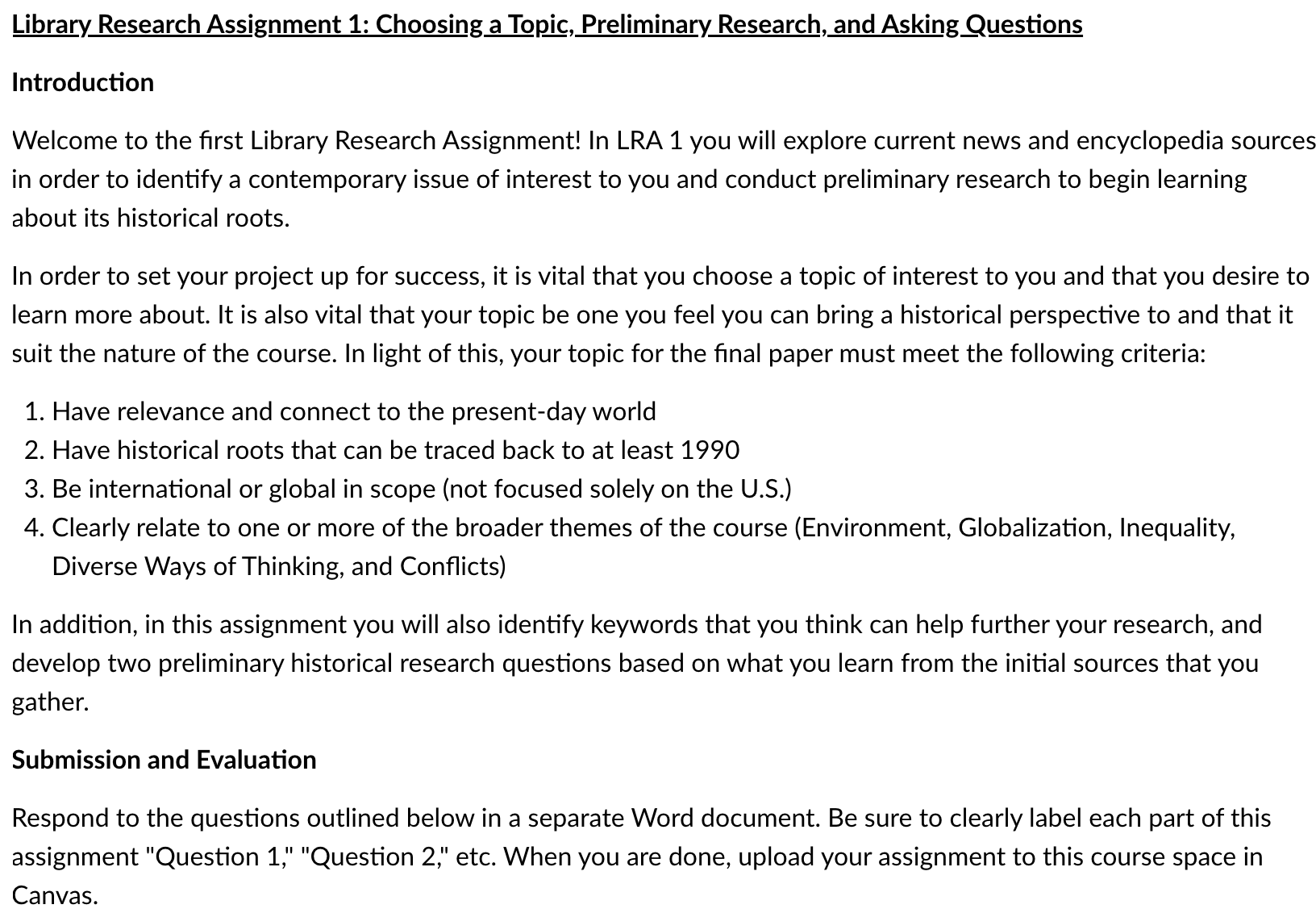
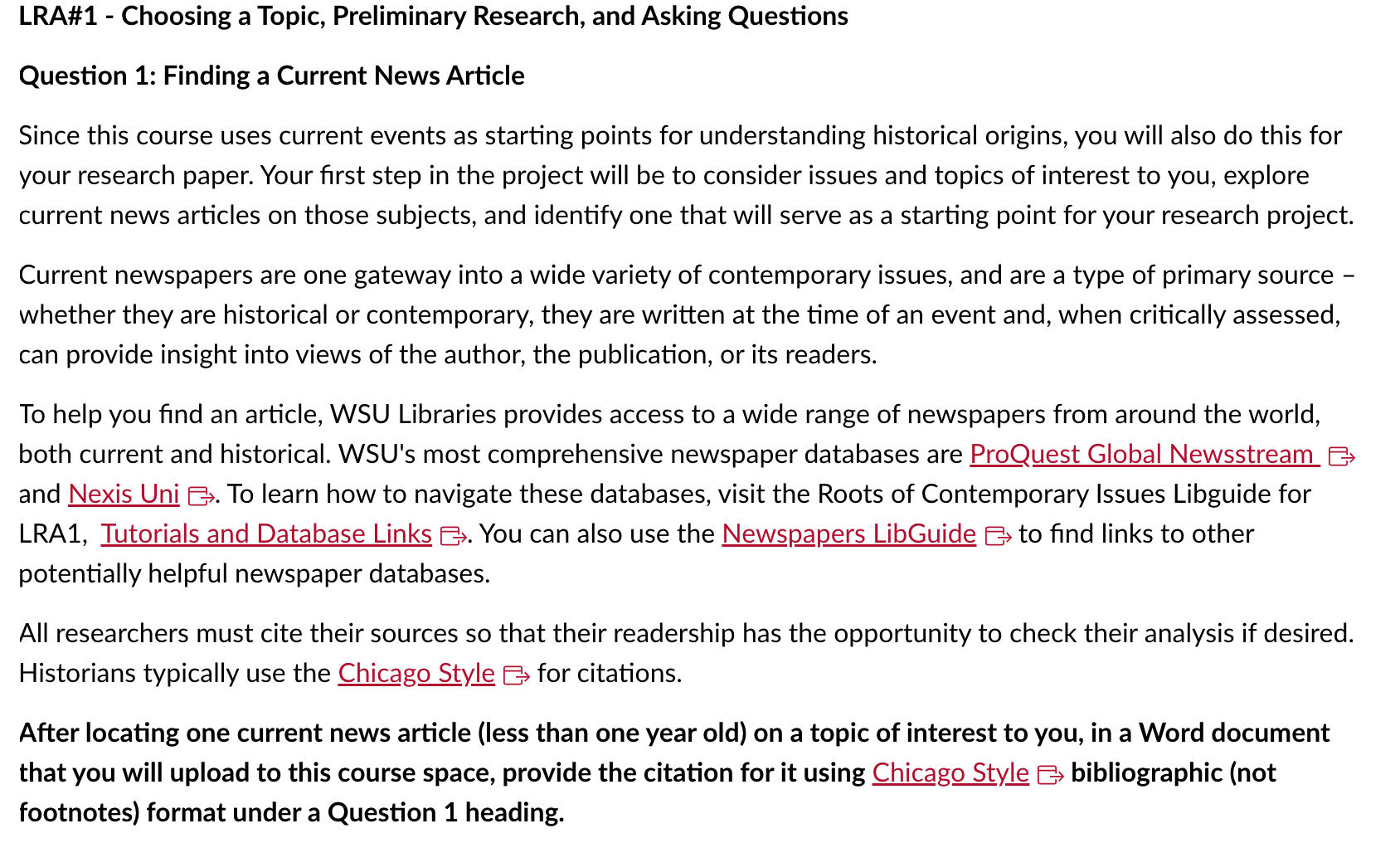
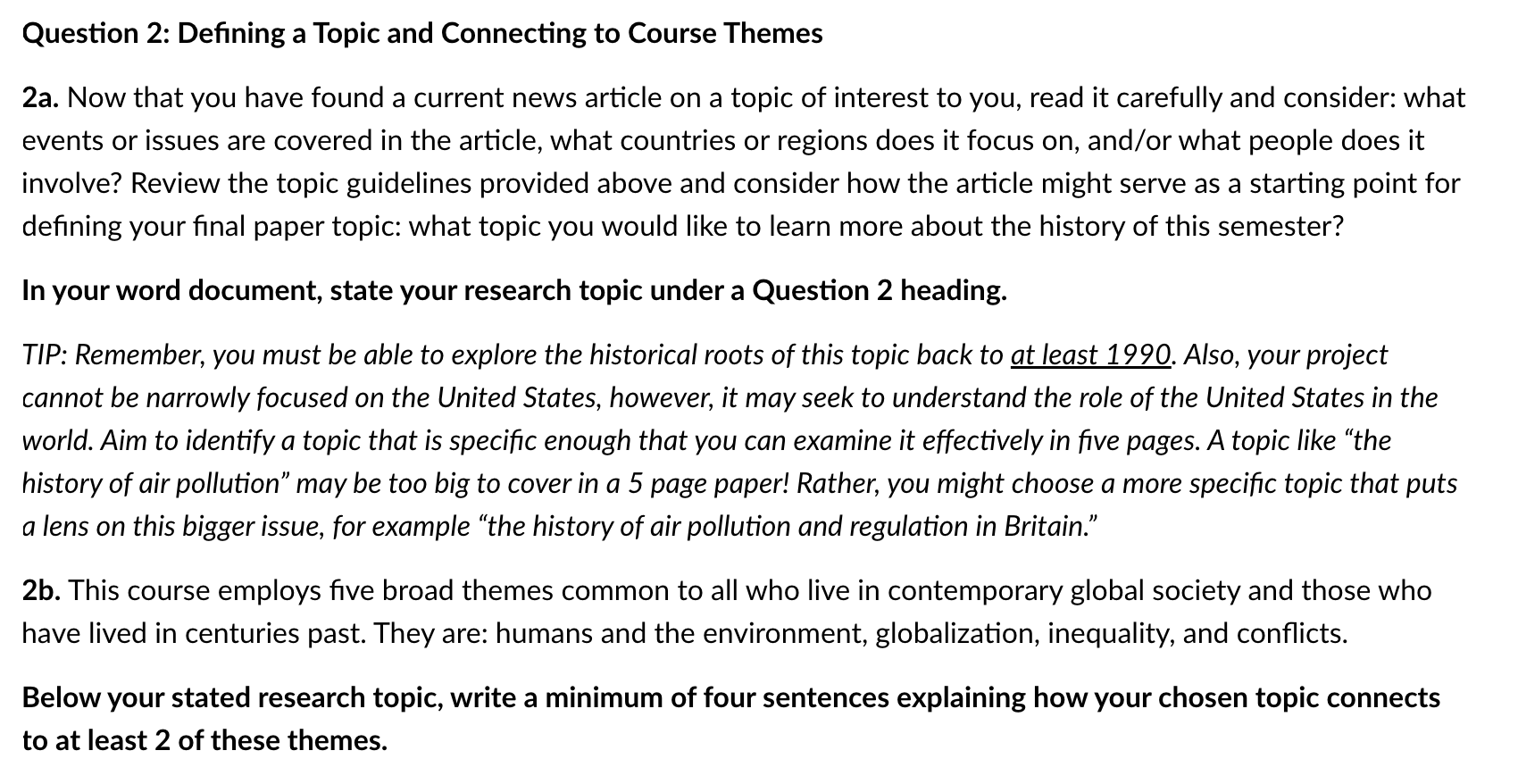
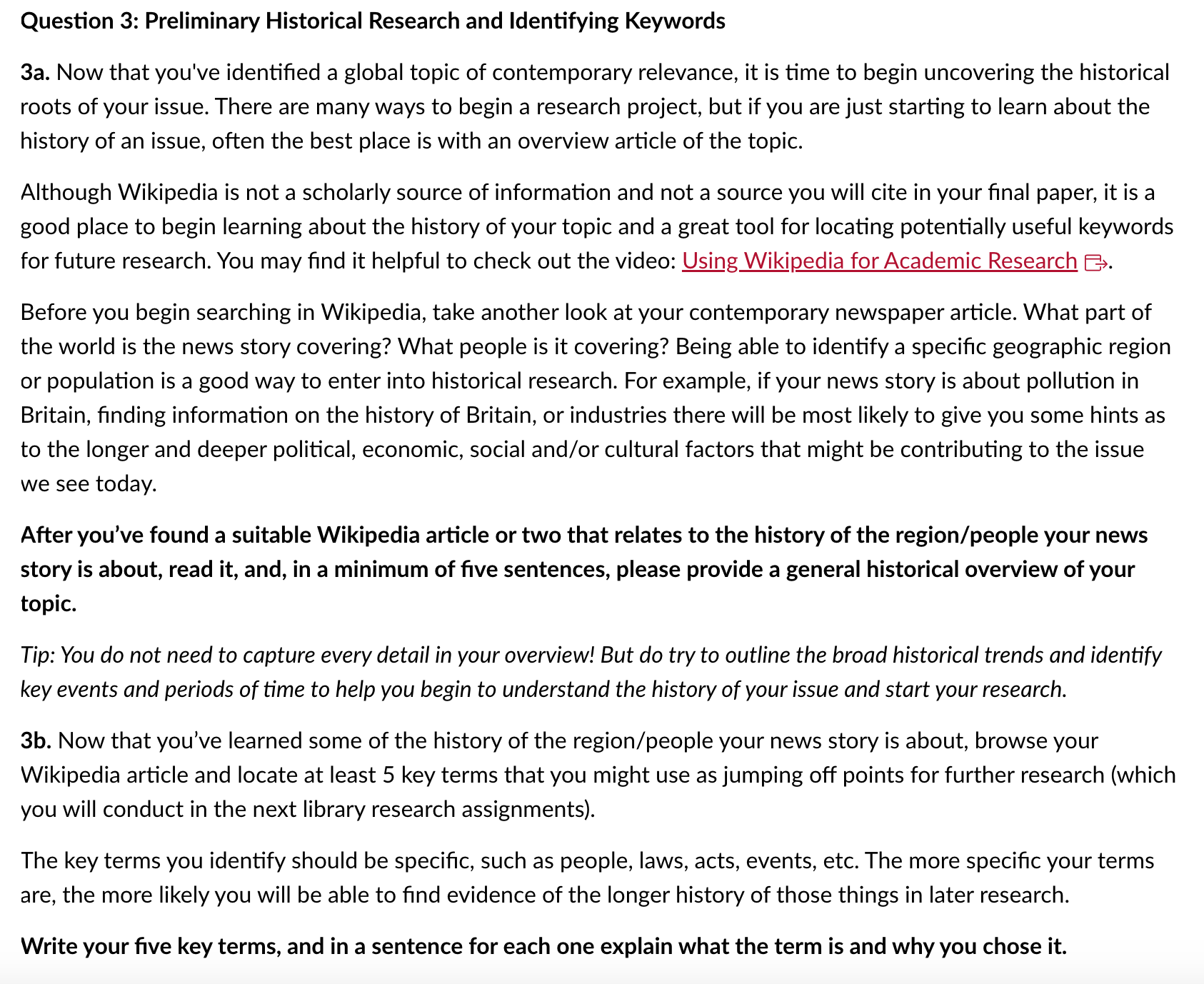
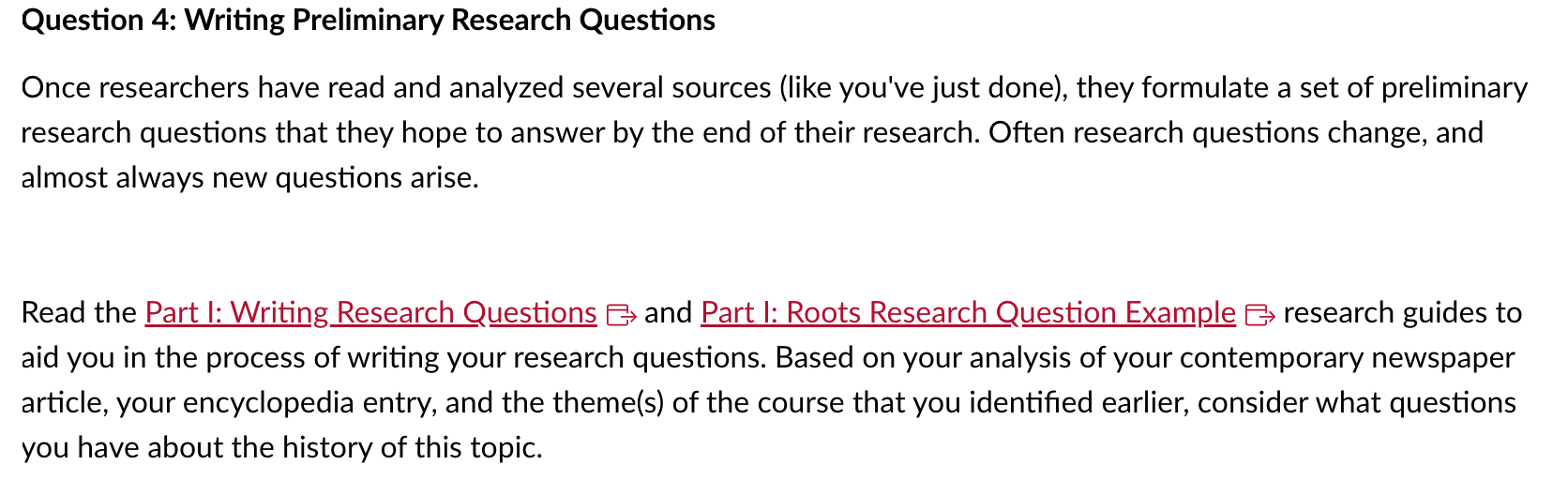
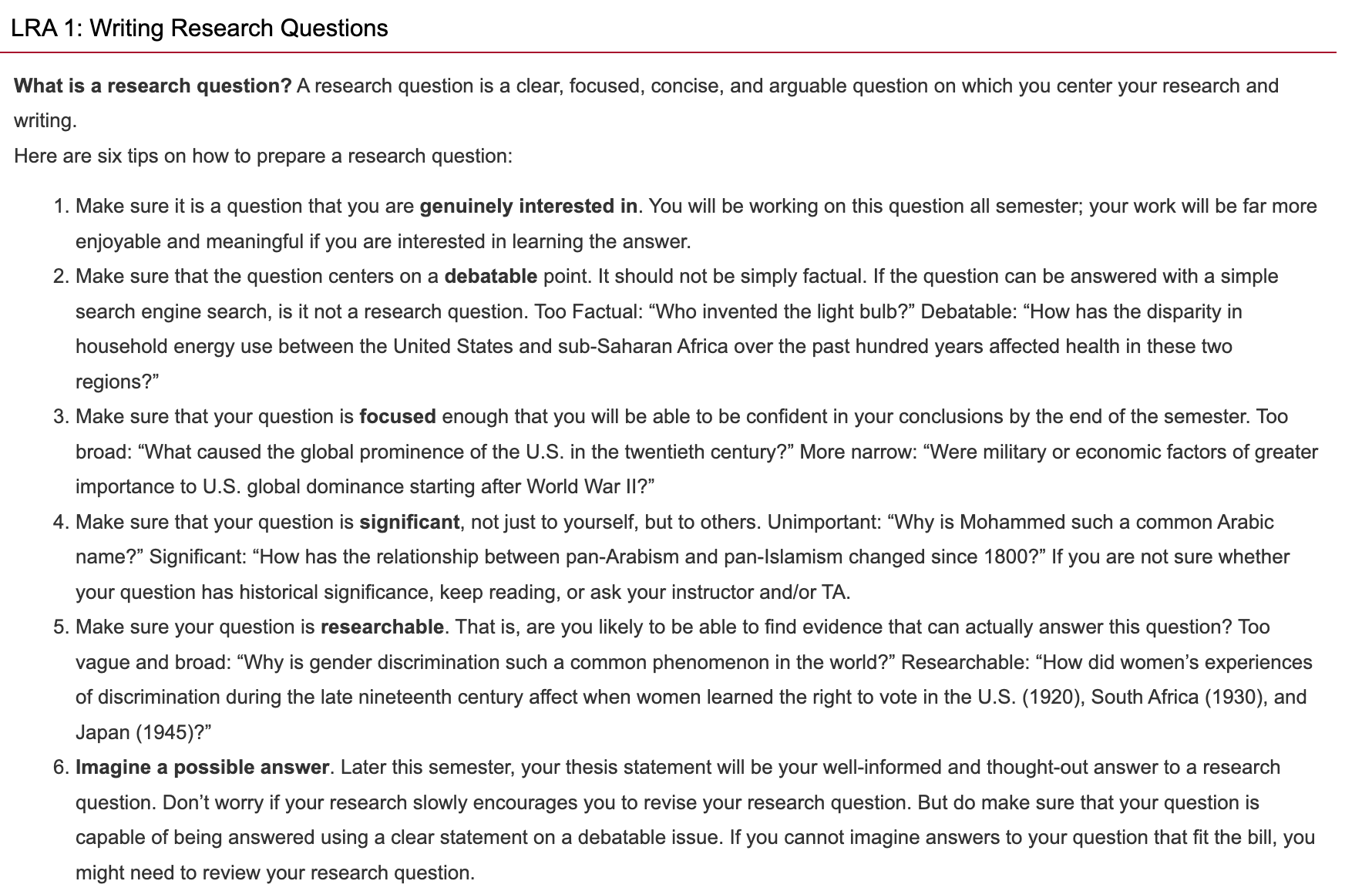
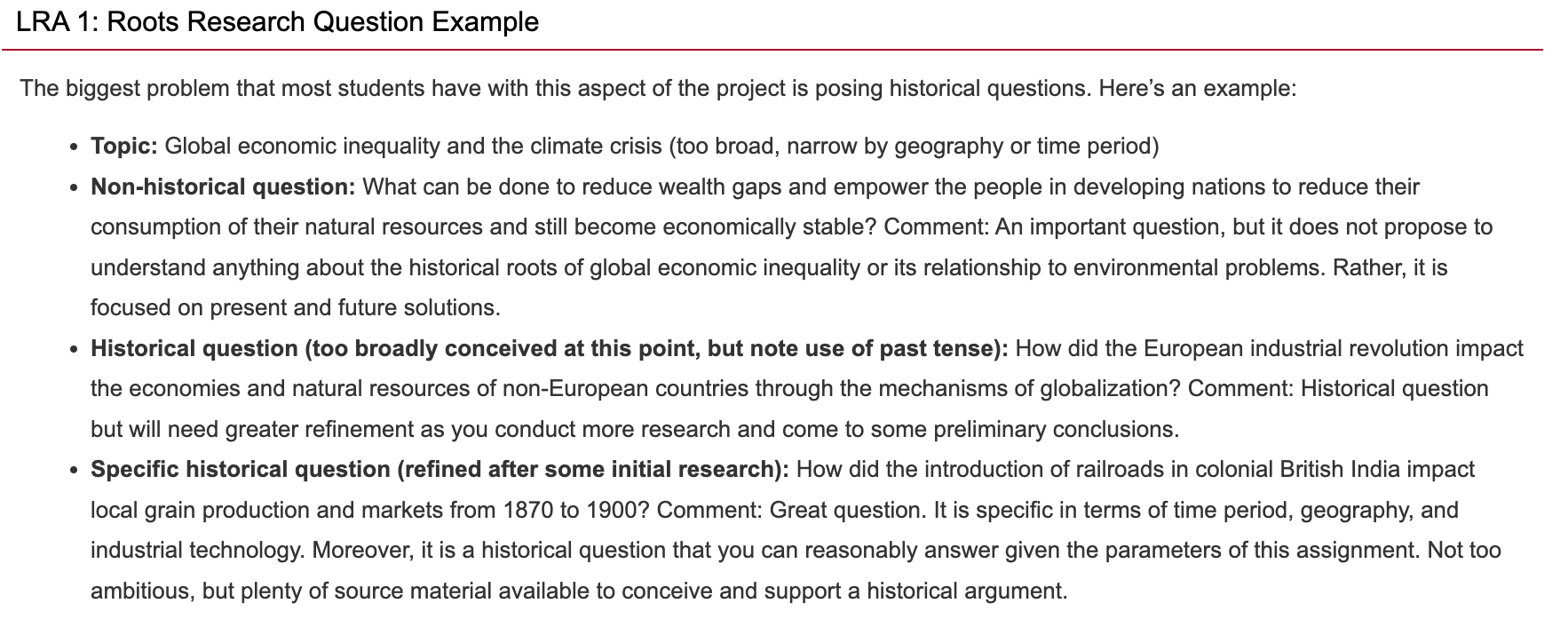
Library Research Assignment 1: Choosing_ a Topic, Preliminary Research, and Asking Questions Introduction Welcome to the first Library Research Assignment! In LRA 1 you will explore current news and encyclopedia sources in order to identify a contemporary issue of interest to you and conduct preliminary research to begin learning about its historical roots. In order to set your project up for success, it is vital that you choose a topic of interest to you and that you desire to learn more about. It is also vital that your topic be one you feel you can bring a historical perspective to and that it suit the nature of the course. In light of this, your topic for the final paper must meet the following criteria: 1. Have relevance and connect to the present-day world 2. Have historical roots that can be traced back to at least 1990 3. Be international or global in scope (not focused solely on the U.S.) 4. Clearly relate to one or more of the broader themes of the course (Environment, Globalization, Inequality, Diverse Ways of Thinking, and Conflicts) In addition, in this assignment you will also identify keywords that you think can help further your research, and develop two preliminary historical research questions based on what you learn from the initial sources that you gather. Submission and Evaluation Respond to the questions outlined below in a separate Word document. Be sure to clearly label each part of this assignment "Question 1," "Question 2," etc. When you are done, upload your assignment to this course space in Canvas. LRA#1 - Choosing a Topic, Preliminary Research, and Asking Questions Question 1: Finding a Current News Article Since this course uses current events as starting points for understanding historical origins, you will also do this for your research paper. Your first step in the project will be to consider issues and topics of interest to you, explore current news articles on those subjects, and identify one that will serve as a starting point for your research project. Current newspapers are one gateway into a wide variety of contemporary issues, and are a type of primary source - whether they are historical or contemporary, they are written at the time of an event and, when critically assessed, can provide insight into views of the author, the publication, or its readers. To help you find an article, WSU Libraries provides access to a wide range of newspapers from around the world, both current and historical. WSU's most comprehensive newspaper databases are ProQuest Global Newsstream = and Nexis Uni /. To learn how to navigate these databases, visit the Roots of Contemporary Issues Libguide for LRA1, Tutorials and Database Links . You can also use the Newspapers LibGuide s to find links to other potentially helpful newspaper databases. All researchers must cite their sources so that their readership has the opportunity to check their analysis if desired. Historians typically use the Chicago Style = for citations. After locating one current news article (less than one year old) on a topic of interest to you, in a Word document that you will upload to this course space, provide the citation for it using Chicago Style = bibliographic (not footnotes) format under a Question 1 heading. Question 2: Defining a Topic and Connecting to Course Themes 2a. Now that you have found a current news article on a topic of interest to you, read it carefully and consider: what events or issues are covered in the article, what countries or regions does it focus on, and/or what people does it involve? Review the topic guidelines provided above and consider how the article might serve as a starting point for defining your final paper topic: what topic you would like to learn more about the history of this semester? In your word document, state your research topic under a Question 2 heading. TIP: Remember, you must be able to explore the historical roots of this topic back to at least 1290. Also, your project cannot be narrowly focused on the United States, however, it may seek to understand the role of the United States in the world. Aim to identify a topic that is specific enough that you can examine it effectively in five pages. A topic like \"the history of air pollution\" may be too big to cover in a 5 page paper! Rather, you might choose a more specific topic that puts a lens on this bigger issue, for example \"the history of air pollution and regulation in Britain.\" 2b. This course employs five broad themes common to all who live in contemporary global society and those who have lived in centuries past. They are: humans and the environment, globalization, inequality, and conflicts. Below your stated research topic, write a minimum of four sentences explaining how your chosen topic connects to at least 2 of these themes. Question 3: Preliminary Historical Research and Identifying Keywords 3a. Now that you've identified a global topic of contemporary relevance, it is time to begin uncovering the historical roots of your issue. There are many ways to begin a research project, but if you are just starting to learn about the history of an issue, often the best place is with an overview article of the topic. Although Wikipedia is not a scholarly source of information and not a source you will cite in your final paper, it is a good place to begin learning about the history of your topic and a great tool for locating potentially useful keywords for future research. You may find it helpful to check out the video: Using Wikipedia for Academic Research . Before you begin searching in Wikipedia, take another look at your contemporary newspaper article. What part of the world is the news story covering? What people is it covering? Being able to identify a specific geographic region or population is a good way to enter into historical research. For example, if your news story is about pollution in Britain, finding information on the history of Britain, or industries there will be most likely to give you some hints as to the longer and deeper political, economic, social and/or cultural factors that might be contributing to the issue we see today. After you've found a suitable Wikipedia article or two that relates to the history of the region/people your news story is about, read it, and, in a minimum of five sentences, please provide a general historical overview of your topic. Tip: You do not need to capture every detail in your overview! But do try to outline the broad historical trends and identify key events and periods of time to help you begin to understand the history of your issue and start your research. 3b. Now that you've learned some of the history of the region/people your news story is about, browse your Wikipedia article and locate at least 5 key terms that you might use as jumping off points for further research (which you will conduct in the next library research assignments). The key terms you identify should be specific, such as people, laws, acts, events, etc. The more specific your terms are, the more likely you will be able to find evidence of the longer history of those things in later research. Write your five key terms, and in a sentence for each one explain what the term is and why you chose it. Question 4: Writing Preliminary Research Questions Once researchers have read and analyzed several sources (like you've just done), they formulate a set of preliminary research questions that they hope to answer by the end of their research. Often research questions change, and almost always new questions arise. Read the Part |: Writing Research Questions s and Part |: Roots Research Question Example 5> research guides to aid you in the process of writing your research questions. Based on your analysis of your contemporary newspaper article, your encyclopedia entry, and the theme(s) of the course that you identified earlier, consider what questions you have about the history of this topic. As the last part of your Word document for LRA1, formulate two clear and concise research questions on the history of your topic (label them as QA and QB). LRA 1: Writing Research Questions What is a research question? A research question is a clear, focused, concise, and arguable question on which you center your research and writing. Here are six tips on how to prepare a research question: 1 . Make sure it is a question that you are genuinely interested in. You will be working on this question all semester; your work will be far more enjoyable and meaningful if you are interested in learning the answer. . Make sure that the question centers on a debatable point. It should not be simply factual. If the question can be answered with a simple search engine search, is it not a research question. Too Factual: \"Who invented the light bulb?\" Debatable: \"How has the disparity in household energy use between the United States and sub-Saharan Africa over the past hundred years affected health in these two regions?\" . Make sure that your question is focused enough that you will be able to be confident in your conclusions by the end of the semester. Too broad: \"What caused the global prominence of the U.S. in the twentieth century?\" More narrow: \"Were military or economic factors of greater importance to U.S. global dominance starting after World War 11?\" . Make sure that your question is significant, not just to yourself, but to others. Unimportant: \"Why is Mohammed such a common Arabic name?\" Significant: \"How has the relationship between pan-Arabism and pan-Islamism changed since 18007?" If you are not sure whether your question has historical significance, keep reading, or ask your instructor and/or TA. . Make sure your gquestion is researchable. That is, are you likely to be able to find evidence that can actually answer this question? Too vague and broad: \"Why is gender discrimination such a common phenomenon in the world?\" Researchable: \"How did women''s experiences of discrimination during the late nineteenth century affect when women learned the right to vote in the U.S. (1920), South Africa (1930), and Japan (1945)7?\" . Imagine a possible answer. Later this semester, your thesis statement will be your well-informed and thought-out answer to a research question. Don't worry if your research slowly encourages you to revise your research question. But do make sure that your question is capable of being answered using a clear statement on a debatable issue. If you cannot imagine answers to your question that fit the bill, you might need to review your research question. LRA 1: Roots Research Question Example The biggest problem that most students have with this aspect of the project is posing historical questions. Here's an example: Topic: Global economic inequality and the climate crisis (too broad, narrow by geography or time period) Non-historical question: What can be done to reduce wealth gaps and empower the people in developing nations to reduce their consumption of their natural resources and still become economically stable? Comment: An important question, but it does not propose to understand anything about the historical roots of global economic inequality or its relationship to environmental problems. Rather, it is focused on present and future solutions. Historical question (too broadly conceived at this point, but note use of past tense): How did the European industrial revolution impact the economies and natural resources of non-European countries through the mechanisms of globalization? Comment: Historical question but will need greater refinement as you conduct more research and come to some preliminary conclusions. Specific historical question (refined after some initial research): How did the introduction of railroads in colonial British India impact local grain production and markets from 1870 to 19007 Comment: Great question. It is specific in terms of time period, geography, and industrial technology. Moreover, it is a historical question that you can reasonably answer given the parameters of this assignment. Not too ambitious, but plenty of source material available to conceive and support a historical argument
Step by Step Solution
There are 3 Steps involved in it
1 Expert Approved Answer
Step: 1 Unlock
Question Has Been Solved by an Expert!
Get step-by-step solutions from verified subject matter experts
Step: 2 Unlock
Step: 3 Unlock
Students Have Also Explored These Related Business Writing Questions!










 Study Help