Question: Please read and respond to the Mini Case found in the corresponding module. You will answer the 4 questions at the end of the case.
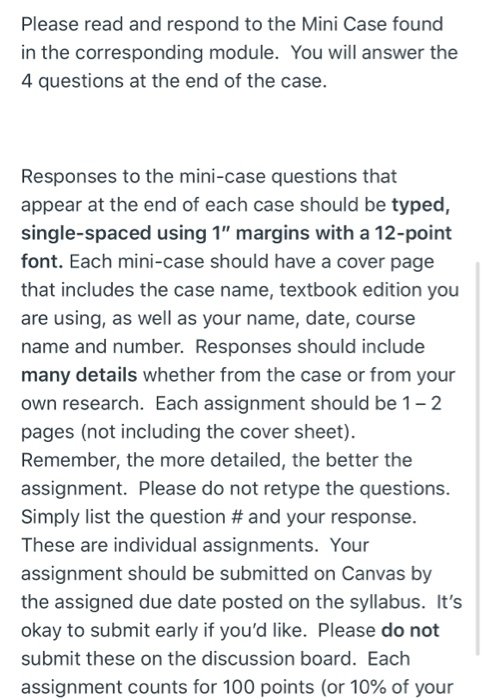
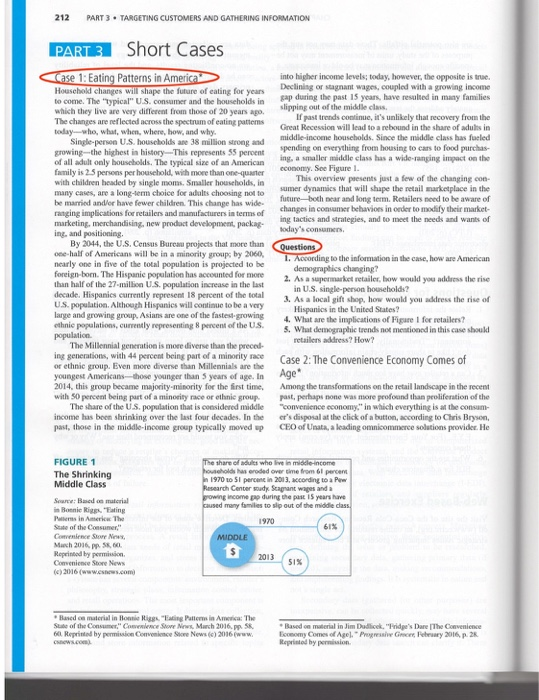
Please read and respond to the Mini Case found in the corresponding module. You will answer the 4 questions at the end of the case. Responses to the mini-case questions that appear at the end of each case should be typed, single-spaced using 1" margins with a 12-point font. Each mini-case should have a cover page that includes the case name, textbook edition you are using, as well as your name, date, course name and number. Responses should include many details whether from the case or from your own research. Each assignment should be 1-2 pages (not including the cover sheet). Remember, the more detailed, the better the assignment. Please do not retype the questions. Simply list the question # and your response. These are individual assignments. Your assignment should be submitted on Canvas by the assigned due date posted on the syllabus. It's okay to submit early if you'd like. Please do not submit these on the discussion board. Each assignment counts for 100 points (or 10% of your 212 PART 3 .TARGETING CUSTOMERS AND GATHERING INFORMATION PART 3 Short Cases into higher income levels; today, however, the opposite is true Declining or stagnant wages, coupled with a growing income cap during the past 15 years have resulted in many families slipping out of the middle class If past trends continue, it's unlikely that recovery from the Great Recession will lead to a rebound in the share of adults in middle-income households. Since the middle class has fueled spending on everything from housing to cars to food purchas- iny, a smaller middle class has a wide ranging impact on the economy. See Figure 1. This overview presents just a few of the changing con- sumer dynamics that will shape the retail marketplace in the future both near and long term. Retailers need to be aware of changes in consumer behavioes in order to modify their market ing tacties and strategies, and to meet the needs and wants of today's consumers Case 1: Eating Patterns in America Household changes will shape the future of eating for years to come. The typical" U.S. consumer and the households in which they live are very different from those of 20 years ago The chances are reflected across the spectrum of eating patterns todaywho, what, when, where, how, and why. Single person U.S. households are 38 million tone growing the highest in history This represents 55 percent of all adult only households. The typical size of an American family is 25 persons per household, with more than one quarter with children headed by single moms. Smaller households, in many cases, are a long-term choice for adults choosing not to be married and/or have fewer children. This change has wide raging implications for retailers and manufacturers in terms of marketing, merchandising new product development package ing and positioning. By 2044, the US, Census Bureau projects that more than one-half of Americans will be in a minority groups by 2060, nearly one in five of the total population is projected to be foreign-bom. The Hispanie population has accounted for more than half of the 27-million U.S. Population increase in the last decade. Hispanics currently represent 18 percent of the total U.S. population. Although Hispanics will continue to be a very large and growing group. Asians are one of the fastest growing ethnie populations, currently representing 8 percent of the US population The Millennial generation is more diverse than the preced- ing generations, with 44 percent being part of a minority race or ethnic group. Even more diverse than Millennials are the youngest Americans those younger than 5 years of age. In 2014, this group became majority-minority for the first time, with 50 percent being part of a minority race or ethnic group. The share of the U.S. population that is considered middle income has been shrinking over the last four decades. In the past, those in the middle-income group typically moved up Questions 1. According to the information in the case, how are American demographies changing? 2. As a supermarket retailer, how would you address the rise in U.S. single-person households? 3. As a local gift shop, how would you address the rise of Hispanics in the United States? 4. What are the implications of Fire for retailers? 3. What demographic trends not mentioned in this case should retailers dress? How? Case 2: The Convenience Economy Comes of Age Among the transformations on the retail landscape in the recent past, perhaps one was more profound than proliferation of the convenience economy." in which everything is at the consum er's disposal at the click of a button, according to Chris Bryson, CEO of Unata, a leading omnicommerce solutions provider. He FIGURE 1 The Shrinking Middle Class The share of us who live in mode-income husholds has orded over time from 6 percent h 1970 to Si percent in 2013, according to a Pw Research Center Budy Sant wages and a growing income o during the past 15 years have caused many families to slip out of the middle class Sew: Bado murial in Bonnie "Eating Pues in America. The State of the Consumer" Convenience Store Now March 2016 Reprinted by permission Convenience Store News (c) 2016 (www.ests.com MIDDLE 2013 . Based on material in Bonnie Rings Eating Pations in America: The Suite of the Cons " Ch e w , March 2016.pp. 58 60 Reprinted by permission Convence Store News 2016 www. Based on material in Jim Dudlicek, "Fridge's Dare The Convenience Loomy Comes of AxelPa r y 2016, p. 26 Reprinted by permission









 Study Help