







Question: PLEASE READ, ANSWER THE WHOLE QUESTION PLEASE. 2. Quack Pharmaceuticals 60 points Quack Pharmaceuticals is currently in the development of a drug, Symilin, that has
PLEASE READ, ANSWER THE WHOLE QUESTION PLEASE.
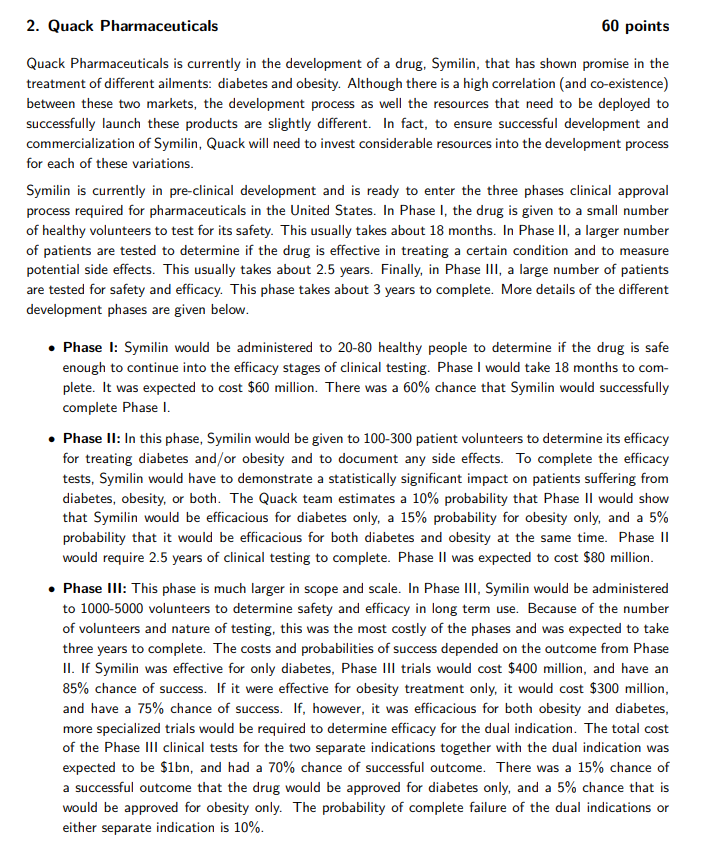
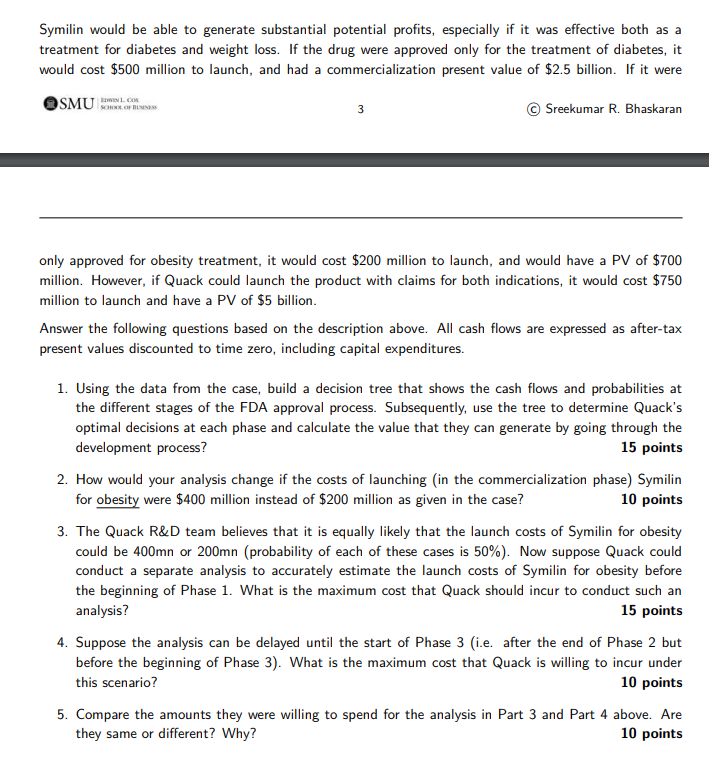
2. Quack Pharmaceuticals 60 points Quack Pharmaceuticals is currently in the development of a drug, Symilin, that has shown promise in the treatment of different ailments: diabetes and obesity. Although there is a high correlation (and co-existence) between these two markets, the development process as well the resources that need to be deployed to successfully launch these products are slightly different. In fact, to ensure successful development and commercialization of Symilin, Quack will need to invest considerable resources into the development process for each of these variations Symilin is currently in pre-clinical development and is ready to enter the three phases clinical approval process required for pharmaceuticals in the United States. In Phase I, the drug is given to a small number of healthy volunteers to test for its safety. This usually takes about 18 months. In Phase I, a larger number of patients are tested to determine if the drug is effective in treating a certain condition and to measure potential side effects. This usually takes about 2.5 years. Finally, in PhaseI, a large number of patients are tested for safety and efficacy. This phase takes about 3 years to complete. More details of the different development phases are given below Phase Symilin would be administered to 20-80 healthy people to determine if the drug is safe enough to continue into the efficacy stages of clinical testing. Phase would take 18 months to com- plete. It was expected to cost $60 million. There was a 60% chance that Symlin would successfully complete Phase I Phase II: In this phase, Symilin would be given to 100-300 patient volunteers to determine its efficacy for treating diabetes and/or obesity and to document any side effects. To complete the efficacy tests, Symilin would have to demonstrate a statistically significant impact on patients suffering from diabetes, obesity, or both. The Quack team estimates a 10% probability that Phase II would show that Symilin would be efficacious for diabetes only, a 15% probability for obesity only, and a 5% probability that it would be efficacious for both diabetes and obesity at the same time. Phase II would require 2.5 years of clinical testing to complete. Phase I was expected to cost $80 million . Phase lll: This phase is much larger in scope and scale. In Phase III, Symilin would be administered to 1000-5000 volunteers to determine safety and efficacy in long term use. Because of the number of volunteers and nature of testing, this was the most costly of the phases and was expected to take three years to complete. The costs and probabilities of success depended on the outcome from Phase Il. If Symilin was effective for only diabetes, Phase II trials would cost $400 million, and have an 85% chance of success. If it were effective for obesity treatment only, it would cost $300 million and have a 75% chance of success. If, however, it was efficacious for both obesity and diabetes more specialized trials would be required to determine efficacy for the dual indication. The total cost of the PhaseI clinical tests for the two separate indications together with the dual indication was expected to be $1bn, and had a 70% chance of successful outcome. There was a 15% chance of a successful outcome that the drug would be approved for diabetes only, and a 5% chance that is would be approved for obesity only. The probability of complete failure of the dual indications or either separate indication is 10% 2. Quack Pharmaceuticals 60 points Quack Pharmaceuticals is currently in the development of a drug, Symilin, that has shown promise in the treatment of different ailments: diabetes and obesity. Although there is a high correlation (and co-existence) between these two markets, the development process as well the resources that need to be deployed to successfully launch these products are slightly different. In fact, to ensure successful development and commercialization of Symilin, Quack will need to invest considerable resources into the development process for each of these variations Symilin is currently in pre-clinical development and is ready to enter the three phases clinical approval process required for pharmaceuticals in the United States. In Phase I, the drug is given to a small number of healthy volunteers to test for its safety. This usually takes about 18 months. In Phase I, a larger number of patients are tested to determine if the drug is effective in treating a certain condition and to measure potential side effects. This usually takes about 2.5 years. Finally, in PhaseI, a large number of patients are tested for safety and efficacy. This phase takes about 3 years to complete. More details of the different development phases are given below Phase Symilin would be administered to 20-80 healthy people to determine if the drug is safe enough to continue into the efficacy stages of clinical testing. Phase would take 18 months to com- plete. It was expected to cost $60 million. There was a 60% chance that Symlin would successfully complete Phase I Phase II: In this phase, Symilin would be given to 100-300 patient volunteers to determine its efficacy for treating diabetes and/or obesity and to document any side effects. To complete the efficacy tests, Symilin would have to demonstrate a statistically significant impact on patients suffering from diabetes, obesity, or both. The Quack team estimates a 10% probability that Phase II would show that Symilin would be efficacious for diabetes only, a 15% probability for obesity only, and a 5% probability that it would be efficacious for both diabetes and obesity at the same time. Phase II would require 2.5 years of clinical testing to complete. Phase I was expected to cost $80 million . Phase lll: This phase is much larger in scope and scale. In Phase III, Symilin would be administered to 1000-5000 volunteers to determine safety and efficacy in long term use. Because of the number of volunteers and nature of testing, this was the most costly of the phases and was expected to take three years to complete. The costs and probabilities of success depended on the outcome from Phase Il. If Symilin was effective for only diabetes, Phase II trials would cost $400 million, and have an 85% chance of success. If it were effective for obesity treatment only, it would cost $300 million and have a 75% chance of success. If, however, it was efficacious for both obesity and diabetes more specialized trials would be required to determine efficacy for the dual indication. The total cost of the PhaseI clinical tests for the two separate indications together with the dual indication was expected to be $1bn, and had a 70% chance of successful outcome. There was a 15% chance of a successful outcome that the drug would be approved for diabetes only, and a 5% chance that is would be approved for obesity only. The probability of complete failure of the dual indications or either separate indication is 10%
Step by Step Solution
There are 3 Steps involved in it

Get step-by-step solutions from verified subject matter experts
 Study Help