







Question: PLEASE READ BACKBGROUND AND EXISTING FACILITIES THEN ANSWER THE QUESTIONS IN DETAIL. Project background: Leeds Water Limited ( LWL ) operates a wastewater treatment plant
PLEASE READ BACKBGROUND AND EXISTING FACILITIES THEN ANSWER THE QUESTIONS IN DETAIL.
Project background:
Leeds Water Limited LWL operates a wastewater treatment plant that was built in the s for the town of Jeddah Ali, population equivalent of Jeddah Ali Sewage Treatment Works STW is an activated sludge treatment plant that treats an average flow of million litres per day Mld The plant was commissioned in after a conversion from trickling filter to an activated sludge and the current consent that the plant must meet is BODSSNH on a percentile basis. In November ; the treatment plant was required to meet an annual average phosphorus limit of mgl in addition to the current limits for BOD, SS and ammonia. The Jeddah Emirate Council approved the building of a petrochemical plant in the industrial estate close to Jeddah Ali STW An agreement has been reached with GWL to treat the wastewater from the petrochemical plant at GWL STW Production is expected to start in September with an estimated oily wastewater of Mld and a COD of mgl
Existing Facilities:
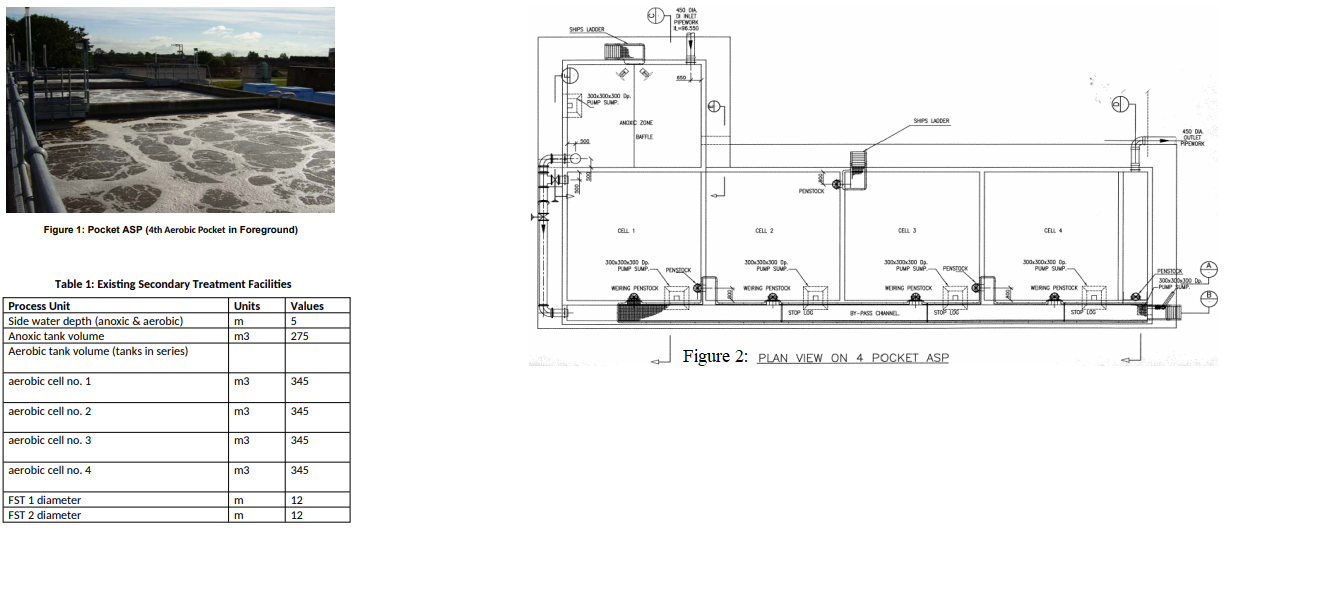
Figure show the top view and figure the plan view of the existing activated sludge basins at the Jeddah Ali STW It is a pocket ASP design, fully nitrifying plant with anoxic and aerobic basins. There is one anoxic basin, divided into two sections by a baffle wall, followed by four aerobic basins. The basins are run at a maximum design mixed liquor suspended solids MLSS of mgl The plant also has two m diameter, circular final settling tanks with a net surface area of m The activated sludge process is preceded by fine screens, grit removal and circular primary settling tanks. Table summarizes the existing secondary facilities.
TASKS:
Check the adequacy of the existing plant to cope with the additional loads by investigating the various operational parameters. If not, what could be done to continue to meet consents.
Design a new sludge treatment plant to deal with the total sludge and estimate the potential electricity generation from the plant make any necessary assumptions and provide justifications
Review retrofit options for removing SARSCoVthe virus that causes COVID Prior to the outbreak, most wastewater treatment works were not intentionally designed for SARSCoV removal. In addressing this, the following points should be considered:
In what form does the virus exist in wastewater?
How is the virus detected?
How is the virus removed from wastewater; and at what pointstage in the treatment stageprocess
Step by Step Solution
There are 3 Steps involved in it
1 Expert Approved Answer
Step: 1 Unlock

Question Has Been Solved by an Expert!
Get step-by-step solutions from verified subject matter experts
Step: 2 Unlock
Step: 3 Unlock
 Study Help