







Question: Please read Case #12 and pick ONE topic from the following 2 potential discussion topics...1.Perform PESTEL analysis on Nike to identifytrends that represent opportunities and
Please read Case #12 and pick ONE topic from the following 2 potential discussion topics...1.Perform PESTEL analysis on Nike to identifytrends that represent opportunities and threatsfacing Nike. What trends are the mostimportant for Nikes future? your comment should be 400-600 words!!! 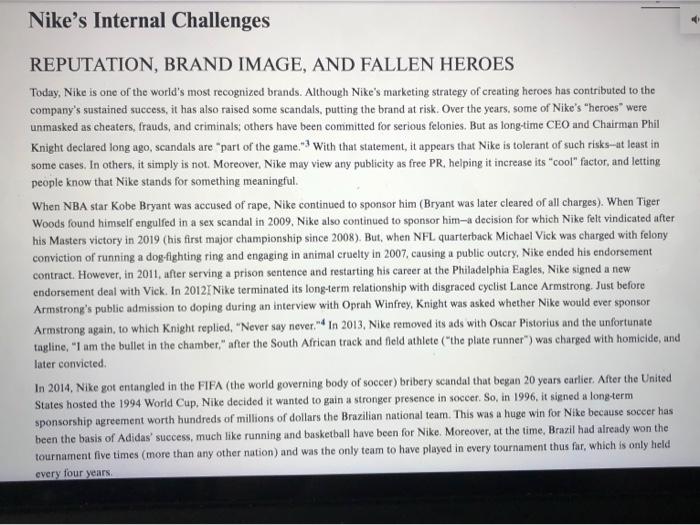
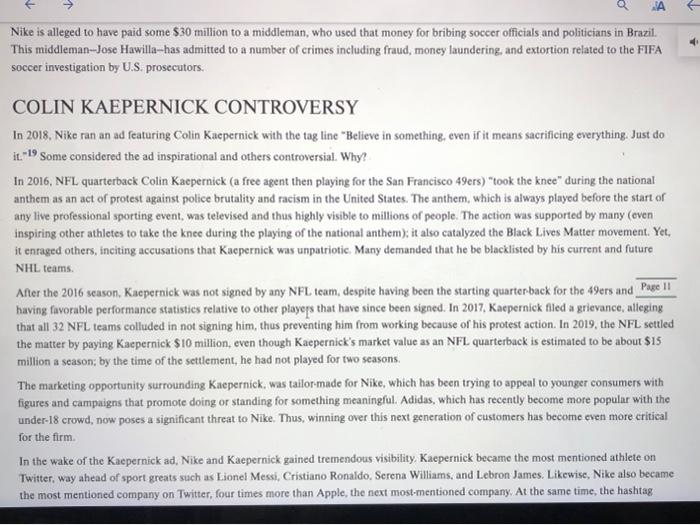
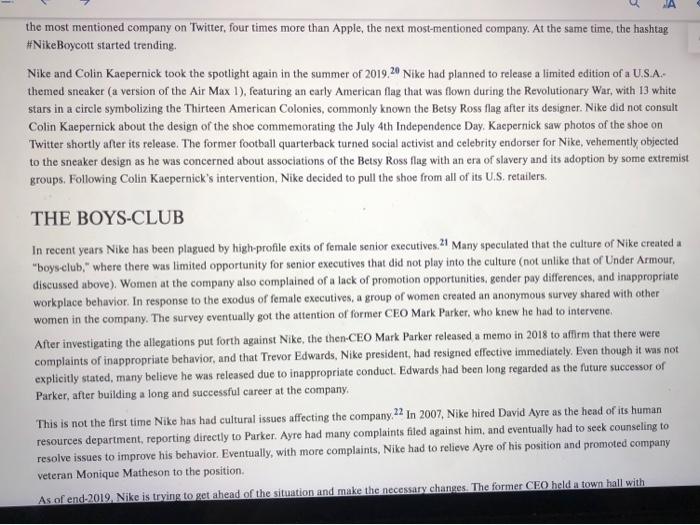
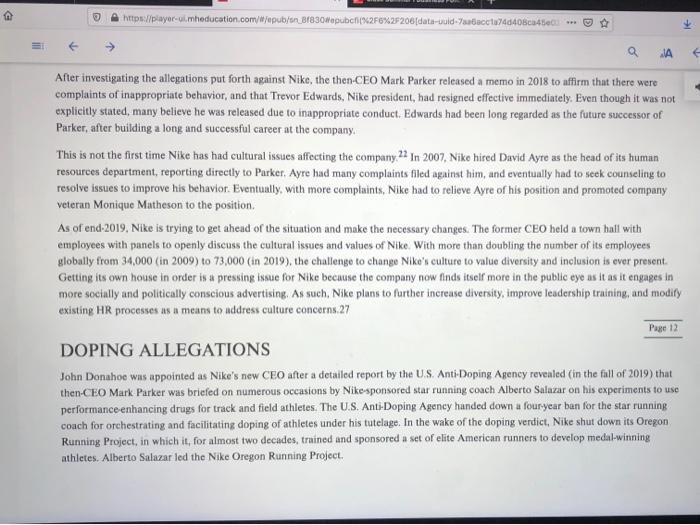
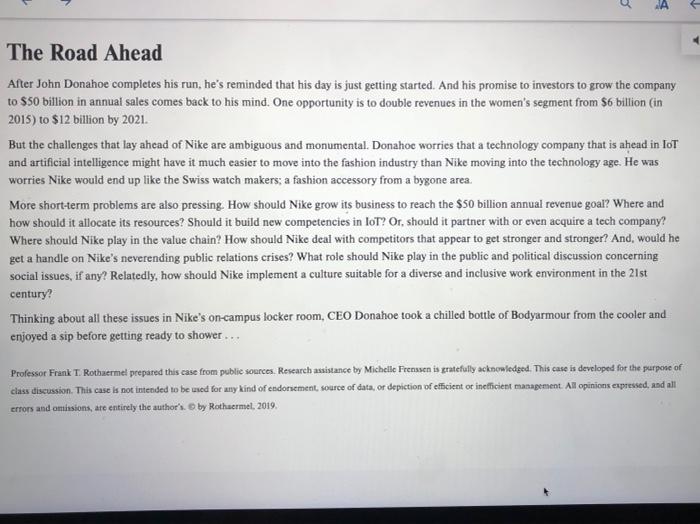
Nike's Internal Challenges REPUTATION, BRAND IMAGE, AND FALLEN HEROES Today, Nike is one of the world's most recognized brands. Although Nike's marketing strategy of creating heroes has contributed to the company's sustained success, it has also raised some scandals, putting the brand at risk. Over the years, some of Nike's "heroes" were unmasked as cheaters, frauds, and criminals, others have been committed for serious felonies. But as long-time CEO and Chairman Phil Knight declared long ago, scandals are part of the game." With that statement, it appears that Nike is tolerant of such risks-at least in some cases. In others, it simply is not. Moreover, Nike may view any publicity as free PR, helping it increase its "cool" factor, and letting people know that Nike stands for something meaningful. When NBA star Kobe Bryant was accused of rape, Nike continued to sponsor him (Bryant was later cleared of all charges). When Tiger Woods found himself engulfed in a sex scandal in 2009, Nike also continued to sponsor him-a decision for which Nike felt vindicated after his Masters victory in 2019 (his first major championship since 2008). But, when NFL quarterback Michael Vick was charged with felony conviction of running a dog-fighting ring and engaging in animal cruelty in 2007, causing a public outcry, Nike ended his endorsement contract. However, in 2011, after serving a prison sentence and restarting his career at the Philadelphia Eagles, Nike signed a new endorsement deal with Vick. In 20121 Nike terminated its long-term relationship with disgraced cyclist Lance Armstrong. Just before Armstrong's public admission to doping during an interview with Oprah Winfrey, Knight was asked whether Nike would ever sponsor Armstrong again, to which Knight replied, "Never say never. In 2013, Nike removed its ads with Oscar Pistorius and the unfortunate tagline, "I am the bullet in the chamber," after the South African track and field athlete ("the plate runner") was charged with homicide, and later convicted In 2014, Nike got entangled in the FIFA (the world governing body of soccer) bribery scandal that began 20 years earlier. After the United States hosted the 1994 World Cup, Nike decided it wanted to gain a stronger presence in soccer. So, in 1996, it signed a long-term sponsorship agreement worth hundreds of millions of dollars the Brazilian national team. This was a huge win for Nike because soccer has been the basis of Adidas' success, much like running and basketball have been for Nike. Moreover, at the time, Brazil had already won the tournament five times more than any other nation) and was the only team to have played in every tournament thus far, which is only held every four years Nike is alleged to have paid some $30 million to a middleman, who used that money for bribing soccer officials and politicians in Brazil. This middleman-Jose Hawilla-has admitted to a number of crimes including fraud, money laundering, and extortion related to the FIFA soccer investigation by U.S. prosecutors. COLIN KAEPERNICK CONTROVERSY In 2018. Nike ran an ad featuring Colin Kaepernick with the tag line "Believe in something, even if it means sacrificing everything. Just do IL"19 Some considered the ad inspirational and others controversial. Why? In 2016, NFL quarterback Colin Kaepernick (a free agent then playing for the San Francisco 49ers) "took the knee" during the national anthem as an act of protest against police brutality and racism in the United States. The anthem, which is always played before the start or any live professional sporting event was televised and thus highly visible to millions of people. The action was supported by many (even inspiring other athletes to take the knee during the playing of the national anthem); it also catalyzed the Black Lives Matter movement. Yet, it enraged others, inciting accusations that Kaepernick was unpatriotic Many demanded that he be blacklisted by his current and future NHL teams. After the 2016 season, Kaepernick was not signed by any NFL team, despite having been the starting quarterback for the 49ers and Page 1 having favorable performance statistics relative to other players that have since been signed. In 2017, Kaepernick filed a grievance, alleging that all 32 NFL teams colluded in not signing him, thus preventing him from working because of his protest action. In 2019, the NFL settled the matter by paying Kacpernick $10 million, even though Kaepernick's market value as an NFL quarterback is estimated to be about $15 million a season: by the time of the settlement, he had not played for two seasons The marketing opportunity surrounding Kaepernick, was tailor made for Nike, which has been trying to appeal to younger consumers with figures and campaigns that promote doing or standing for something meaningful. Adidas, which has recently become more popular with the under-18 crowd, now poses a significant threat to Nike. Thus, winning over this next generation of customers has become even more critical for the firm In the wake of the Kaepernick ad, Nike and Kaepernick gained tremendous visibility. Kaepernick became the most mentioned athlete on Twitter, way ahead of sport greats such as Lionel Messi, Cristiano Ronaldo, Serena Williams, and Lebron James. Likewise, Nike also became the most mentioned company on Twitter, four times more than Apple, the next most-mentioned company, At the same time, the hashtag the most mentioned company on Twitter, four times more than Apple, the next most-mentioned company. At the same time, the hashtag #Nike Boycott started trending, Nike and Colin Kaepernick took the spotlight again in the summer of 2019.20 Nike had planned to release a limited edition of a U.S.A. themed sneaker (a version of the Air Max 1), featuring an early American flag that was flown during the Revolutionary War, with 13 white stars in a circle symbolizing the Thirteen American Colonies, commonly known the Betsy Ross flag after its designer. Nike did not consult Colin Kaepernick about the design of the shoe commemorating the July 4th Independence Day, Kaepernick saw photos of the shoe on Twitter shortly after its release. The former football quarterback turned social activist and celebrity endorser for Nike, vehemently objected to the sneaker design as he was concerned about associations of the Betsy Ross flag with an era of slavery and its adoption by some extremist groups. Following Colin Kaepernick's intervention, Nike decided to pull the shoe from all of its U.S. retailers. THE BOYS-CLUB In recent years Nike has been plagued by high-profile exits of fomale senior executives, 21 Many speculated that the culture of Nike created a "boys-club," where there was limited opportunity for senior executives that did not play into the culture (not unlike that of Under Armour discussed above). Women at the company also complained of a lack of promotion opportunities, gender pay differences, and inappropriate workplace behavior. In response to the exodus of female executives, a group of women created an anonymous survey shared with other women in the company. The survey eventually got the attention of former CEO Mark Parker, who knew he had to intervene. After investigating the allegations put forth against Nike, the then CEO Mark Parker released a memo in 2018 to affirm that there were complaints of inappropriate behavior, and that Trevor Edwards, Nike president, had resigned effective immediately. Even though it was not explicitly stated, many believe he was released due to inappropriate conduct. Edwards had been long regarded as the future successor of Parker, after building a long and successful career at the company This is not the first time Nike has had cultural issues affecting the company, 22 In 2007, Nike hired David Ayre as the head of its human resources department, reporting directly to Parker. Ayre had many complaints filed against him, and eventually had to seek counseling to resolve issues to improve his behavior. Eventually, with more complaints, Nike had to relieve Ayre of his position and promoted company veteran Monique Matheson to the position, As of end-2019 Nike is trying to get ahead of the situation and make the necessary changes. The former CEO held a town hall with https://player.meducation.com/pub/on_30830epubcri(%2F%2F206[data-uuldaduocta/404080245 = Q After investigating the allegations put forth against Nike, the then-CEO Mark Parker released a memo in 2018 to affirm that there were complaints of inappropriate behavior, and that Trevor Edwards, Nike president, had resigned effective immediately. Even though it was not explicitly stated, many believe he was released due to inappropriate conduct. Edwards had been long regarded as the future successor of Parker, after building a long and successful career at the company. This is not the first time Nike has had cultural issues affecting the company, 22 In 2007, Nike hired David Ayre as the head of its human resources department, reporting directly to Parker. Ayre had many complaints filed against him, and eventually had to seek counseling to resolve issues to improve his behavior. Eventually, with more complaints, Nike had to relieve Ayre of his position and promoted company veteran Monique Matheson to the position. As of end-2019, Nike is trying to get ahead of the situation and make the necessary changes. The former CEO held a town hall with employees with panels to openly discuss the cultural issues and values of Nike With more than doubling the number of its employees globally from 34,000 (in 2009) to 73.000 (in 2019), the challenge to change Nike's culture to value diversity and inclusion is ever present Getting its own house in order is a pressing issue for Nike because the company now finds itself more in the public eye as it as it engages in more socially and politically conscious advertising. As such, Nike plans to further increase diversity, improve leadership training, and modify existing HR processes as a means to address culture concerns.27 Page 12 DOPING ALLEGATIONS John Donahoe was appointed as Nike's new CEO after a detailed report by the U.S. Anti-Doping Agency revealed (in the fall of 2019) that then-CEO Mark Parker was briefed on numerous occasions by Nike sponsored star running coach Alberto Salazar on his experiments to use performance enhancing drugs for track and field athletes. The U.S. Anti-Doping Agency handed down a four-year ban for the star running coach for orchestrating and facilitating doping of athletes under his tutelage. In the wake of the doping verdict, Nike shut down its Oregon Running Project, in which it, for almost two decades, trained and sponsored a set of elite American runners to develop medal-winning athletes. Alberto Salazar led the Nike Oregon Running Project. The Road Ahead After John Donahoe completes his run, he's reminded that his day is just getting started. And his promise to investors to grow the company to $50 billion in annual sales comes back to his mind. One opportunity is to double revenues in the women's segment from $6 billion (in 2015) to $12 billion by 2021. But the challenges that lay ahead of Nike are ambiguous and monumental. Donahoe worries that a technology company that is ahead in IoT and artificial intelligence might have it much easier to move into the fashion industry than Nike moving into the technology age. He was worries Nike would end up like the Swiss watch makers; a fashion accessory from a bygone area. More short-term problems are also pressing. How should Nike grow its business to reach the $50 billion annual revenue goal? Where and how should it allocate its resources? Should it build new competencies in loT? Or, should it partner with or even acquire a tech company? Where should Nike play in the value chain? How should Nike deal with competitors that appear to get stronger and stronger? And, would he get a handle on Nike's neverending public relations crises? What role should Nike play in the public and political discussion concerning social issues, if any? Relatedly, how should Nike implement a culture suitable for a diverse and inclusive work environment in the 21st century? Thinking about all these issues in Nike's on-campus locker room, CEO Donahoe took a chilled bottle of Bodyarmour from the cooler and enjoyed a sip before getting ready to shower... Professor Frank T Rothuerme prepared this case from public sources. Research assistance by Michelle Frenasen is gratefully acknowledged. This case is developed for the purpose of class discussion. This case is not intended to be used for any kind of endorsement, source of data, or depiction of efficient or inefficient management. All opinions expressed, and all errors and omissions, ate entirely the author's by Rothaermel, 2019 Step by Step Solution
There are 3 Steps involved in it
1 Expert Approved Answer
Step: 1 Unlock

Question Has Been Solved by an Expert!
Get step-by-step solutions from verified subject matter experts
Step: 2 Unlock
Step: 3 Unlock
 Study Help