







Question: Please read instructions a) Solve Problem 9.2-9 (a) on page 559. Manually obtain ONLY the initial BF solution. Do not solve using the Transport simplex
Please read instructions
a) Solve Problem 9.2-9 (a) on page 559. Manually obtain ONLY the initial BF solution. Do not solve using the Transport simplex method.
b) Solve Problem 9.3-6 (a) and (c) on page 561 and draw a well-labeled network representation diagram for the assignment and transportation problem in 9.3-6 (a) and (c) respectively.
9.2-9
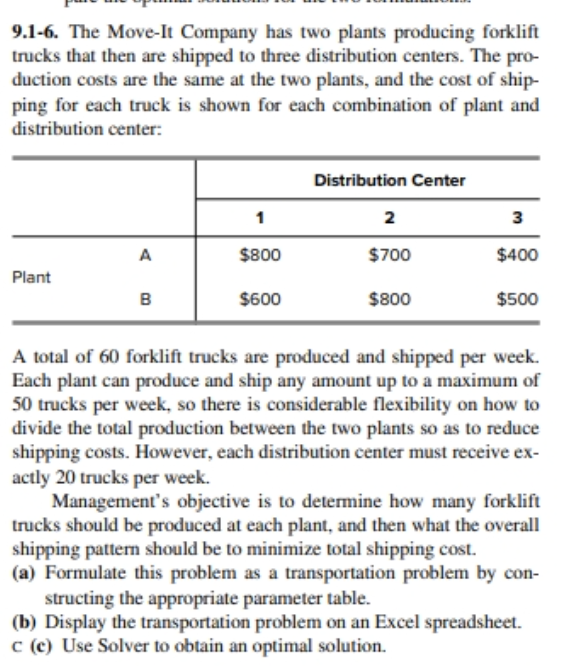
Consider problem 9.1-6 (below under reference) having the following parameter table:
| Distribution | ||||
| Source | 1 | 2 | Supply | |
| A | 8 | 5 | 4 | |
| B | 6 | 4 | 2 | |
| Demand | 3 | 3 |
(a) Using the northwest corner rule for obtaining the initial BF solution, solve this problem manually by the transportation simplex method.
(b) Reformulate this problem as a general linear programming problem, and then solve it manually by the simplex method. Keep track of how long this takes you, and contrast it with the computation time for part (a
9.3-6.
Reconsider Prob. 9.1-6. Now assume that distribution centers 1, 2, and 3 must receive exactly 10, 20, and 30 units per week, respectively. For administrative convenience, manage-ment has decided that each distribution center will be supplied totally by a single plant, so that one plant will supply one distri-bution center and the other plant will supply the other two distri-bution centers. The choice of these assignments of plants to distribution centers is to be made solely on the basis of minimiz-ing total shipping cost.
(a) Formulate this problem as an assignment problem by con-structing the appropriate cost table, including identifying the corresponding assignees and tasks.
(b) Obtain an optimal solution.
(c) Reformulate this assignment problem as an equivalent transportation problem (with four sources) by constructing the ap-propriate parameter table.
(d) Solve the problem as formulated in part (c).
(e) Repeat part (c) with just two sources.
(f) Solve the problem as formulated in part (e).
Reference:
HERE IS THE TRANSPORTATION PROBLEM mentioned in the exercise
this following problem is the problem both exercises refer to.
Step by Step Solution
There are 3 Steps involved in it

Get step-by-step solutions from verified subject matter experts
 Study Help