







Question: Please read question carefully, a response ASPA would be appreciated, thank you ! Question 17 3 pts (If you are still unfamiliar with the notation
Please read question carefully, a response ASPA would be appreciated, thank you !
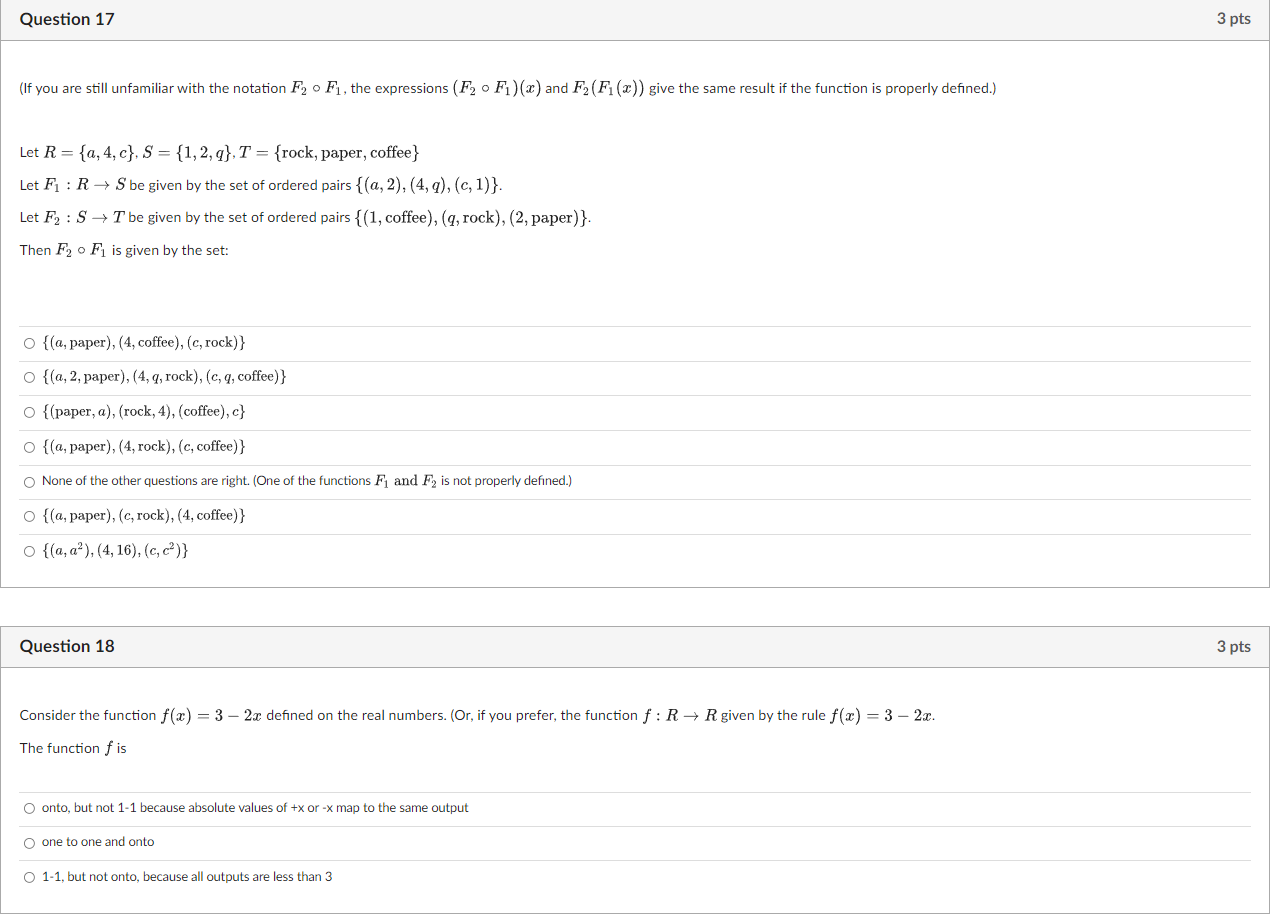
Question 17 3 pts (If you are still unfamiliar with the notation F2 o Fi, the expressions (F2 o Fi) (*) and F2 ( Fi (*:)) give the same result if the function is properly defined.) Let R = {a, 4, c}, S = {1, 2, q). T = {rock, paper, coffee } Let F1 : R -> S be given by the set of ordered pairs { (a, 2), (4, q), (c, 1)}. Let F2 : S -> T be given by the set of ordered pairs { (1, coffee), (q, rock), (2, paper) }. Then F2 o Fi is given by the set: O {(a, paper), (4, coffee), (c, rock) } O {(a, 2, paper), (4, q, rock), (c, q, coffee)} O {(paper, a), (rock, 4), (coffee), c} O {(a, paper), (4, rock), (c, coffee) } O None of the other questions are right. (One of the functions F, and F2 is not properly defined.) O {(a, paper), (c, rock), (4, coffee) } O {(a, a?), (4, 16), (c, c?) } Question 18 3 pts Consider the function f(x) = 3 - 2x defined on the real numbers. (Or, if you prefer, the function f : R -> R given by the rule f(x) = 3 - 2x. The function f is O onto, but not 1-1 because absolute values of +x or -x map to the same output O one to one and onto O 1-1, but not onto, because all outputs are less than 3
Step by Step Solution
There are 3 Steps involved in it

Get step-by-step solutions from verified subject matter experts
 Study Help