



Question: Please read section 3.2, pages 74-79 in your textbook and answer the questions at right Figure B y + B B A 2019 Pearson
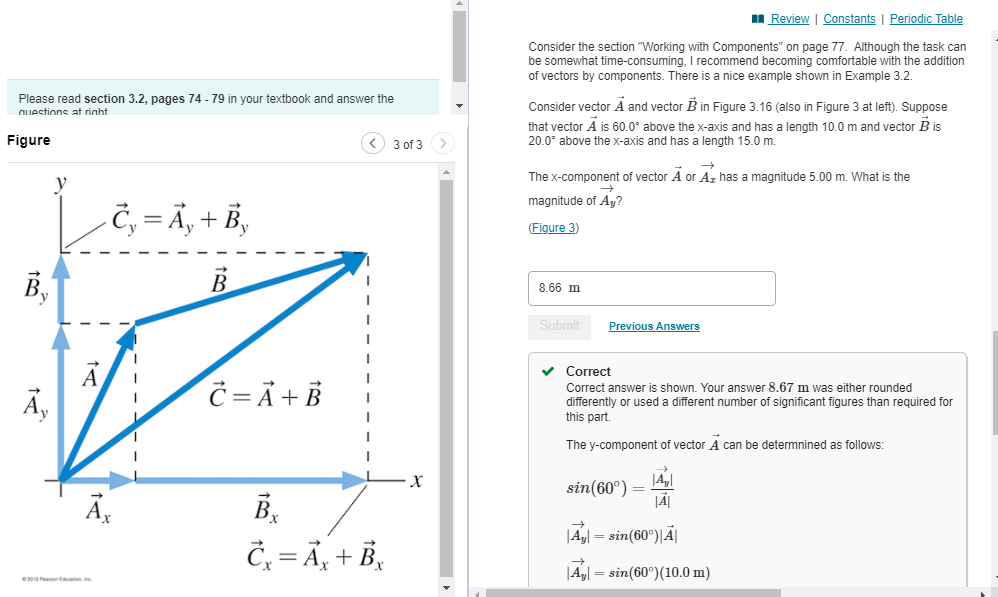
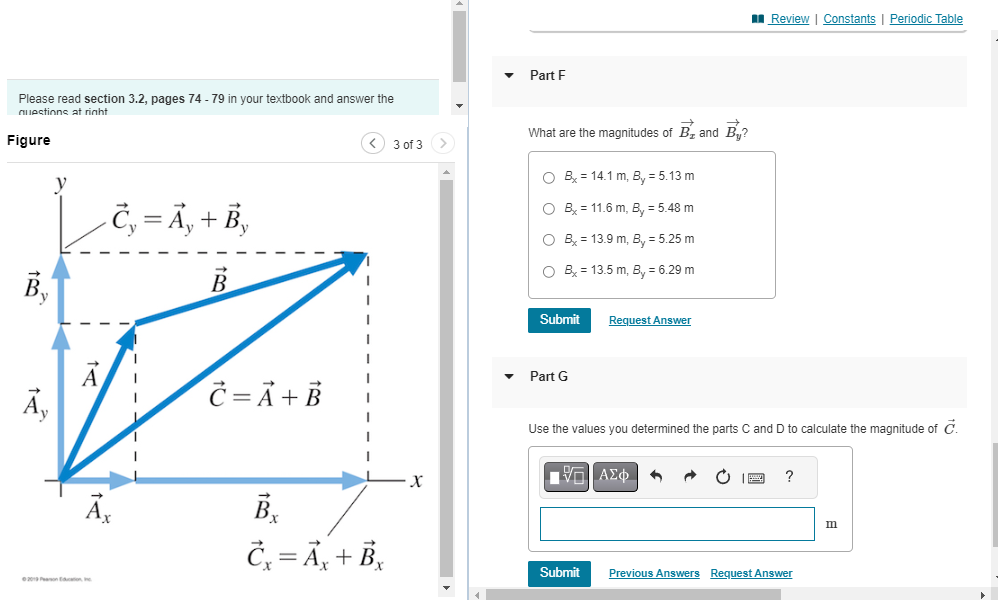
Please read section 3.2, pages 74-79 in your textbook and answer the questions at right Figure B y + B B A 2019 Pearson Education, h C=A+B B x C =+ Bx 3 of 3 Review | Constants | Periodic Table Consider the section "Working with Components" on page 77. Although the task can be somewhat time-consuming, I recommend becoming comfortable with the addition of vectors by components. There is a nice example shown in Example 3.2. Consider vector A and vector B in Figure 3.16 (also in Figure 3 at left). Suppose that vector A is 60.0 above the x-axis and has a length 10.0 m and vector B is 20.0 above the x-axis and has a length 15.0 m. The x-component of vector A or A2 has a magnitude 5.00 m. What is the magnitude of Ay? (Figure 3) 8.66 m Submit Previous Answers X Correct Correct answer is shown. Your answer 8.67 m was either rounded differently or used a different number of significant figures than required for this part. The y-component of vector A can be determined as follows: sin(60) Ayl |A| 4-(60) + = |Ay=sin(60)(10.0 m) Please read section 3.2, pages 74 - 79 in your textbook and answer the questions at right Figure By Ay = A + By B Part F What are the magnitudes of B, and By? OBX = 14.1 m, By = 5.13 m OBX 11.6 m, By = 5.48 m O Bx = 13.9 m, By = 5.25 m OBX13.5 m, By = 6.29 m Submit Request Answer Part G Review | Constants | Periodic Table C=A+B Use the values you determined the parts C and D to calculate the magnitude of . ? 2019 Education, Inc Ax BX Cx = Ax+Bx Submit Previous Answers Request Answer m
Step by Step Solution
There are 3 Steps involved in it

Get step-by-step solutions from verified subject matter experts