







Question: Please read the academic paper and answer the question. 3. Do you believe JC Premium Cars will run into future recruitment and selection challenges and
Please read the academic paper and answer the question.
3. Do you believe JC Premium Cars will run into future recruitment and selection challenges and explain why?
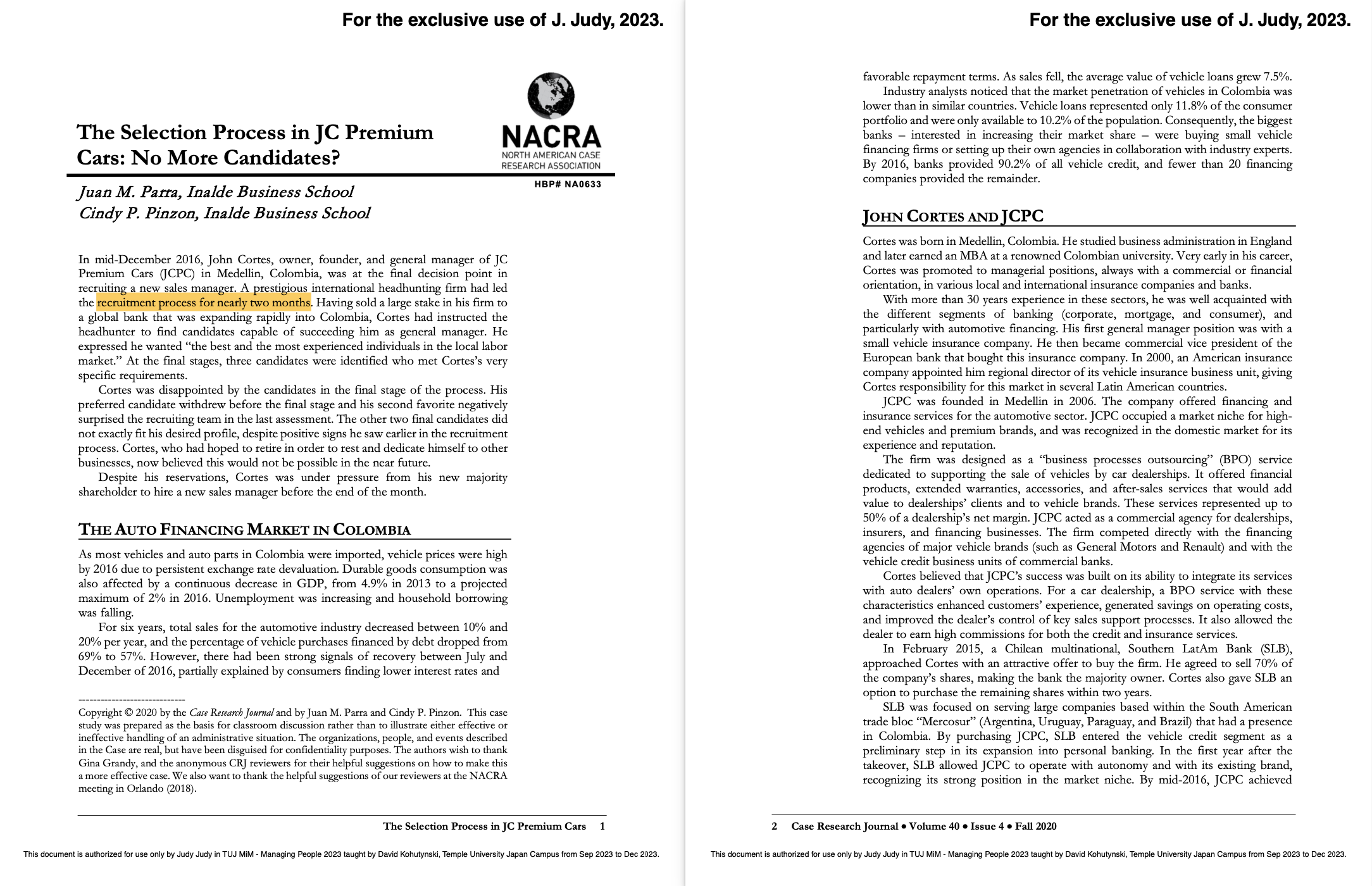
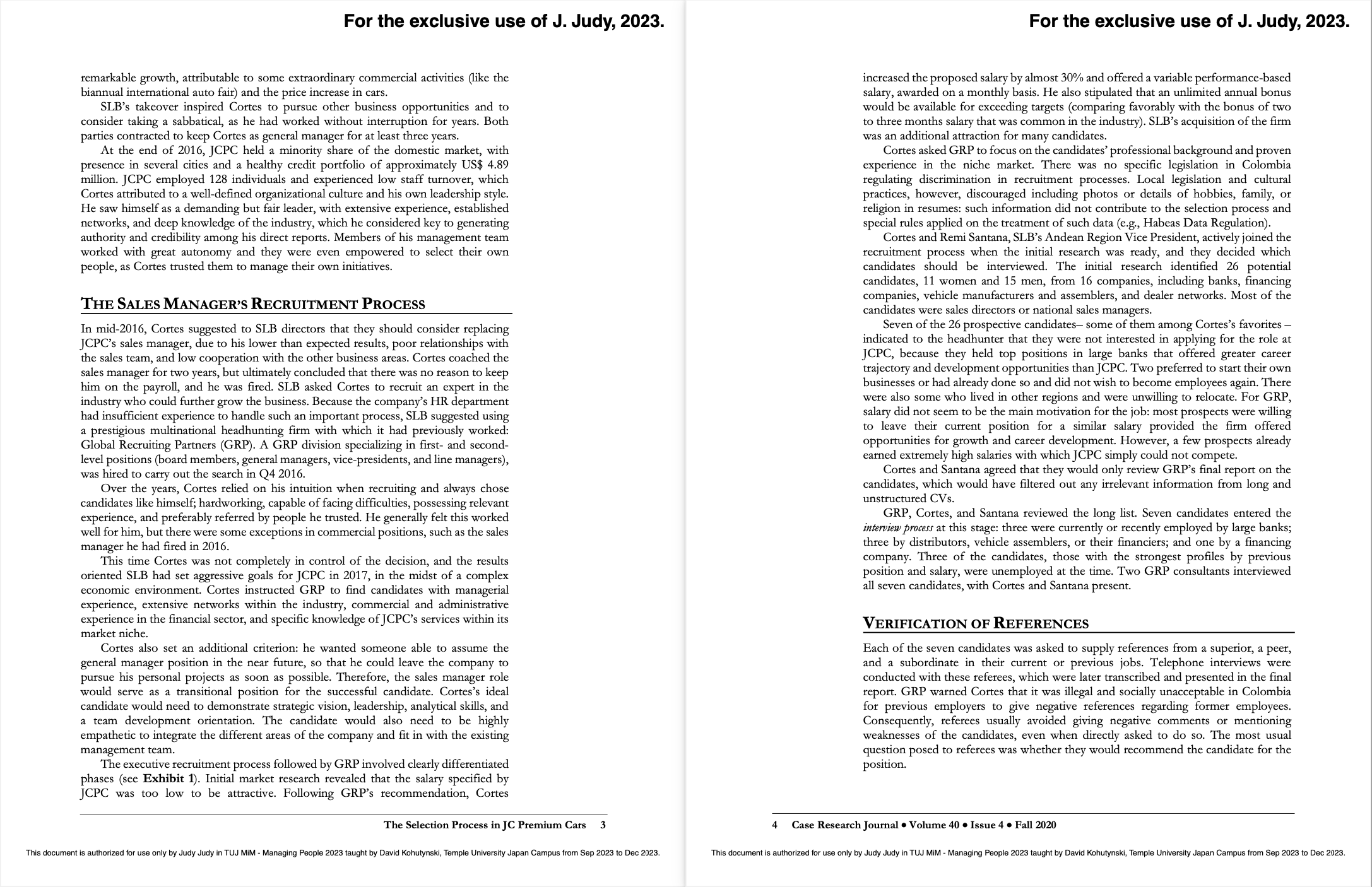
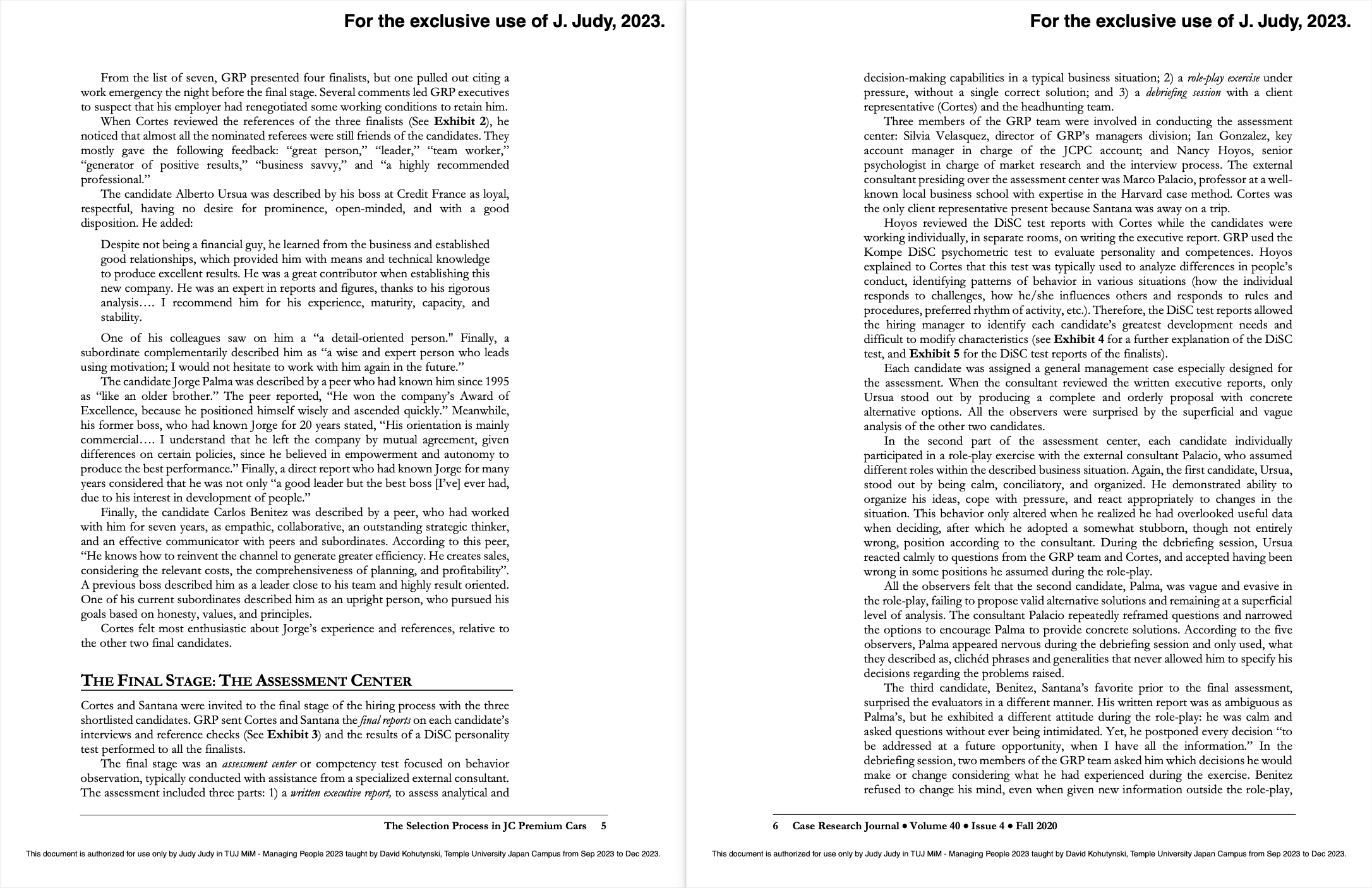
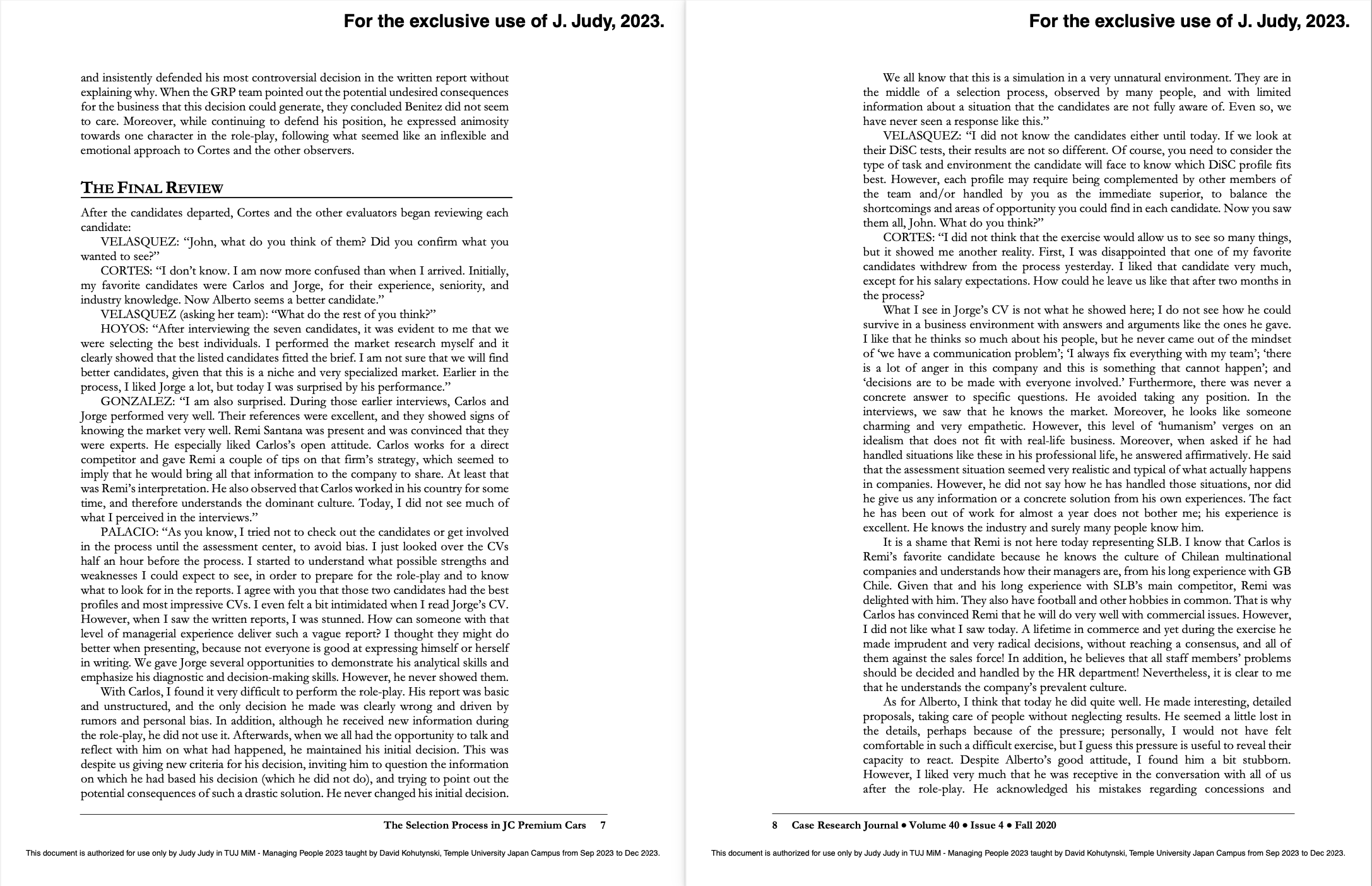
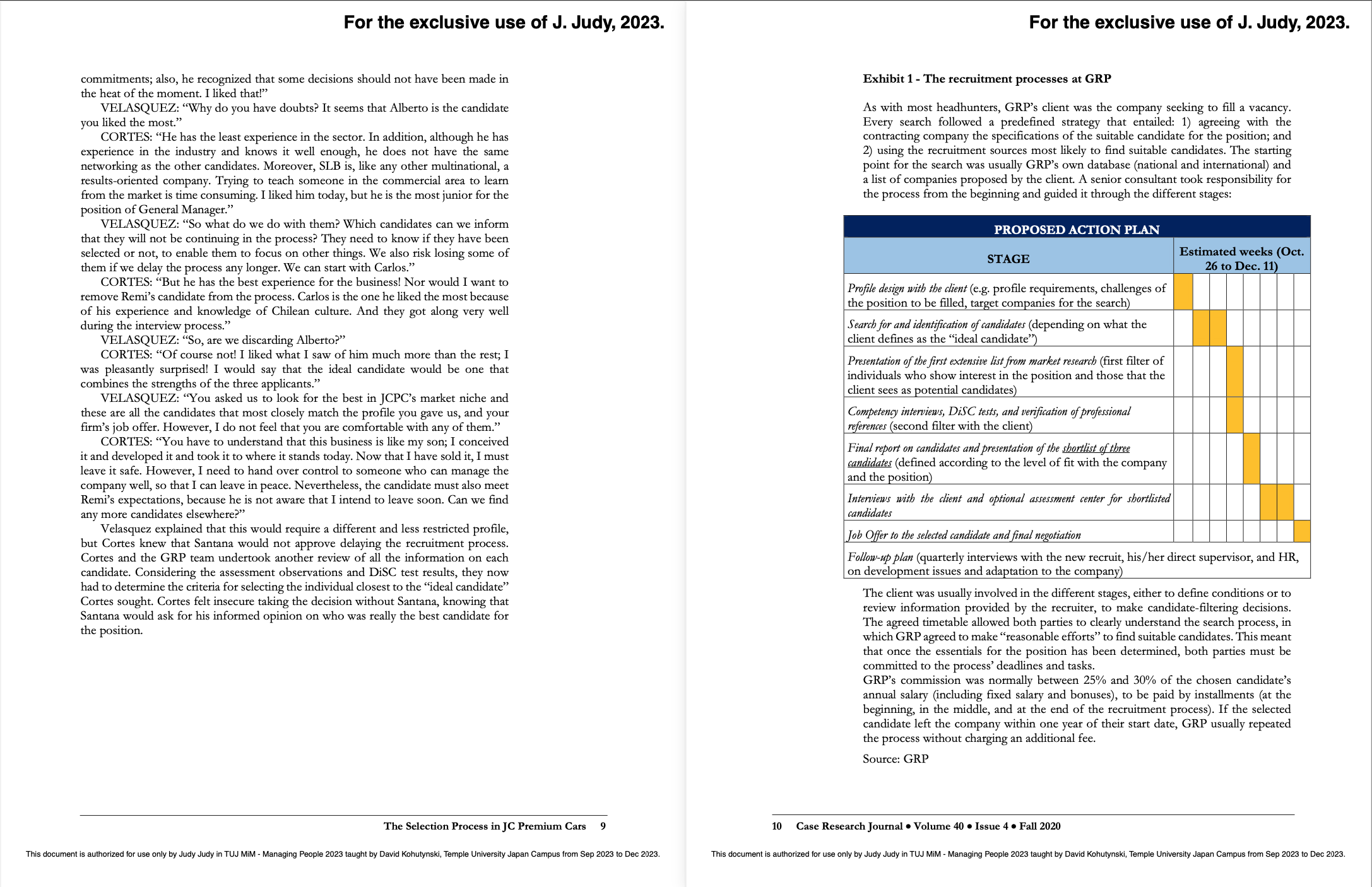
For the exclusive use of J. Judy, 2023. Cindy P. Pinzon, Inalde Business School In mid-December 2016, John Cortes, owner, founder, and general manager of JC Premium Cars (JCPC) in Medellin, Colombia, was at the final decision point in recruiting a new sales manager. A prestigious international headhunting firm had led the recruitment process for nearly two months. Having sold a large stake in his firm to a global bank that was expanding rapidly into Colombia, Cortes had instructed the headhunter to find candidates capable of succeeding him as general manager. He expressed he wanted "the best and the most experienced individuals in the local labor market." At the final stages, three candidates were identified who met Cortes's very specific requirements. Cortes was disappointed by the candidates in the final stage of the process. His preferred candidate withdrew before the final stage and his second favorite negatively surprised the recruiting team in the last assessment. The other two final candidates did not exactly fit his desired profile, despite positive signs he saw earlier in the recruitment process. Cortes, who had hoped to retire in order to rest and dedicate himself to other businesses, now believed this would not be possible in the near future. Despite his reservations, Cortes was under pressure from his new majority shareholder to hire a new sales manager before the end of the month. The Auto Financing Market in Colombia As most vehicles and auto parts in Colombia were imported, vehicle prices were high by 2016 due to persistent exchange rate devaluation. Durable goods consumption was also affected by a continuous decrease in GDP, from 4.9\% in 2013 to a projected maximum of 2% in 2016. Unemployment was increasing and household borrowing was falling. For six years, total sales for the automotive industry decreased between 10% and 20% per year, and the percentage of vehicle purchases financed by debt dropped from 69% to 57%. However, there had been strong signals of recovery between July and December of 2016, partially explained by consumers finding lower interest rates and Copyright (C) 2020 by the Case Researn Journal and by Juan M. Parra and Cindy P. Pinzon. This case study was prepared as the basis for classroom discussion rather than to illustrate either effective or ineffective handling of an administrative situation. The organizations, people, and events described in the Case are real, but have been disguised for confidentiality purposes. The authors wish to thank Gina Grandy, and the anonymous CRJ reviewers for their helpful suggestions on how to make this a more effective case. We also want to thank the helpful suggestions of our reviewers at the NACRA meeting in Orlando (2018). For the exclusive use of J. Judy, 2023. favorable repayment terms. As sales fell, the average value of vehicle loans grew 7.5%. Industry analysts noticed that the market penetration of vehicles in Colombia was lower than in similar countries. Vehicle loans represented only 11.8% of the consumer portfolio and were only available to 10.2% of the population. Consequently, the biggest banks - interested in increasing their market share - were buying small vehicle financing firms or setting up their own agencies in collaboration with industry experts. By 2016, banks provided 90.2% of all vehicle credit, and fewer than 20 financing companies provided the remainder. JOHN CORTES AND JCPC Cortes was born in Medellin, Colombia. He studied business administration in England and later earned an MBA at a renowned Colombian university. Very early in his career, Cortes was promoted to managerial positions, always with a commercial or financial orientation, in various local and international insurance companies and banks. With more than 30 years experience in these sectors, he was well acquainted with the different segments of banking (corporate, mortgage, and consumer), and particularly with automotive financing. His first general manager position was with a small vehicle insurance company. He then became commercial vice president of the European bank that bought this insurance company. In 2000, an American insurance company appointed him regional director of its vehicle insurance business unit, giving Cortes responsibility for this market in several Latin American countries. JCPC was founded in Medellin in 2006. The company offered financing and insurance services for the automotive sector. JCPC occupied a market niche for highend vehicles and premium brands, and was recognized in the domestic market for its experience and reputation. The firm was designed as a "business processes outsourcing" (BPO) service dedicated to supporting the sale of vehicles by car dealerships. It offered financial products, extended warranties, accessories, and after-sales services that would add value to dealerships' clients and to vehicle brands. These services represented up to 50% of a dealership's net margin. JCPC acted as a commercial agency for dealerships, insurers, and financing businesses. The firm competed directly with the financing agencies of major vehicle brands (such as General Motors and Renault) and with the vehicle credit business units of commercial banks. Cortes believed that JCPC's success was built on its ability to integrate its services with auto dealers' own operations. For a car dealership, a BPO service with these characteristics enhanced customers' experience, generated savings on operating costs, and improved the dealer's control of key sales support processes. It also allowed the dealer to earn high commissions for both the credit and insurance services. In February 2015, a Chilean multinational, Southern LatAm Bank (SLB), approached Cortes with an attractive offer to buy the firm. He agreed to sell 70% of the company's shares, making the bank the majority owner. Cortes also gave SLB an option to purchase the remaining shares within two years. SLB was focused on serving large companies based within the South American trade bloc "Mercosur" (Argentina, Uruguay, Paraguay, and Brazil) that had a presence in Colombia. By purchasing JCPC, SLB entered the vehicle credit segment as a preliminary step in its expansion into personal banking. In the first year after the takeover, SLB allowed JCPC to operate with autonomy and with its existing brand, recognizing its strong position in the market niche. By mid-2016, JCPC achieved The Selection Process in JC Premium Cars 1 This document is authorized for use only by Judy Judy in TUJ MiM - Managing People 2023 taught by David Kohutynski, Temple University Japan Campus from Sep 2023 to Dec 2023. 2 Case Research Journal Volume 40 Issue 4 Fall 2020 This document is authorized for use only by Judy Judy in TUJ MiM - Managing People 2023 taught by David Kohutynski, Temple University Japan Campus from Sep 2023 to Dec 2023. From the list of seven, GRP presented four finalists, but one pulled out citing a work emergency the night before the final stage. Several comments led GRP executives to suspect that his employer had renegotiated some working conditions to retain him. When Cortes reviewed the references of the three finalists (See Exhibit 2), he noticed that almost all the nominated referees were still friends of the candidates. They mostly gave the following feedback: "great person," "leader," "team worker," "generator of positive results," "business savvy," and "a highly recommended professional." The candidate Alberto Ursua was described by his boss at Credit France as loyal, respectful, having no desire for prominence, open-minded, and with a good disposition. He added: Despite not being a financial guy, he learned from the business and established good relationships, which provided him with means and technical knowledge to produce excellent results. He was a great contributor when establishing this new company. He was an expert in reports and figures, thanks to his rigorous analysis.... I recommend him for his experience, maturity, capacity, and stability. One of his colleagues saw on him a "a detail-oriented person." Finally, a subordinate complementarily described him as "a wise and expert person who leads using motivation; I would not hesitate to work with him again in the future." The candidate Jorge Palma was described by a peer who had known him since 1995 as "like an older brother." The peer reported, "He won the company's Award of Excellence, because he positioned himself wisely and ascended quickly." Meanwhile, his former boss, who had known Jorge for 20 years stated, "His orientation is mainly commercial.... I understand that he left the company by mutual agreement, given differences on certain policies, since he believed in empowerment and autonomy to produce the best performance." Finally, a direct report who had known Jorge for many years considered that he was not only "a good leader but the best boss [I've] ever had, due to his interest in development of people." Finally, the candidate Carlos Benitez was described by a peer, who had worked with him for seven years, as empathic, collaborative, an outstanding strategic thinker, and an effective communicator with peers and subordinates. According to this peer, "He knows how to reinvent the channel to generate greater efficiency. He creates sales, considering the relevant costs, the comprehensiveness of planning, and profitability". A previous boss described him as a leader close to his team and highly result oriented. One of his current subordinates described him as an upright person, who pursued his goals based on honesty, values, and principles. Cortes felt most enthusiastic about Jorge's experience and references, relative to the other two final candidates. The Final Stage: The Assessment Center Cortes and Santana were invited to the final stage of the hiring process with the three shortlisted candidates. GRP sent Cortes and Santana the final reports on each candidate's interviews and reference checks (See Exhibit 3) and the results of a DiSC personality test performed to all the finalists. The final stage was an assessment center or competency test focused on behavior observation, typically conducted with assistance from a specialized external consultant. The assessment included three parts: 1) a written executive report, to assess analytical and decision-making capabilities in a typical business situation; 2) a role-play exercise under pressure, without a single correct solution; and 3) a debriefing session with a client representative (Cortes) and the headhunting team. Three members of the GRP team were involved in conducting the assessment center: Silvia Velasquez, director of GRP's managers division; Ian Gonzalez, key account manager in charge of the JCPC account; and Nancy Hoyos, senior psychologist in charge of market research and the interview process. The external consultant presiding over the assessment center was Marco Palacio, professor at a wellknown local business school with expertise in the Harvard case method. Cortes was the only client representative present because Santana was away on a trip. Hoyos reviewed the DiSC test reports with Cortes while the candidates were working individually, in separate rooms, on writing the executive report. GRP used the Kompe DiSC psychometric test to evaluate personality and competences. Hoyos explained to Cortes that this test was typically used to analyze differences in people's conduct, identifying patterns of behavior in various situations (how the individual responds to challenges, how he/she influences others and responds to rules and procedures, preferred rhythm of activity, etc.). Therefore, the DiSC test reports allowed the hiring manager to identify each candidate's greatest development needs and difficult to modify characteristics (see Exhibit 4 for a further explanation of the DiSC test, and Exhibit 5 for the DiSC test reports of the finalists). Each candidate was assigned a general management case especially designed for the assessment. When the consultant reviewed the written executive reports, only Ursua stood out by producing a complete and orderly proposal with concrete alternative options. All the observers were surprised by the superficial and vague analysis of the other two candidates. In the second part of the assessment center, each candidate individually participated in a role-play exercise with the external consultant Palacio, who assumed different roles within the described business situation. Again, the first candidate, Ursua, stood out by being calm, conciliatory, and organized. He demonstrated ability to organize his ideas, cope with pressure, and react appropriately to changes in the situation. This behavior only altered when he realized he had overlooked useful data when deciding, after which he adopted a somewhat stubborn, though not entirely wrong, position according to the consultant. During the debriefing session, Ursua reacted calmly to questions from the GRP team and Cortes, and accepted having been wrong in some positions he assumed during the role-play. All the observers felt that the second candidate, Palma, was vague and evasive in the role-play, failing to propose valid alternative solutions and remaining at a superficial level of analysis. The consultant Palacio repeatedly reframed questions and narrowed the options to encourage Palma to provide concrete solutions. According to the five observers, Palma appeared nervous during the debriefing session and only used, what they described as, clichd phrases and generalities that never allowed him to specify his decisions regarding the problems raised. The third candidate, Benitez, Santana's favorite prior to the final assessment, surprised the evaluators in a different manner. His written report was as ambiguous as Palma's, but he exhibited a different attitude during the role-play: he was calm and asked questions without ever being intimidated. Yet, he postponed every decision "to be addressed at a future opportunity, when I have all the information." In the debriefing session, two members of the GRP team asked him which decisions he would make or change considering what he had experienced during the exercise. Benitez refused to change his mind, even when given new information outside the role-play, 6 Case Research Journal Volume 40 Issue 4 Fall 2020 This document is authorized for use only by Judy Judy in TUJ MiM - Managing People 2023 taught by David Kohutynski, Temple University Japan Campus from Sep 2023 to Dec 2023. This document is authorized for use only by Judy Judy in TUJ MiM - Managing People 2023 taught by David Kohutynski, Temple University Japan Campus from Sep 2023 to Dec 2023. remarkable growth, attributable to some extraordinary commercial activities (like the biannual international auto fair) and the price increase in cars. SLB's takeover inspired Cortes to pursue other business opportunities and to consider taking a sabbatical, as he had worked without interruption for years. Both parties contracted to keep Cortes as general manager for at least three years. At the end of 2016, JCPC held a minority share of the domestic market, with presence in several cities and a healthy credit portfolio of approximately US $4.89 million. JCPC employed 128 individuals and experienced low staff turnover, which Cortes attributed to a well-defined organizational culture and his own leadership style. He saw himself as a demanding but fair leader, with extensive experience, established networks, and deep knowledge of the industry, which he considered key to generating authority and credibility among his direct reports. Members of his management team worked with great autonomy and they were even empowered to select their own people, as Cortes trusted them to manage their own initiatives. The Sales Manager's Recruitment Process In mid-2016, Cortes suggested to SLB directors that they should consider replacing JCPC's sales manager, due to his lower than expected results, poor relationships with the sales team, and low cooperation with the other business areas. Cortes coached the sales manager for two years, but ultimately concluded that there was no reason to keep him on the payroll, and he was fired. SLB asked Cortes to recruit an expert in the industry who could further grow the business. Because the company's HR department had insufficient experience to handle such an important process, SLB suggested using a prestigious multinational headhunting firm with which it had previously worked: Global Recruiting Partners (GRP). A GRP division specializing in first- and secondlevel positions (board members, general managers, vice-presidents, and line managers), was hired to carry out the search in Q4 2016. Over the years, Cortes relied on his intuition when recruiting and always chose candidates like himself; hardworking, capable of facing difficulties, possessing relevant experience, and preferably referred by people he trusted. He generally felt this worked well for him, but there were some exceptions in commercial positions, such as the sales manager he had fired in 2016. This time Cortes was not completely in control of the decision, and the results oriented SLB had set aggressive goals for JCPC in 2017, in the midst of a complex economic environment. Cortes instructed GRP to find candidates with managerial experience, extensive networks within the industry, commercial and administrative experience in the financial sector, and specific knowledge of JCPC's services within its market niche. Cortes also set an additional criterion: he wanted someone able to assume the general manager position in the near future, so that he could leave the company to pursue his personal projects as soon as possible. Therefore, the sales manager role would serve as a transitional position for the successful candidate. Cortes's ideal candidate would need to demonstrate strategic vision, leadership, analytical skills, and a team development orientation. The candidate would also need to be highly empathetic to integrate the different areas of the company and fit in with the existing management team. The executive recruitment process followed by GRP involved clearly differentiated phases (see Exhibit 1). Initial market research revealed that the salary specified by JCPC was too low to be attractive. Following GRP's recommendation, Cortes increased the proposed salary by almost 30% and offered a variable performance-based salary, awarded on a monthly basis. He also stipulated that an unlimited annual bonus would be available for exceeding targets (comparing favorably with the bonus of two to three months salary that was common in the industry). SLB's acquisition of the firm was an additional attraction for many candidates. Cortes asked GRP to focus on the candidates' professional background and proven experience in the niche market. There was no specific legislation in Colombia regulating discrimination in recruitment processes. Local legislation and cultural practices, however, discouraged including photos or details of hobbies, family, or religion in resumes: such information did not contribute to the selection process and special rules applied on the treatment of such data (e.g., Habeas Data Regulation). Cortes and Remi Santana, SLB's Andean Region Vice President, actively joined the recruitment process when the initial research was ready, and they decided which candidates should be interviewed. The initial research identified 26 potential candidates, 11 women and 15 men, from 16 companies, including banks, financing companies, vehicle manufacturers and assemblers, and dealer networks. Most of the candidates were sales directors or national sales managers. Seven of the 26 prospective candidates- some of them among Cortes's favorites indicated to the headhunter that they were not interested in applying for the role at JCPC, because they held top positions in large banks that offered greater career trajectory and development opportunities than JCPC. Two preferred to start their own businesses or had already done so and did not wish to become employees again. There were also some who lived in other regions and were unwilling to relocate. For GRP, salary did not seem to be the main motivation for the job: most prospects were willing to leave their current position for a similar salary provided the firm offered opportunities for growth and career development. However, a few prospects already earned extremely high salaries with which JCPC simply could not compete. Cortes and Santana agreed that they would only review GRP's final report on the candidates, which would have filtered out any irrelevant information from long and unstructured CVs. GRP, Cortes, and Santana reviewed the long list. Seven candidates entered the interview process at this stage: three were currently or recently employed by large banks; three by distributors, vehicle assemblers, or their financiers; and one by a financing company. Three of the candidates, those with the strongest profiles by previous position and salary, were unemployed at the time. Two GRP consultants interviewed all seven candidates, with Cortes and Santana present. VERIFICATION OF REFERENCES Each of the seven candidates was asked to supply references from a superior, a peer, and a subordinate in their current or previous jobs. Telephone interviews were conducted with these referees, which were later transcribed and presented in the final report. GRP warned Cortes that it was illegal and socially unacceptable in Colombia for previous employers to give negative references regarding former employees. Consequently, referees usually avoided giving negative comments or mentioning weaknesses of the candidates, even when directly asked to do so. The most usual question posed to referees was whether they would recommend the candidate for the position. The Selection Process in JC Premium Cars 3 4 Case Research Journal Volume 40 Issue 4 Fall 2020 This document is authorized for use only by Judy Judy in TUJ MiM - Managing People 2023 taught by David Kohutynski, Temple University Japan Campus from Sep 2023 to Dec 2023. This document is authorized for use only by Judy Judy in TUJ MiM - Managing People 2023 taught by David Kohutynski, Temple University Japan Campus from Sep 2023 to Dec 2023. For the exclusive use of J. Judy, 2023. For the exclusive use of J. Judy, 2023. commitments; also, he recognized that some decisions should not have been made in the heat of the moment. I liked that!" VELASQUEZ: "Why do you have doubts? It seems that Alberto is the candidate you liked the most." CORTES: "He has the least experience in the sector. In addition, although he has experience in the industry and knows it well enough, he does not have the same networking as the other candidates. Moreover, SLB is, like any other multinational, a results-oriented company. Trying to teach someone in the commercial area to learn from the market is time consuming. I liked him today, but he is the most junior for the position of General Manager." VELASQUEZ: "So what do we do with them? Which candidates can we inform that they will not be continuing in the process? They need to know if they have been selected or not, to enable them to focus on other things. We also risk losing some of them if we delay the process any longer. We can start with Carlos." CORTES: "But he has the best experience for the business! Nor would I want to remove Remi's candidate from the process. Carlos is the one he liked the most because of his experience and knowledge of Chilean culture. And they got along very well during the interview process." VELASQUEZ: "So, are we discarding Alberto?" CORTES: "Of course not! I liked what I saw of him much more than the rest; I was pleasantly surprised! I would say that the ideal candidate would be one that combines the strengths of the three applicants." VELASQUEZ: 'You asked us to look for the best in JCPC's market niche and these are all the candidates that most closely match the profile you gave us, and your firm's job offer. However, I do not feel that you are comfortable with any of them." CORTES: "You have to understand that this business is like my son; I conceived it and developed it and took it to where it stands today. Now that I have sold it, I must leave it safe. However, I need to hand over control to someone who can manage the company well, so that I can leave in peace. Nevertheless, the candidate must also meet Remi's expectations, because he is not aware that I intend to leave soon. Can we find any more candidates elsewhere?" Velasquez explained that this would require a different and less restricted profile, but Cortes knew that Santana would not approve delaying the recruitment process. Cortes and the GRP team undertook another review of all the information on each candidate. Considering the assessment observations and DiSC test results, they now had to determine the criteria for selecting the individual closest to the "ideal candidate" Cortes sought. Cortes felt insecure taking the decision without Santana, knowing that Santana would ask for his informed opinion on who was really the best candidate for the position. Exhibit 1 - The recruitment processes at GRP As with most headhunters, GRP's client was the company seeking to fill a vacancy. Every search followed a predefined strategy that entailed: 1) agreeing with the contracting company the specifications of the suitable candidate for the position; and 2) using the recruitment sources most likely to find suitable candidates. The starting point for the search was usually GRP's own database (national and international) and a list of companies proposed by the client. A senior consultant took responsibility for the process from the beginning and guided it through the different stages: Follow-up plan (quarterly interviews with the new recruit, his/ her direct supervisor, and HK, on development issues and adaptation to the company) The client was usually involved in the different stages, either to define conditions or to review information provided by the recruiter, to make candidate-filtering decisions. The agreed timetable allowed both parties to clearly understand the search process, in which GRP agreed to make "reasonable efforts" to find suitable candidates. This meant that once the essentials for the position has been determined, both parties must be committed to the process' deadlines and tasks. GRP's commission was normally between 25% and 30% of the chosen candidate's annual salary (including fixed salary and bonuses), to be paid by installments (at the beginning, in the middle, and at the end of the recruitment process). If the selected candidate left the company within one year of their start date, GRP usually repeated the process without charging an additional fee. Source: GRP The Selection Process in JC Premium Cars 9 This document is authorized for use only by Judy Judy in TUJ MiM - Managing People 2023 taught by David Kohutynski, Temple University Japan Campus from Sep 2023 to Dec 2023. 10 Case Research Journal Volume 40 Issue 4 Fall 2020 and insistently defended his most controversial decision in the written report without explaining why. When the GRP team pointed out the potential undesired consequences for the business that this decision could generate, they concluded Benitez did not seem to care. Moreover, while continuing to defend his position, he expressed animosity towards one character in the role-play, following what seemed like an inflexible and emotional approach to Cortes and the other observers. THE FINAL REVIEW After the candidates departed, Cortes and the other evaluators began reviewing each candidate: VELASQUEZ: "John, what do you think of them? Did you confirm what you wanted to see?" CORTES: 'I don't know. I am now more confused than when I arrived. Initially, my favorite candidates were Carlos and Jorge, for their experience, seniority, and industry knowledge. Now Alberto seems a better candidate." VELASQUEZ (asking her team): "What do the rest of you think?" HOYOS: "After interviewing the seven candidates, it was evident to me that we were selecting the best individuals. I performed the market research myself and it clearly showed that the listed candidates fitted the brief. I am not sure that we will find better candidates, given that this is a niche and very specialized market. Earlier in the process, I liked Jorge a lot, but today I was surprised by his performance." GONZALEZ: "I am also surprised. During those earlier interviews, Carlos and Jorge performed very well. Their references were excellent, and they showed signs of knowing the market very well. Remi Santana was present and was convinced that they were experts. He especially liked Carlos's open attitude. Carlos works for a direct competitor and gave Remi a couple of tips on that firm's strategy, which seemed to imply that he would bring all that information to the company to share. At least that was Remi's interpretation. He also observed that Carlos worked in his country for some time, and therefore understands the dominant culture. Today, I did not see much of what I perceived in the interviews." PALACIO: "As you know, I tried not to check out the candidates or get involved in the process until the assessment center, to avoid bias. I just looked over the CVs half an hour before the process. I started to understand what possible strengths and weaknesses I could expect to see, in order to prepare for the role-play and to know what to look for in the reports. I agree with you that those two candidates had the best profiles and most impressive CVs. I even felt a bit intimidated when I read Jorge's CV. However, when I saw the written reports, I was stunned. How can someone with that level of managerial experience deliver such a vague report? I thought they might do better when presenting, because not everyone is good at expressing himself or herself in writing. We gave Jorge several opportunities to demonstrate his analytical skills and emphasize his diagnostic and decision-making skills. However, he never showed them. With Carlos, I found it very difficult to perform the role-play. His report was basic and unstructured, and the only decision he made was clearly wrong and driven by rumors and personal bias. In addition, although he received new information during the role-play, he did not use it. Afterwards, when we all had the opportunity to talk and reflect with him on what had happened, he maintained his initial decision. This was despite us giving new criteria for his decision, inviting him to question the information on which he had based his decision (which he did not do), and trying to point out the potential consequences of such a drastic solution. He never changed his initial decision. The Selection Process in JC Premium Cars 7 We all know that this is a simulation in a very unnatural environment. They are in the middle of a selection process, observed by many people, and with limited information about a situation that the candidates are not fully aware of. Even so, we have never seen a response like this." VELASQUEZ: "I did not know the candidates either until today. If we look at their DiSC tests, their results are not so different. Of course, you need to consider the type of task and environment the candidate will face to know which DiSC profile fits best. However, each profile may require being complemented by other members of the team and/or handled by you as the immediate superior, to balance the shortcomings and areas of opportunity you could find in each candidate. Now you saw them all, John. What do you think?" CORTES: "I did not think that the exercise would allow us to see so many things, but it showed me another reality. First, I was disappointed that one of my favorite candidates withdrew from the process yesterday. I liked that candidate very much, except for his salary expectations. How could he leave us like that after two months in the process? What I see in Jorge's CV is not what he showed here; I do not see how he could survive in a business environment with answers and arguments like the ones he gave. I like that he thinks so much about his people, but he never came out of the mindset of 'we have a communication problem'; 'I always fix everything with my team'; 'there is a lot of anger in this company and this is something that cannot happen'; and 'decisions are to be made with everyone involved.' Furthermore, there was never a concrete answer to specific questions. He avoided taking any position. In the interviews, we saw that he knows the market. Moreover, he looks like someone charming and very empathetic. However, this level of 'humanism' verges on an idealism that does not fit with real-life business. Moreover, when asked if he had handled situations like these in his professional life, he answered affirmatively. He said that the assessment situation seemed very realistic and typical of what actually happens in companies. However, he did not say how he has handled those situations, nor did he give us any information or a concrete solution from his own experiences. The fact he has been out of work for almost a year does not bother me; his experience is excellent. He knows the industry and surely many people know him. It is a shame that Remi is not here today representing SLB. I know that Carlos is Remi's favorite candidate because he knows the culture of Chilean multinational companies and understands how their managers are, from his long experience with GB Chile. Given that and his long experience with SLB's main competitor, Remi was delighted with him. They also have football and other hobbies in common. That is why Carlos has convinced Remi that he will do very well with commercial issues. However, I did not like what I saw today. A lifetime in commerce and yet during the exercise he made imprudent and very radical decisions, without reaching a consensus, and all of them against the sales force! In addition, he believes that all staff members' problems should be decided and handled by the HR department! Nevertheless, it is clear to me that he understands the company's prevalent culture. As for Alberto, I think that today he did quite well. He made interesting, detailed proposals, taking care of people without neglecting results. He seemed a little lost in the details, perhaps because of the pressure; personally, I would not have felt comfortable in such a difficult exercise, but I guess this pressure is useful to reveal their capacity to react. Despite Alberto's good attitude, I found him a bit stubborn. However, I liked very much that he was receptive in the conversation with all of us after the role-play. He acknowledged his mistakes regarding concessions and 8 Case Research Journal Volume 40 Issue 4 Fall 2020 This document is authorized for use only by Judy Judy in TUJ MiM - Managing People 2023 taught by David Kohutynski, Temple University Japan Campus from Sep 2023 to Dec 2023. This document is authorized for use only by Judy Judy in TUJ MiM - Managing People 2023 taught by David Kohutynski, Temple University Japan Campus from Sep 2023 to Dec 2023
Step by Step Solution
There are 3 Steps involved in it

Get step-by-step solutions from verified subject matter experts
 Study Help