







Question: Please read the article above and answer the question below: Apply a framework to the situation and suggest an ethical course of action based on
Please read the article above and answer the question below:
Apply a framework to the situation and suggest an ethical course of action based on that framework (what should be done)
Ethical Frameworks to apply:
Egoism
Utilitarianism
Kantian Ethics
Prima Facie
Libertarian
Theory of Justice
Descriptive Ethics
****PLEASE PROVIDE AN ETHICAL FRAMEWORK TO THE ANSWER***
will give thumbs up
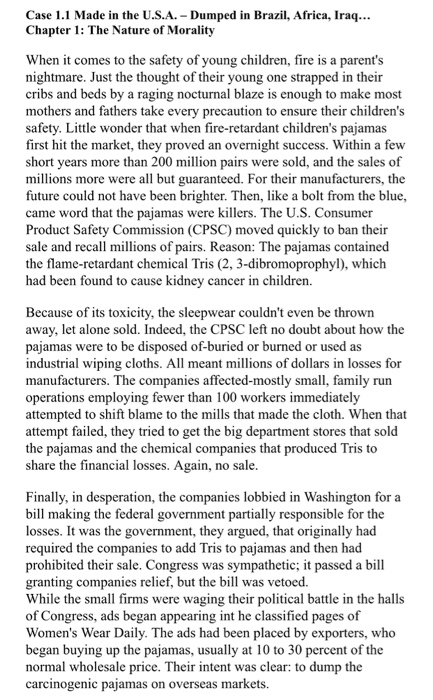
Case 1.1 Made in the U.S.A. - Dumped in Brazil, Africa, Iraq... Chapter 1: The Nature of Morality When it comes to the safety of young children, fire is a parent's nightmare. Just the thought of their young one strapped in their cribs and beds by a raging nocturnal blaze is enough to make most mothers and fathers take every precaution to ensure their children's safety. Little wonder that when fire-retardant children's pajamas first hit the market, they proved an overnight success. Within a few short years more than 200 million pairs were sold, and the sales of millions more were all but guaranteed. For their manufacturers, the future could not have been brighter. Then, like a bolt from the blue, came word that the pajamas were killers. The U.S. Consumer Product Safety Commission (CPSC) moved quickly to ban their sale and recall millions of pairs. Reason: The pajamas contained the flame-retardant chemical Tris (2, 3-dibromoprophyl), which had been found to cause kidney cancer in children. Because of its toxicity, the sleepwear couldn't even be thrown away, let alone sold. Indeed, the CPSC left no doubt about how the pajamas were to be disposed of-buried or burned or used as industrial wiping cloths. All meant millions of dollars in losses for manufacturers. The companies affected-mostly small, family run operations employing fewer than 100 workers immediately attempted to shift blame to the mills that made the cloth. When that attempt failed, they tried to get the big department stores that sold the pajamas and the chemical companies that produced Tris to share the financial losses. Again, no sale. Finally, in desperation, the companies lobbied in Washington for a bill making the federal government partially responsible for the losses. It was the government, they argued, that originally had required the companies to add Tris to pajamas and then had prohibited their sale. Congress was sympathetic; it passed a bill granting companies relief, but the bill was vetoed. While the small firms were waging their political battle in the halls of Congress, ads began appearing int he classified pages of Women's Wear Daily. The ads had been placed by exporters, who began buying up the pajamas, usually at 10 to 30 percent of the normal wholesale price. Their intent was clear: to dump the carcinogenic pajamas on overseas markets. Case 1.1 Made in the U.S.A. - Dumped in Brazil, Africa, Iraq... Chapter 1: The Nature of Morality When it comes to the safety of young children, fire is a parent's nightmare. Just the thought of their young one strapped in their cribs and beds by a raging nocturnal blaze is enough to make most mothers and fathers take every precaution to ensure their children's safety. Little wonder that when fire-retardant children's pajamas first hit the market, they proved an overnight success. Within a few short years more than 200 million pairs were sold, and the sales of millions more were all but guaranteed. For their manufacturers, the future could not have been brighter. Then, like a bolt from the blue, came word that the pajamas were killers. The U.S. Consumer Product Safety Commission (CPSC) moved quickly to ban their sale and recall millions of pairs. Reason: The pajamas contained the flame-retardant chemical Tris (2, 3-dibromoprophyl), which had been found to cause kidney cancer in children. Because of its toxicity, the sleepwear couldn't even be thrown away, let alone sold. Indeed, the CPSC left no doubt about how the pajamas were to be disposed of-buried or burned or used as industrial wiping cloths. All meant millions of dollars in losses for manufacturers. The companies affected-mostly small, family run operations employing fewer than 100 workers immediately attempted to shift blame to the mills that made the cloth. When that attempt failed, they tried to get the big department stores that sold the pajamas and the chemical companies that produced Tris to share the financial losses. Again, no sale. Finally, in desperation, the companies lobbied in Washington for a bill making the federal government partially responsible for the losses. It was the government, they argued, that originally had required the companies to add Tris to pajamas and then had prohibited their sale. Congress was sympathetic; it passed a bill granting companies relief, but the bill was vetoed. While the small firms were waging their political battle in the halls of Congress, ads began appearing int he classified pages of Women's Wear Daily. The ads had been placed by exporters, who began buying up the pajamas, usually at 10 to 30 percent of the normal wholesale price. Their intent was clear: to dump the carcinogenic pajamas on overseas marketsStep by Step Solution
There are 3 Steps involved in it
1 Expert Approved Answer
Step: 1 Unlock

Question Has Been Solved by an Expert!
Get step-by-step solutions from verified subject matter experts
Step: 2 Unlock
Step: 3 Unlock
 Study Help