Question: Please read the article and provide a summary and answer the three question below. / CT1/6/361/4/4/46/24/2/12/2/2@0:0 G Bloomberg Businessweek Case in the News Europe's Magic
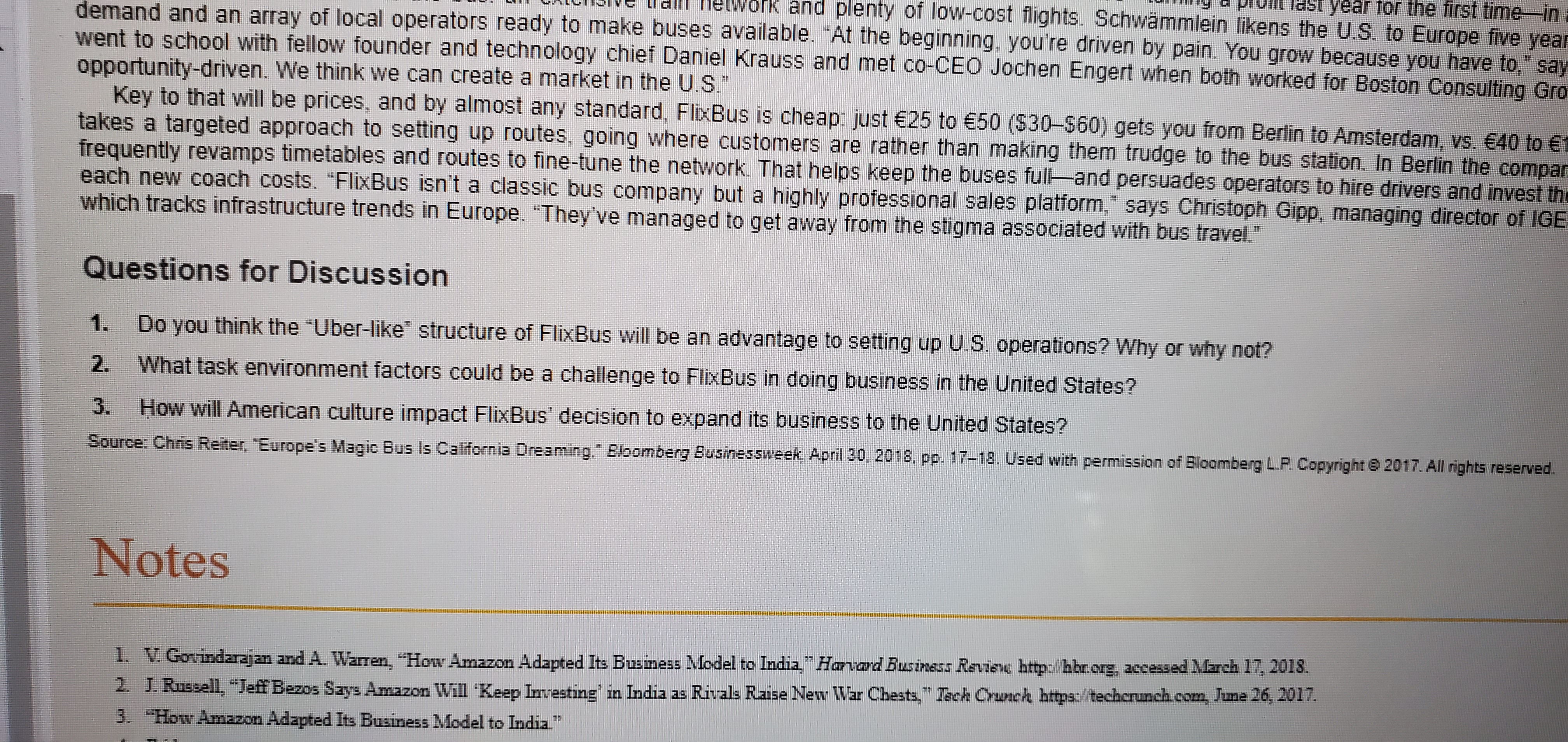
Please read the article and provide a summary and answer the three question below.
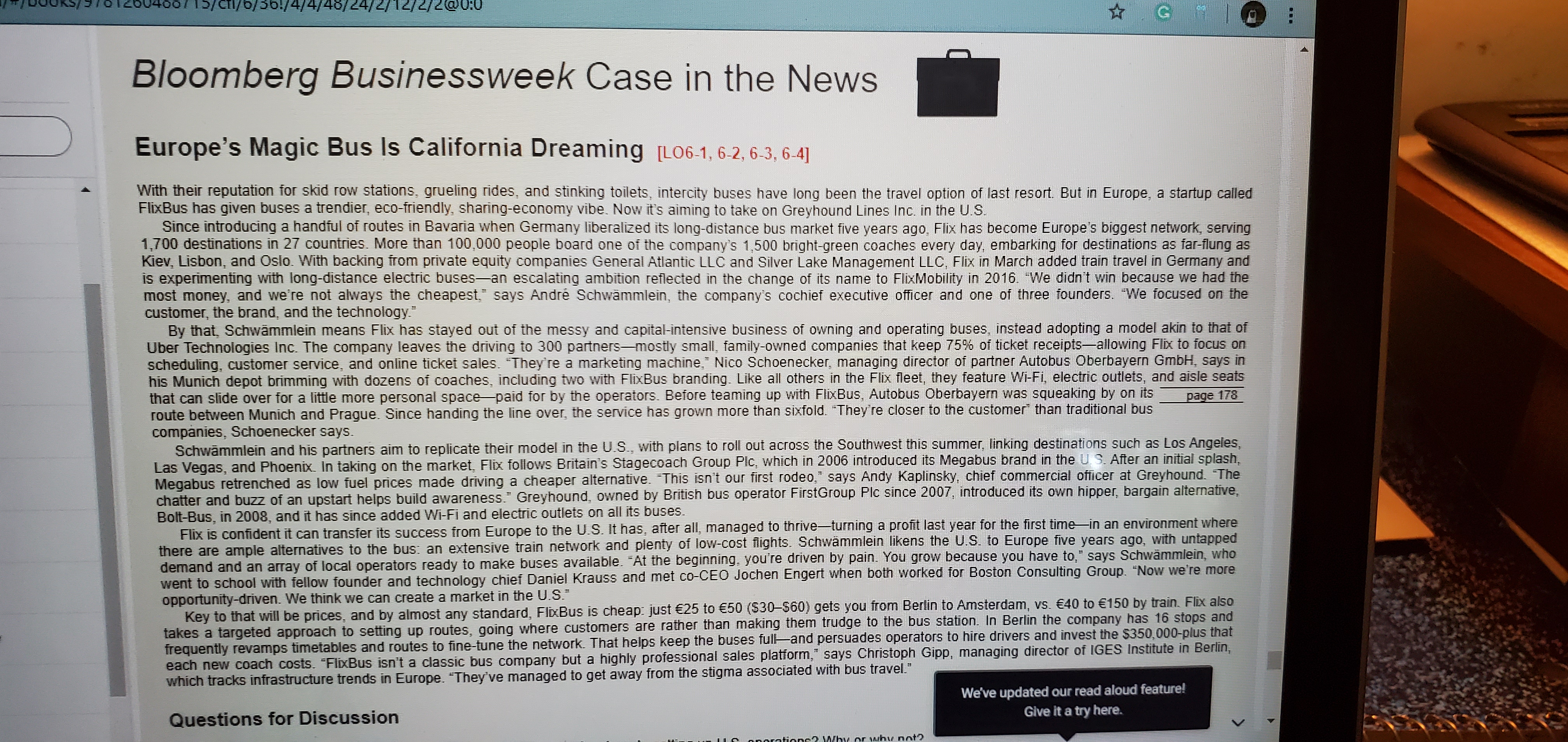
/ CT1/6/361/4/4/46/24/2/12/2/2@0:0 G Bloomberg Businessweek Case in the News Europe's Magic Bus Is California Dreaming [LOG-1, 6-2, 6-3, 6-4] With their reputation for skid row stations, grueling rides, and stinking toilets, intercity buses have long been the travel option of last resort. But in Europe, a startup called FlixBus has given buses a trendier, eco-friendly, sharing-economy vibe. Now it's aiming to take on Greyhound Lines Inc. in the U.S Since introducing a handful of routes in Bavaria when Germany liberalized its long-distance bus market five years ago, Flix has become Europe's biggest network, serving 1,700 destinations in 27 countries. More than 100,000 people board one of the company's 1,500 bright-green coaches every day, embarking for destinations as far-flung as Kiev, Lisbon, and Oslo. With backing from private equity companies General Atlantic LLC and Silver Lake Management LLC, Flix in March added train travel in Germany and is experimenting with long-distance electric buses-an escalating ambition reflected in the change of its name to FlixMobility in 2016. We didn't win because we had the most money, and we're not always the cheapest, says Andre Schwammlein, the company's cochief executive officer and one of three founders. "We focused on the customer, the brand, and the technology." By that, Schwammlein means Flix has stayed out of the messy and capital-intensive business of owning and operating buses, instead adopting a model akin to that of Uber Technologies Inc. The company leaves the driving to 300 partners-mostly small, family-owned companies that keep 75% of ticket receipts-allowing Flix to focus on scheduling, customer service, and online ticket sales. "They're a marketing machine,"Nico Schoenecker, managing director of partner Autobus Oberbayern GmbH, says in his Munich depot brimming with dozens of coaches, including two with FlixBus branding. Like all others in the Flix fleet, they feature Wi-Fi, electric outlets, and aisle seats that can slide over for a little more personal space-paid for by the operators. Before teaming up with FlixBus, Autobus Oberbayern was squeaking by on its route between Munich and Prague. Since handing the line over, the service has grown more than sixfold. "They're closer to the customer than traditional bus page 178 companies, Schoenecker says. Schwammlein and his partners aim to replicate their model in the U.S., with plans to roll out across the Southwest this summer, linking destinations such as Los Angeles, Las Vegas, and Phoenix. In taking on the market, Flix follows Britain's Stagecoach Group Pic, which in 2006 introduced its Megabus brand in the U. S. After an initial splash, Megabus retrenched as low fuel prices made driving a cheaper alternative. "This isn't our first rodeo, says Andy Kaplinsky, chief commercial officer at Greyhound. "The chatter and buzz of an upstart helps build awareness." Greyhound, owned by British bus operator FirstGroup Plc since 2007, introduced its own hipper, bargain alternative, Bolt-Bus, in 2008, and it has since added Wi-fi and electric outlets on all its buses. Flix is confident it can transfer its success from Europe to the U.S. It has, after all, managed to thrive-turning a profit last year for the first time-in an environment where there are ample alternatives to the bus: an extensive train network and plenty of low-cost flights. Schwammlein likens the U.S. to Europe five years ago, with untapped demand and an array of local operators ready to make buses available. "At the beginning, you're driven by pain. You grow because you have to," says Schwammlein, who went to school with fellow founder and technology chief Daniel Krauss and met co-CEO Jochen Engert when both worked for Boston Consulting Group. "Now we're more opportunity-driven. We think we can create a market in the U.S." Key to that will be prices, and by almost any standard, FlixBus is cheap: just E25 to E50 ($30-$60) gets you from Berlin to Amsterdam, vs. E40 to E150 by train. Flix also takes a targeted approach to setting up routes, going where customers are rather than making them trudge to the bus station. In Berlin the company has 16 stops and frequently revamps timetables and routes to fine-tune the network. That helps keep the buses full-and persuades operators to hire drivers and invest the $350,000-plus that each new coach costs. "FlixBus isn't a classic bus company but a highly professional sales platform," says Christoph Gipp, managing director of IGES Institute in Berlin, which tracks infrastructure trends in Europe. "They've managed to get away from the stigma associated with bus travel." We've updated our read aloud feature! Questions for Discussion Give it a try here.Point last year for the first time-in Inetwork and plenty of low-cost flights. Schwammlein likens the U.S. to Europe five year demand and an array of local operators ready to make buses available. "At the beginning, you're driven by pain. You grow because you have to, say went to school with fellow founder and technology chief Daniel Krauss and met co-CEO Jochen Engert when both worked for Boston Consulting Gro opportunity-driven. We think we can create a market in the U.S." Key to that will be prices, and by almost any standard, FlixBus is cheap: just









 Study Help