







Question: Please read the article in the PDF What Is Design Thinking and Why Is It So Popular? By Rikke Dam and Teo Siang answer the
Please read the article in the PDF What Is Design Thinking and Why Is It So Popular? By Rikke Dam and Teo Siang answer the following questions:
Dam, Rikke, and Teo Siang. What Is Design Thinking and Why Is It So Popular?
Summary:
- Describe the problem the authors are trying to address.
2. What are the research questions?
3. What is the impact of the research study?
4. Which methodology do the researchers use?
- Critique the article on its contribution to understanding leadership and the design thinking process.
- Include at least five examples of alignment or critique of the article based on the content from Lesson 4.
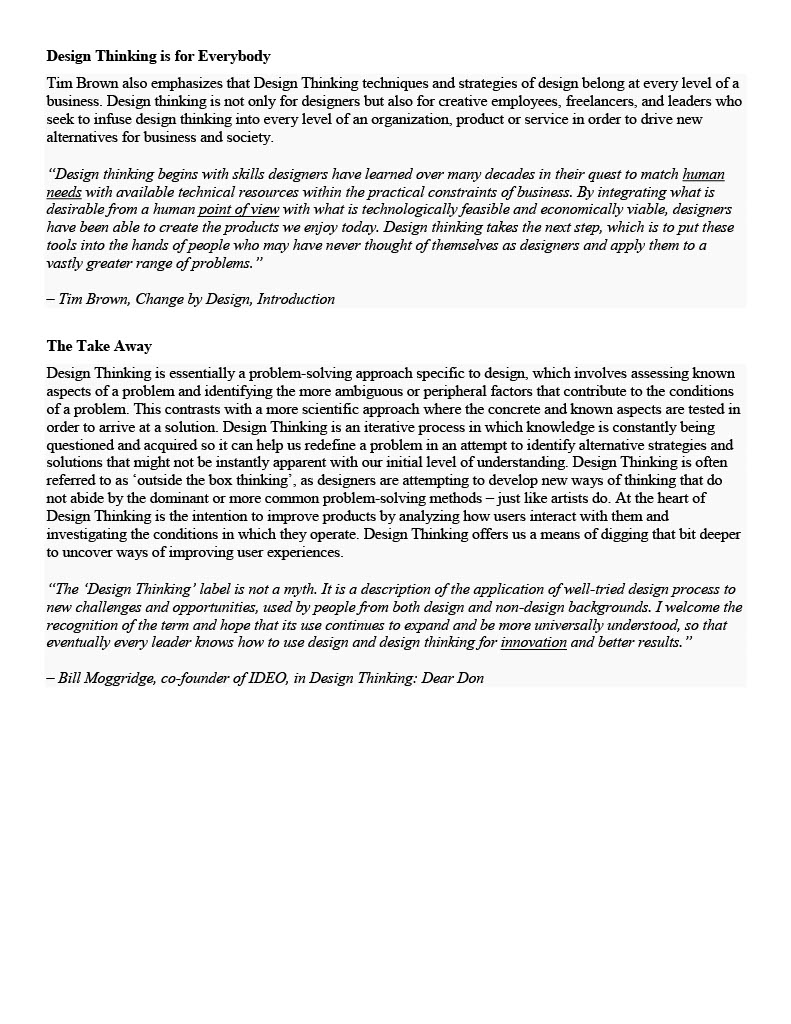
Design Thinking is for Everybody Tim Brown also emphasizes that Design Thinking techniques and strategies of design belong at every level of a business. Design thinking is not only for designers but also for creative employees, freelancers, and leaders who seek to infuse design thinking into every level of an organization, product or service in order to drive new alternatives for business and society. "Design thinking begins with skills designers have learned over many decades in their quest to match human needs with available technical resources within the practical constraints of business. By integrating what is desirable from a human point of view with what is technologically feasible and economically viable, designers have been able to create the products we enjoy today. Design thinking takes the next step, which is to put these tools into the hands of people who may have never thought of themselves as designers and apply them to a vastly greater range of problems." - Tim Brown, Change by Design, Introduction The Take Away Design Thinking is essentially a problem-solving approach specific to design, which involves assessing known aspects of a problem and identifying the more ambiguous or peripheral factors that contribute to the conditions of a problem. This contrasts with a more scientific approach where the concrete and known aspects are tested in order to arrive at a solution. Design Thinking is an iterative process in which knowledge is constantly being questioned and acquired so it can help us redefine a problem in an attempt to identify alternative strategies and solutions that might not be instantly apparent with our initial level of understanding. Design Thinking is often referred to as 'outside the box thinking', as designers are attempting to develop new ways of thinking that do not abide by the dominant or more common problem-solving methods - just like artists do. At the heart of Design Thinking is the intention to improve products by analyzing how users interact with them and investigating the conditions in which they operate. Design Thinking offers us a means of digging that bit deeper to uncover ways of improving user experiences. "The 'Design Thinking' label is not a myth. It is a description of the application of well-tried design process to new challenges and opportunities, used by people from both design and non-design backgrounds. I welcome the recognition of the term and hope that its use continues to expand and be more universally understood, so that eventually every leader knows how to use design and design thinking for innovation and better results." - Bill Moggridge, co-founder of IDEO, in Design Thinking: Dear Don
Step by Step Solution
There are 3 Steps involved in it

Get step-by-step solutions from verified subject matter experts
 Study Help