







Question: Please read the article then provide a unique clear answer for the following questions Albert Heijn customers driving force behind logistics chain at the till
Please read the article then provide a unique clear answer for the following questions
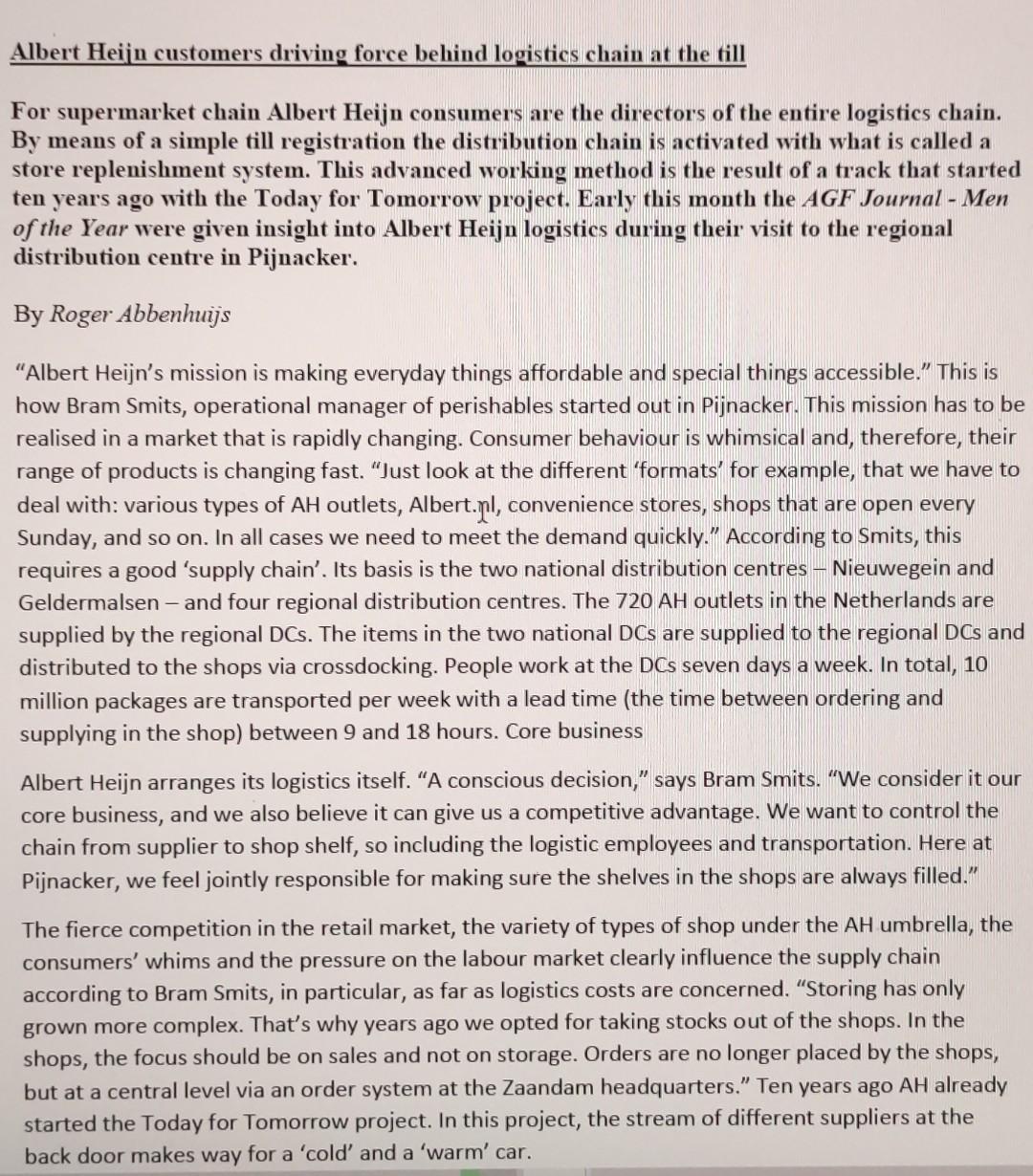
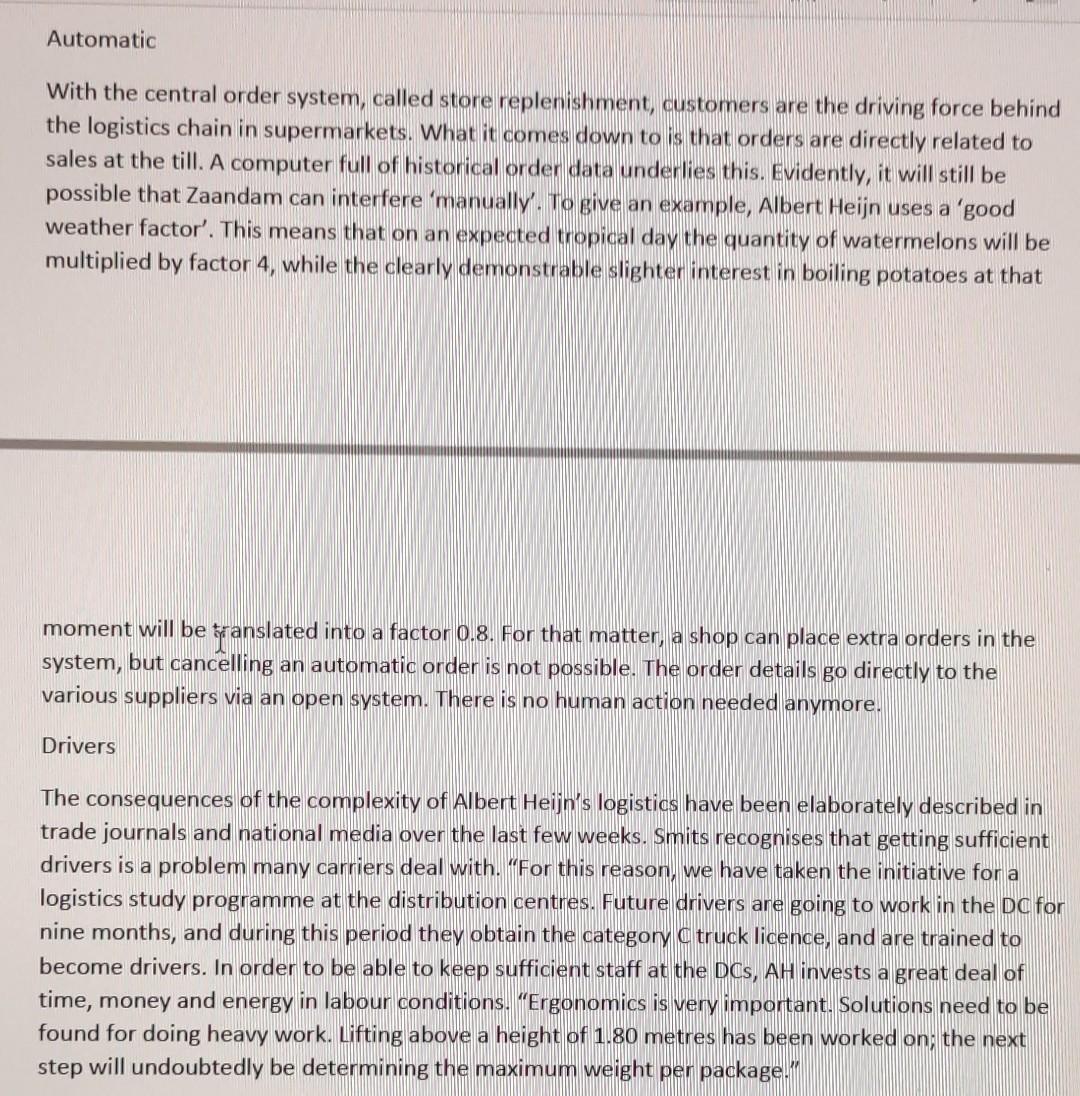
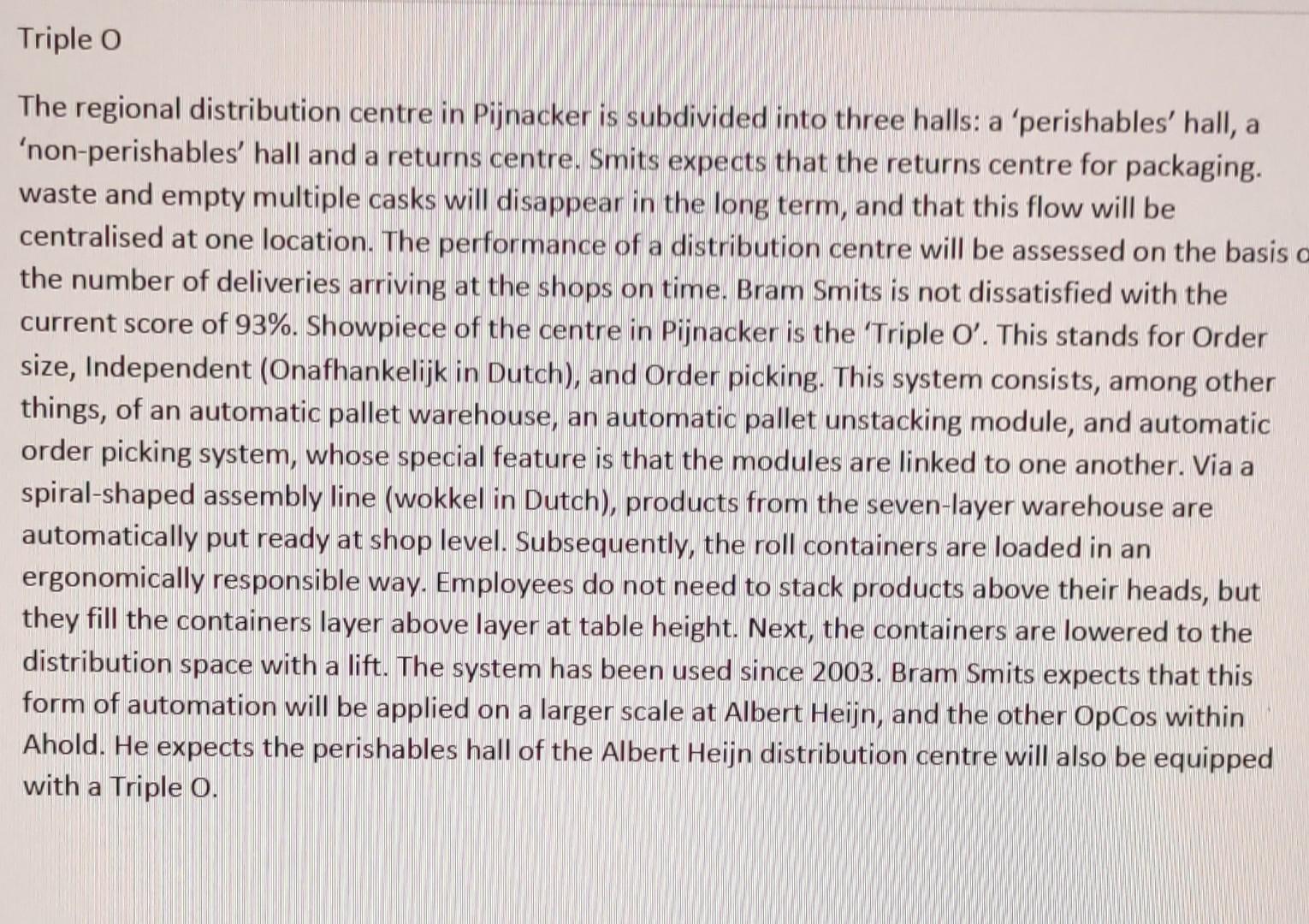
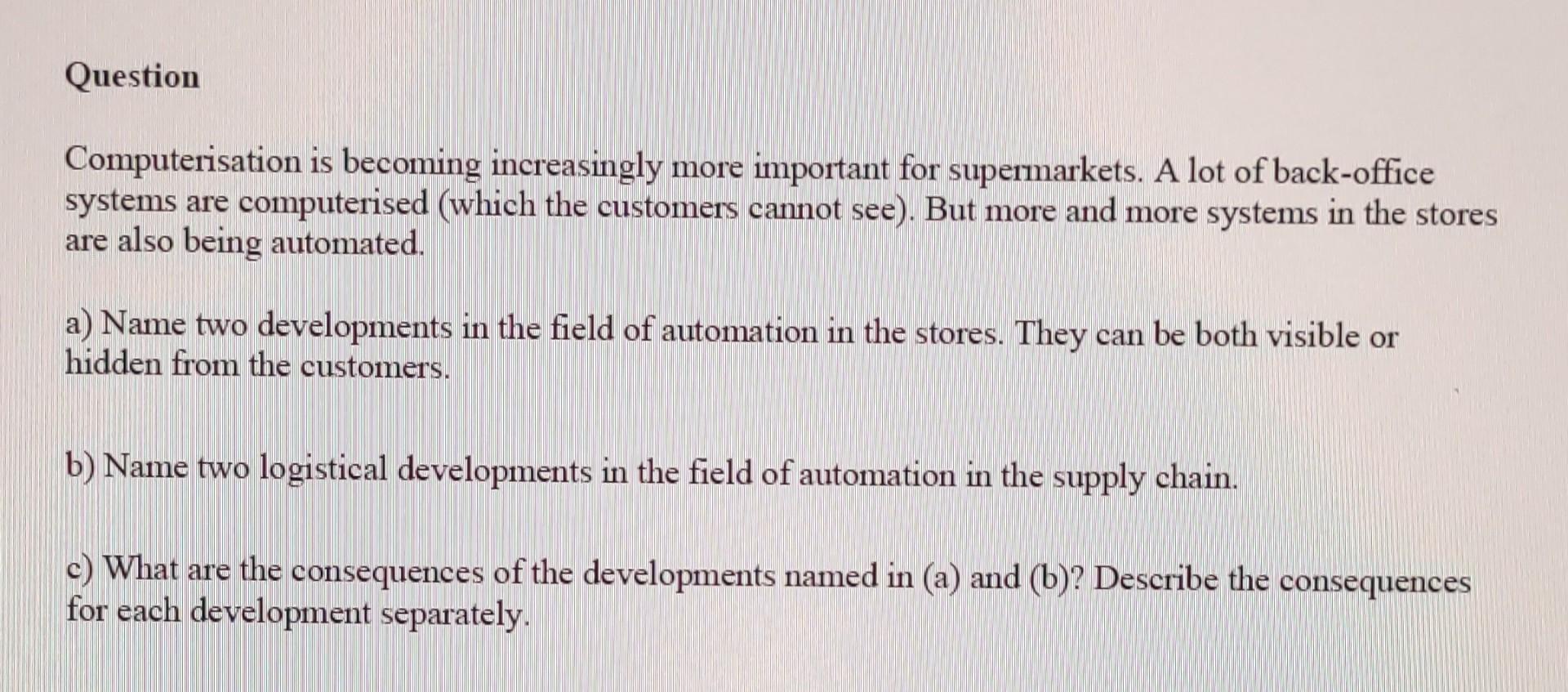
Albert Heijn customers driving force behind logistics chain at the till For supermarket chain Albert Heijn consumers are the directors of the entire logistics chain. By means of a simple till registration the distribution chain is activated with what is called a store replenishment system. This advanced working method is the result of a track that started ten years ago with the Today for Tomorrow project. Early this month the AGF Journal - Men of the Year were given insight into Albert Heijn logistics during their visit to the regional distribution centre in Pijnacker. By Roger Abbenhuijs "Albert Heijn's mission is making everyday things affordable and special things accessible. This is how Bram Smits, operational manager of perishables started out in Pijnacker. This mission has to be realised in a market that is rapidly changing. Consumer behaviour is whimsical and, therefore, their range of products is changing fast. "Just look at the different formats' for example, that we have to deal with: various types of AH outlets, Albert.nl, convenience stores, shops that are open every Sunday, and so on. In all cases we need to meet the demand quickly.' According to Smits, this requires a good supply chain'. Its basis is the two national distribution centres - Nieuwegein and Geldermalsen - and four regional distribution centres. The 720 AH outlets in the Netherlands are supplied by the regional DCs. The items in the two national DCs are supplied to the regional DCs and distributed to the shops via crossdocking. People work at the DCs seven days a week. In total, 10 million packages are transported per week with a lead time (the time between ordering and supplying in the shop) between 9 and 18 hours. Core business Albert Heijn arranges its logistics itself. A conscious decision," says Bram Smits. "We consider it our core business, and we also believe it can give us a competitive advantage. We want to control the chain from supplier to shop shelf, so including the logistic employees and transportation. Here at Pijnacker, we feel jointly responsible for making sure the shelves in the shops are always filled." The fierce competition in the retail market, the variety of types of shop under the AH umbrella, the consumers' whims and the pressure on the labour market clearly influence the supply chain according to Bram Smits, in particular, as far as logistics costs are concerned. "Storing has only grown more complex. That's why years ago we opted for taking stocks out of the shops. In the shops, the focus should be on sales and not on storage. Orders are no longer placed by the shops, but at a central level via an order system at the Zaandam headquarters." Ten years ago AH already started the Today for Tomorrow project. In this project, the stream of different suppliers at the back door makes way for a 'cold' and a 'warm' car. Automatic With the central order system, called store replenishment, customers are the driving force behind the logistics chain in supermarkets. What it comes down to is that orders are directly related to sales at the till. A computer full of historical order data underlies this. Evidently, it will still be possible that Zaandam can interfere 'manually'. To give an example, Albert Heijn uses a 'good weather factor'. This means that on an expected tropical day the quantity of watermelons will be multiplied by factor 4, while the clearly demonstrable slighter interest in boiling potatoes at that moment will be manslated into a factor 0.8. For that matter, a shop can place extra orders in the system, but cancelling an automatic order is not possible. The order details go directly to the various suppliers via an open system. There is no human action needed anymore. Drivers The consequences of the complexity of Albert Heijn's logistics have been elaborately described in trade journals and national media over the last few weeks. Smits recognises that getting sufficient drivers is a problem many carriers deal with. "For this reason, we have taken the initiative for a logistics study programme at the distribution centres. Future drivers are going to work in the DC for nine months, and during this period they obtain the category truck licence, and are trained to become drivers. In order to be able to keep sufficient staff at the DCs, AH invests a great deal of time, money and energy in labour conditions. Ergonomics is very important. Solutions need to be found for doing heavy work. Lifting above a height of 1.80 metres has been worked on; the next step will undoubtedly be determining the maximum weight per package.|| Triple 0 a The regional distribution centre in Pijnacker is subdivided into three halls: a 'perishables' hall, a 'non-perishables' hall and a returns centre. Smits expects that the returns centre for packaging. waste and empty multiple casks will disappear in the long term, and that this flow will be centralised at one location. The performance of a distribution centre will be assessed on the basis a the number of deliveries arriving at the shops on time. Bram Smits is not dissatisfied with the current score of 93%. Showpiece of the centre in Pijnacker is the 'Triple O'. This stands for Order size, Independent (Onafhankelijk in Dutch), and Order picking. This system consists, among other things, of an automatic pallet warehouse, an automatic pallet unstacking module, and automatic order picking system, whose special feature is that the modules are linked to one another. Via a spiral-shaped assembly line (wokkel in Dutch), products from the seven-layer warehouse are automatically put ready at shop level. Subsequently, the roll containers are loaded in an ergonomically responsible way. Employees do not need to stack products above their heads, but they fill the containers layer above layer at table height. Next, the containers are lowered to the distribution space with a lift. The system has been used since 2003. Bram Smits expects that this form of automation will be applied on a larger scale at Albert Heijn, and the other OpCos within Ahold. He expects the perishables hall of the Albert Heijn distribution centre will also be equipped with a Triple 0. Question Computerisation is becoming increasingly more important for supermarkets. A lot of back-office systems are computerised (which the customers cannot see). But more and more systems in the stores are also being automated. a) Name two developments in the field of automation in the stores. They can be both visible or hidden from the customers. b) Name two logistical developments in the field of automation in the supply chain. c) What are the consequences of the developments named in (a) and (b)? Describe the consequences for each development separatelyStep by Step Solution
There are 3 Steps involved in it
1 Expert Approved Answer
Step: 1 Unlock

Question Has Been Solved by an Expert!
Get step-by-step solutions from verified subject matter experts
Step: 2 Unlock
Step: 3 Unlock
 Study Help