Question: PLEASE READ THE ATTACHED ARTICLE AND WRITE A REVIEW NOT EXCEEDING 800 WORDS. ARTICLE TOPIC: Consumer Behavior The influence of family in the decision making
PLEASE READ THE ATTACHED ARTICLE AND WRITE A REVIEW NOT EXCEEDING 800 WORDS.
ARTICLE TOPIC: Consumer Behavior The influence of family in the decision making of household items purchase
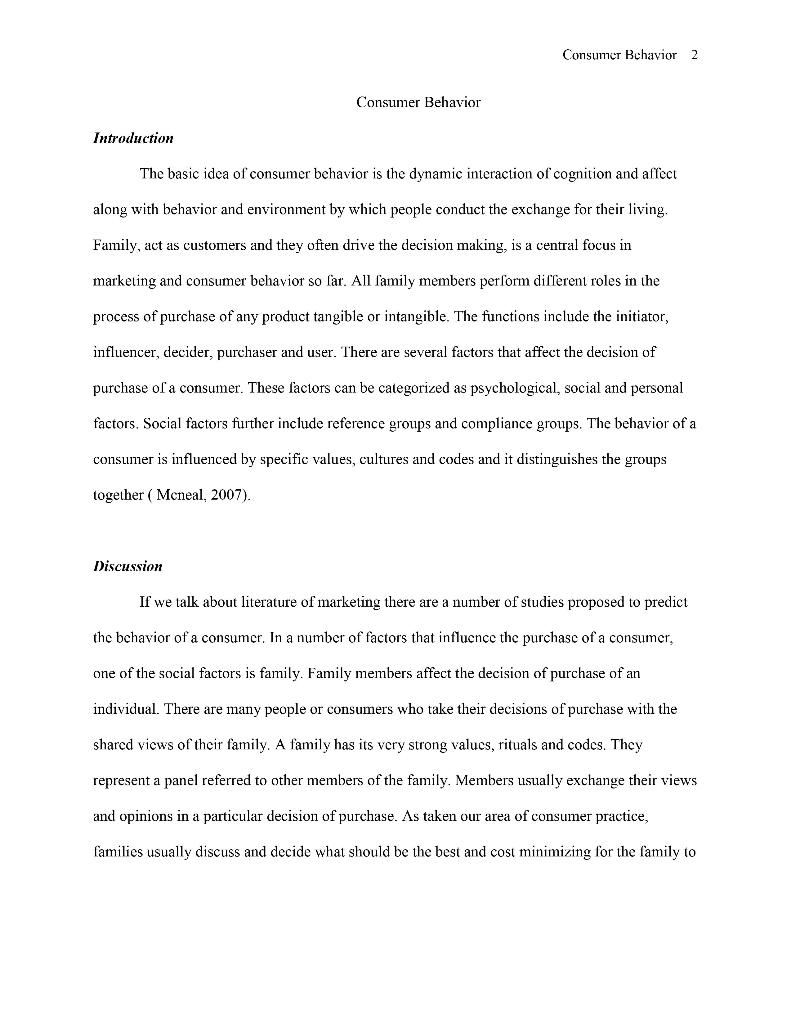
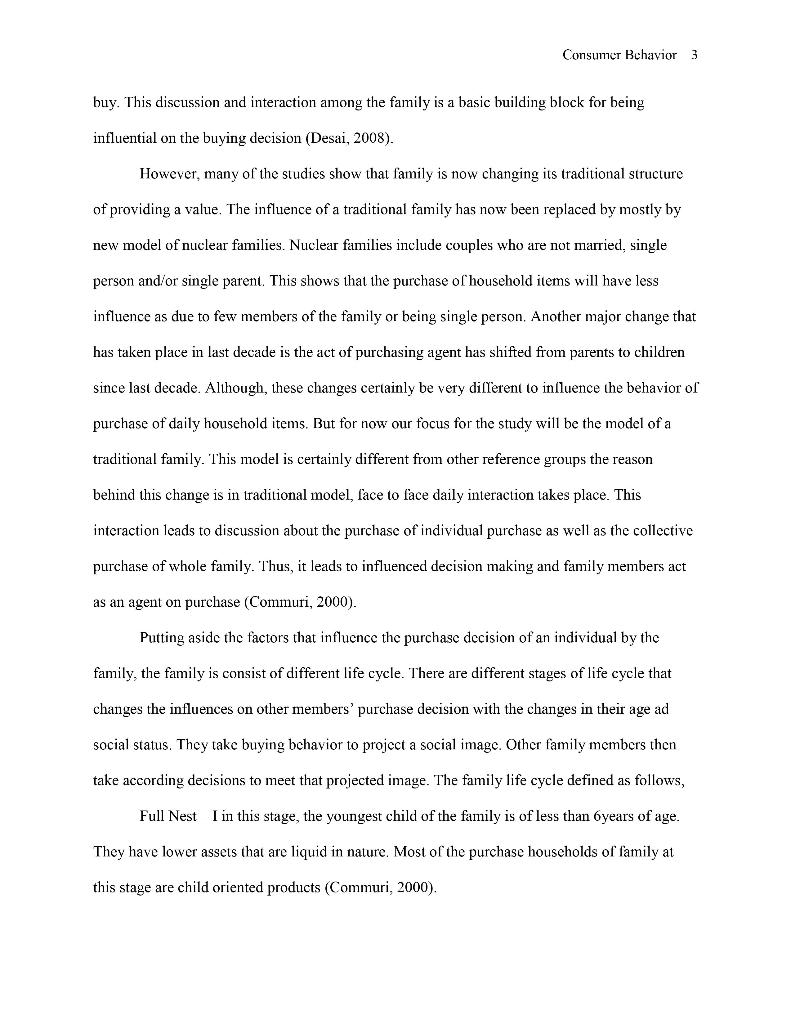
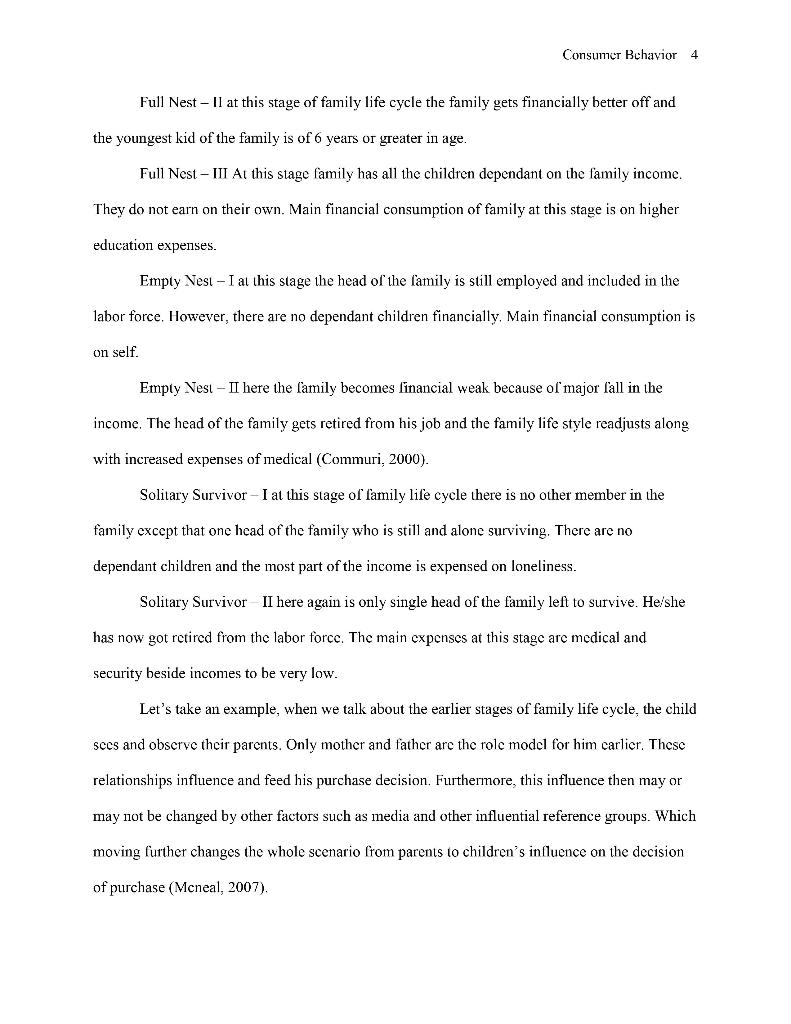
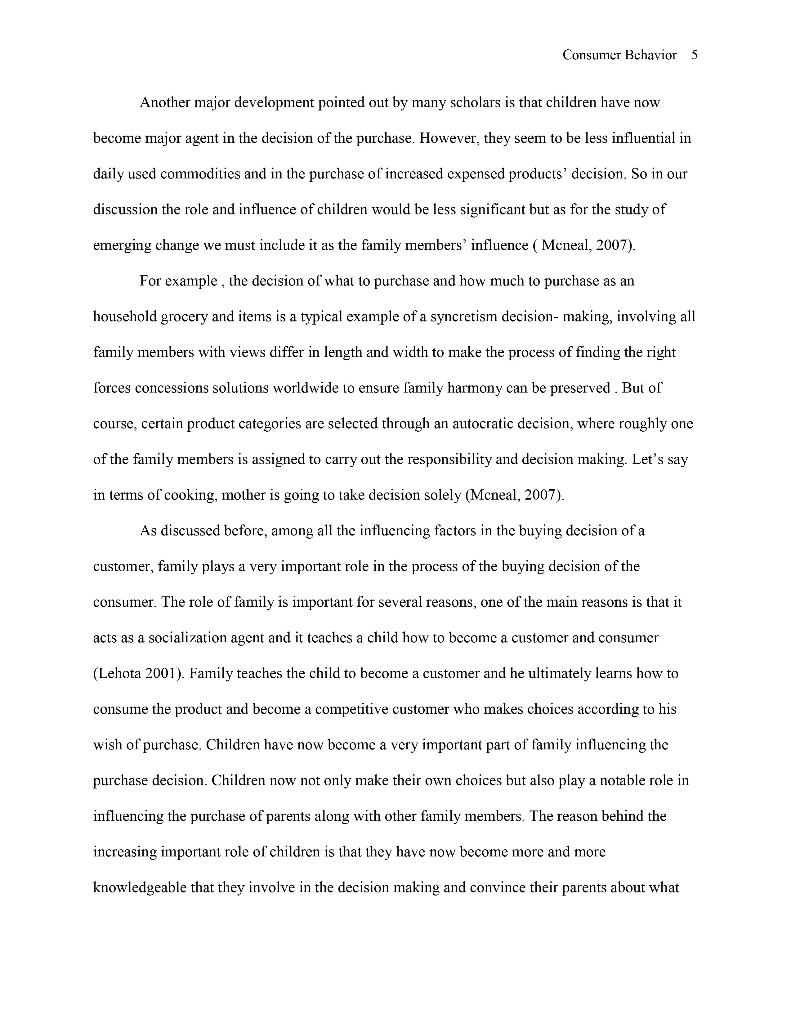
Consumer Behavior 2 Consumer Behavior Introduction The basic idea of consumer behavior is the dynamic interaction of cognition and affect along with behavior and environment by which people conduct the exchange for their living. Family, act as customers and they often drive the decision making, is a central focus in marketing and consumer behavior so far. All family members perform different roles in the process of purchase of any product tangible or intangible. The functions include the initiator, influencer, decider, purchaser and user. There are several factors that affect the decision of purchase of a consumer. These factors can be categorized as psychological, social and personal factors. Social factors further include reference groups and compliance groups. The behavior of a consumer is influenced by specific values, cultures and codes and it distinguishes the groups together (Meneal, 2007). Discussion If we talk about literature of marketing there are a number of studies proposed to predict the behavior of a consumer. In a number of factors that influence the purchase of a consumer, one of the social factors is family. Family members affect the decision of purchase of an individual. There are many people or consumers who take their decisions of purchase with the shared vicws of their family. A family has its very strong values, rituals and codes. They represent a panel referred to other members of the family. Members usually exchange their views and opinions in a particular decision of purchase. As taken our area of consumer practice, families usually discuss and decide what should be the best and cost minimizing for the family to Consumer Behavior 3 buy. This discussion and interaction among the family is a basic building block for being influential on the buying decision (Desai, 2008). However, many of the studies show that family is now changing its traditional structure of providing a value. The influence of a traditional family has now been replaced by mostly by new model of nuclear families. Nuclear families include couples who are not married, single person and/or single parent. This shows that the purchase of household items will have less influence as due to few members of the family or being single person. Another major change that has taken place in last decade is the act of purchasing agent has shifted from parents to children since last decade. Although, these changes certainly be very different to influence the behavior of purchase of daily household items. But for now our focus for the study will be the model of a traditional family. This model is certainly different from other reference groups the reason behind this change is in traditional model, face to face daily interaction takes place. This interaction leads to discussion about the purchase of individual purchase as well as the collective purchase of whole family. Thus, it leads to influenced decision making and family members act as an agent on purchase (Commuri, 2000). Putting aside the factors that influence the purchase decision of an individual by the family, the family is consist of different life cycle. There are different stages of life cycle that changes the influences on other members' purchase decision with the changes in their age ad social status. They take buying behavior to project a social image. Other family members then take according decisions to meet that projected image. The family life cycle defined as follows, Full Nest I in this stage, the youngest child of the family is of less than 6 years of age. They have lower assets that are liquid in nature. Most of the purchase households of family at this stage are child oriented products (Commuri, 2000). Consumer Behavior 4 Full Nest - 11 at this stage of family life cycle the family gets financially better off and the youngest kid of the family is of 6 years or greater in age. Full Nest - III At this stage family has all the children dependant on the family income. They do not earn on their own. Main financial consumption of family at this stage is on higher education expenses. Empty Nest - I at this stage the head of the family is still employed and included in the labor force. However, there are no dependant children financially, Main financial consumption is on self. Empty Nest - II here the family becomes linancial weak because of major fall in the income. The head of the family gets retired from his job and the family life style readjusts along with increased expenses of medical (Commuri, 2000). Solitary Survivor - I at this stage of family life cycle there is no other member in the family except that one head of the family who is still and alone surviving. There are no dependant children and the most part of the income is expensed on loneliness. Solitary Survivor II here again is only single head of the family left to survive. He/she has now got retired from the labor force. The main expenses at this stage are medical and security beside incomes to be very low. Let's take an example, when we talk about the earlier stages of family life cycle, the child secs and observe their parents. Only mother and father are the role model for him carlier. These relationships influence and feed his purchase decision. Furthermore, this influence then may or may not be changed by other factors such as media and other influential reference groups. Which moving further changes the whole scenario from parents to children's influence on the decision of purchase (Mcneal, 2007). Consumer Behavior 5 Another major development pointed out by many scholars is that children have now become major agent in the decision of the purchase. However, they seem to be less influential in daily used commodities and in the purchase of increased expensed products' decision. So in our discussion the role and influence of children would be less significant but as for the study of emerging change we must include it as the family members' influence ( Mcneal, 2007). For example, the decision of what to purchase and how much to purchase as an household grocery and items is a typical example of a syncretism decision-making, involving all family members with views differ in length and width to make the process of finding the right forces concessions solutions worldwide to ensure family harmony can be preserved. But of course, certain product categories are selected through an autocratic decision, where roughly one of the family members is assigned to carry out the responsibility and decision making. Let's say in terms of cooking, mother is going to take decision solely (Mcneal, 2007). As discussed before, among all the influencing factors in the buying decision of a customer, family plays a very important role in the process of the buying decision of the consumer. The role of family is important for several reasons, one of the main reasons is that it acts as a socialization agent and it teaches a child how to become a customer and consumer (Lehota 2001). Family teaches the child to become a customer and he ultimately learns how to consume the product and become a competitive customer who makes choices according to his wish of purchase. Children have now become a very important part of family influencing the purchase decision. Children now not only make their own choices but also play a notable role in influencing the purchase of parents along with other family members. The reason behind the increasing important role of children is that they have now become more and more knowledgeable that they involve in the decision making and convince their parents about what Consumer Behavior 6 and how to buy and how that purchase is beneficial. They have now become an influencer along with consumers since last few decades (Trcsik 2007) However, beside all the studies shown and tested before, it is also a factor to be considered that parents still play key role in making and bring their child to this level of becoming a competitive buyer. They facilitate their child with enough knowledge and along provide them finance to make them potential buyers. By children become individual and independent buyer, the kindergarten market has also expended. Thus, the size of market for children is also increasing (McNeal 2007). Other than this, the relationships and their influence is also rapidly changing in a family thus, effecting the decision making of purchase. The families now live in more liberal sprits. In the whole process of purchase and the decision making children have taken a significant role to be considered along with the changing role of men and women. If we talk about the purchase of general household items, the influence of children make parents to go for the decision of what children influence for, Putting up a toy car in the bottle of cooking oil can make a significant impact on the purchase of that cooking oil. However, a child has nothing to do with that of cooking oil (Desai, 2008). However, the studies have proved that the role of family is changing but still family has been the most influential factor for the decision of purchase. Many authors have tried to identify the dynamics of decisions taken by family (Aribarg 2002, Arora s Allenby 1999, Seetharaman 1999, SU 2003, Ward 2006). Although when we talk about the decision making the role of family is analyzed from many different point of views, which include economical (Becker 1974), general roles ( Pollay 1968, Scanzoni , 1977, Qualls 1988), and social ( Sprey, 1979). Furthermore, there are many authors who has tried to examine the influence of family in terms gender ( Davis, 1970, 1971, 1976, Davis- Rigaux 1974, Filiatrault and Brent 1980, Spiro 1983, Consumer Behavior 7 Cosenza 1985 Corfman 1991, Ward, 2005). It is futher said that the level of significance of family's influence depends on various factors, such as the contributions of spouse to the purchase decision of households (Blood and Wolfe, 1960). It is also cited that the culture and tradition of the family can also be influential in the process of decision making (Qualls, 1987). Keeping aside the above mentioned studies, Johnson et al. (1994) have identified the significance of children's role in the decision making process. Traditional studies have shown that the decision of family purchase is usually made on rational basis by taking account all the family members, without considering the effect of emotion influence of different influencing agents. This argument supports that the decision makers are not fully rational but in cases they may get influenced by the emotional factors (Gelles and Straus, 1979), Following are the delined traditional types of families, Married Couple: it is the simplest type of family which consists of husband and wife only Nuclear Family, it is the type of family which has husband and wife and at least one child along with them staying together. Extended Family: it is type of a nuclear family which has at least one grand parent. . Joint Family: A type of family where all the blood relations, spouses along with their kids live together. The new modes of family, we can categorize it in following ways, Consumer Behavior 8 Blended Tamily: A type of family in which one of the parent or both of the parents were previously married. Single Parent Family: A type of family where only one parent is present. The reason could be divorcc/scparation or death of one partner etc. . Unmarried Family, parents, although unmarried but living together, . Communal Family: a group of number of families living altogether and sharing responsibilities. There are many functions a family performs some of them are as under: It Provides Economic Well Being It Provides Emotional Support . It Provides Suitable Life Style It Provides Social Relationships . It Provides Morals and Ethical Values . It Provides Religious Values It Provides Interpersonal Skills Following are the defined family roles which influence the decision making in the purchase of household items accordingly, Initiator: initiator is the family member who is the first person to recognize the need of the purchase thus he is the one to start the purchase process. In the purchase of household items Consumer Behavior 9 let's say talking about traditional families usually mothers are the one to recognize what is required to purchase for the household. So mother lets say is the initiator in our particular area of purchase Influencer: influencer is the one who influences the decision in evaluating and selecting the alternatives. Again taking our area of practice let's say the alternatives are given by the children who are in their teens, who watch television commercials and who is aware of what new alternatives are available in the market. Decider: decider is the person in family who takes the final decision of what to purchase. This role of decider again comes to the mother or may be female members of the family who actually know what is better to use in order to get efficiency in the usage. Purchaser: purchaser is the member of family who actually purchase the items. In traditional families usually father or the head of the family is the one who perform the task of purchasing items. User: user is the ultimate consumer of the product. Following our area of practice, the user of household items is whole family in general (Desai, 2008). Consumer Behavior 10 Conclusion To conclude the topic I will discuss the basic idea of consumer behavior as the dynamic interaction of cognition and affect along with behavior and environment by which people conduct the aspects of exchange of their lives. There are many factors that influence the purchase of an individual or group of people. One of most important factor is family. Family act as the drive decision making is a central phenomenon in marketing and consumer behavior. Further we discussed many different studies and literature about how and why family is influential in the buying behavior of consumer. Hence, in the marketing literature there are a number of studies on the buying behavior of consumers, family members influence the purchasing decisions of consumers. Further more, we discussed that a more positive development proved by many newer studies is that several scholars mention children as a major driving force. We further defined what traditional family types are along with new modes of family. Both the types include Married Couple, Nuclear Tamily, Extended Family, Joint Family, Blended Family, Single Parent Family, Unmarried Family, and Communal Family. Moreover, there are many of the functions performed by family for the betterment of all the members of family. At the end we discussed roles performed by the family members at the time of decision making in the purchase of household items. The roles included initiator, influencer, decider, purchaser, and user. The area of consumer practice we selected was the purchase of households' items. We discussed different roles of how family is influential in purchase of household items









 Study Help