Question: Please read the attached case and answer in PISCO model method. Thank you for your help! PROBLEM: Identify and state the actual problem presented in
Please read the attached case and answer in PISCO model method. Thank you for your help!
- PROBLEM: Identify and state the actual problem presented in the Case Study. The problem should be short and concise. (Do not include too many facts in this section. Use enough facts to clearly state the problem. Most of the case facts belong in the Input Section. Include just enough facts for the reader to understand the problem.)
- INPUT: Review the facts given in the case provided. Include all the facts that are needed to solve your problem. However, you need to restate the facts, do not copy the facts unless you quote it and properly cite.
- SOLUTIONS: Create at least 2 solutions to the case and conduct a SWOT analysis on each of your solutions. Highlight the words strengths, weaknesses, opportunities and threats (SWOT) when you write your SWOT analysis out. The Solutions area is where you will put the required 3 citations or quotes.
- CHOICE: Write a clear statement that reflects the best choice for change, empowerment, transformation, and/or solution in this case. The choice should be a short, like the problem statement. (Your argument for the choice should be in the Solution section and not the Choice section.)
- OPERATIONAL PLAN: Develop an action plan with at least 4 to 6 action steps. The operational plan are the next steps to be taken after a decision is made. This does not include the decision.
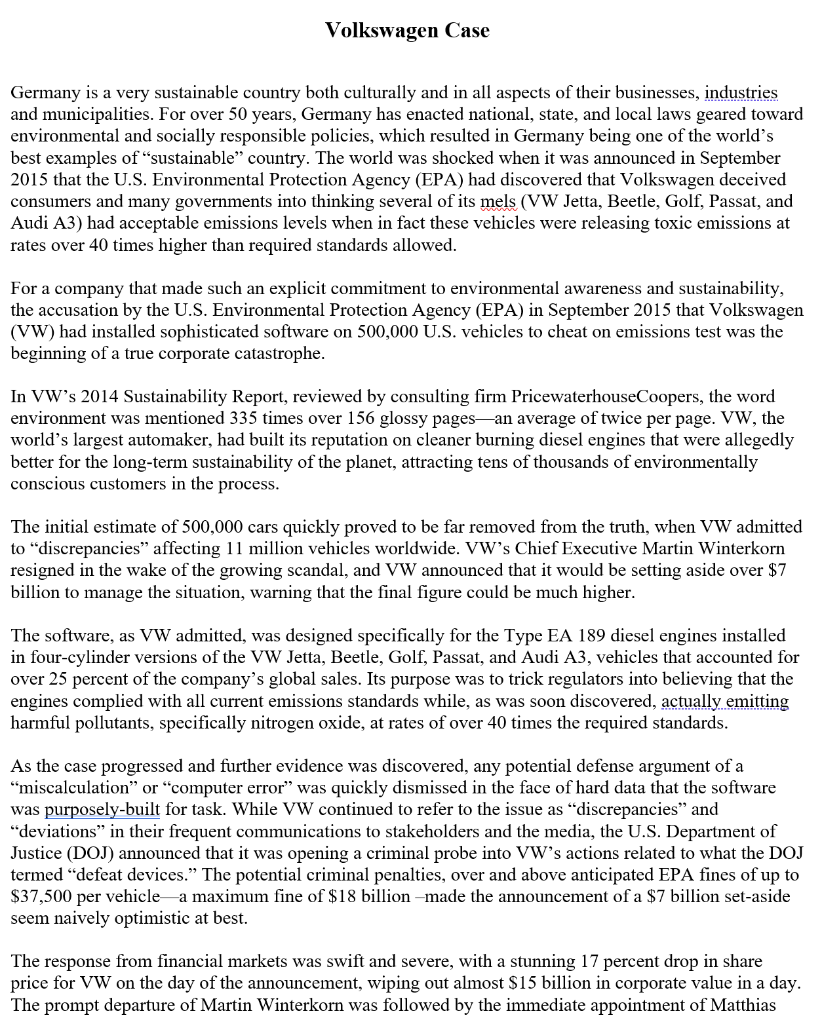
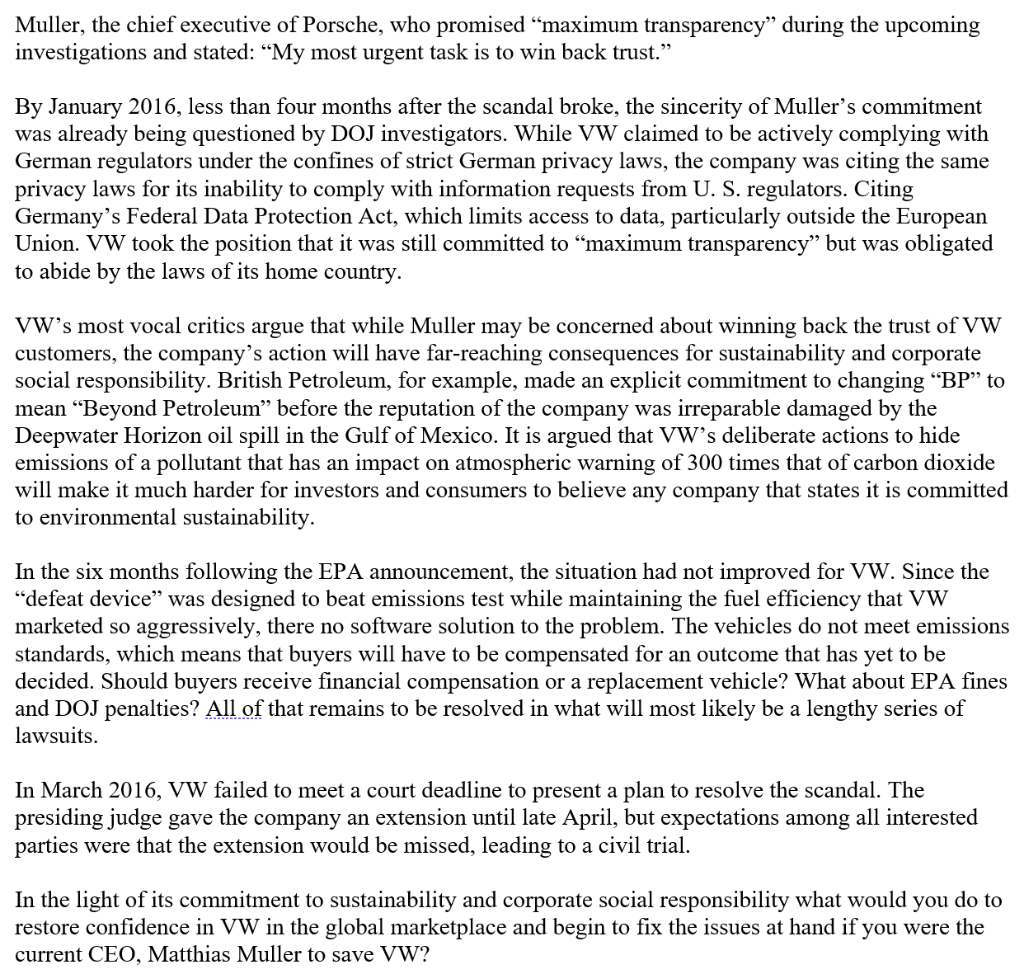
Volkswagen Case Germany is a very sustainable country both culturally and in all aspects of their businesses, industries and municipalities. For over 50 years, Germany has enacted national, state, and local laws geared toward environmental and socially responsible policies, which resulted in Germany being one of the world's best examples of sustainable country. The world was shocked when it was announced in September 2015 that the U.S. Environmental Protection Agency (EPA) had discovered that Volkswagen deceived consumers and many governments into thinking several of its mels (VW Jetta, Beetle, Golf, Passat, and Audi A3) had acceptable emissions levels when in fact these vehicles were releasing toxic emissions at rates over 40 times higher than required standards allowed. For a company that made such an explicit commitment to environmental awareness and sustainability, the accusation by the U.S. Environmental Protection Agency (EPA) in September 2015 that Volkswagen (VW) had installed sophisticated software on 500,000 U.S. vehicles to cheat on emissions test was the beginning of a true corporate catastrophe. In VW's 2014 Sustainability Report, reviewed by consulting firm PricewaterhouseCoopers, the word environment was mentioned 335 times over 156 glossy pagesan average of twice per page. VW, the world's largest automaker, had built its reputation on cleaner burning diesel engines that were allegedly better for the long-term sustainability of the planet, attracting tens of thousands of environmentally conscious customers in the process. The initial estimate of 500,000 cars quickly proved to be far removed from the truth, when VW admitted to "discrepancies affecting 11 million vehicles worldwide. VW's Chief Executive Martin Winterkorn resigned in the wake of the growing scandal, and VW announced that it would be setting aside over $7 billion to manage the situation, warning that the final figure could be much higher. The software, as VW admitted, was designed specifically for the Type EA 189 diesel engines installed in four-cylinder versions of the VW Jetta, Beetle, Golf, Passat, and Audi A3, vehicles that accounted for over 25 percent of the company's global sales. Its purpose was to trick regulators into believing that the engines complied with all current emissions standards while, as was soon discovered, actually emitting harmful pollutants, specifically nitrogen oxide, at rates of over 40 times the required standards. As the case progressed and further evidence was discovered, any potential defense argument of a miscalculation or computer error was quickly dismissed in the face of hard data that the software was purposely-built for task. While VW continued to refer to the issue as discrepancies and "deviations in their frequent communications to stakeholders and the media, the U.S. Department of Justice (DOJ) announced that it was opening a criminal probe into VW's actions related to what the DOJ termed "defeat devices." potential criminal penalties, over and above anticipated EPA fines of up to $37,500 per vehicle a maximum fine of $18 billion-made the announcement of a $7 billion set-aside seem naively optimistic at best. The response from financial markets was swift and severe, with a stunning 17 percent drop in share price for VW on the day of the announcement, wiping out almost $15 billion in corporate value in a day. The prompt departure of Martin Winterkorn was followed by the immediate appointment of Matthias Muller, the chief executive of Porsche, who promised maximum transparency during the upcoming investigations and stated: My most urgent task is to win back trust. By January 2016, less than four months after the scandal broke, the sincerity of Muller's commitment was already being questioned by DOJ investigators. While VW claimed to be actively complying with German regulators under the confines of strict German privacy laws, the company was citing the same privacy laws for its inability to comply with information requests from U. S. regulators. Citing Germany's Federal Data Protection Act, which limits access to data, particularly outside the European Union. VW took the position that it was still committed to maximum transparency but was obligated to abide by the laws of its home country. VW's most vocal critics argue that while Muller may be concerned about winning back the trust of VW customers, the company's action will have far-reaching consequences for sustainability and corporate social responsibility. British Petroleum, for example, made an explicit commitment to changing "BP" to mean Beyond Petroleum before the reputation of the company was irreparable damaged by the Deepwater Horizon oil spill in the Gulf of Mexico. It is argued that VW's deliberate actions to hide emissions of a pollutant that has an impact on atmospheric warning of 300 times that of carbon dioxide will make it much harder for investors and consumers to believe any company that states it is committed to environmental sustainability. In the six months following the EPA announcement, the situation had not improved for VW. Since the defeat device was designed to beat emissions test while maintaining the fuel efficiency that VW marketed so aggressively, there no software solution to the problem. The vehicles do not meet emissions standards, which means that buyers will have to be compensated for an outcome that has yet to be decided. Should buyers receive financial compensation or a replacement vehicle? What about EPA fines and DOJ penalties? All of that remains to be resolved in what will most likely be a lengthy series of lawsuits. In March 2016, VW failed to meet a court deadline to present a plan to resolve the scandal. The presiding judge gave the company an extension until late April, but expectations among all interested parties were that the extension would be missed, leading to a civil trial. In the light of its commitment to sustainability and corporate social responsibility what would you do to restore confidence in VW in the global marketplace and begin to fix the issues at hand if you were the current CEO, Matthias Muller to save VW









 Study Help