







Question: Please read the case study and answer the assignment questions in 400 words each. Thank you It was nearly lunchtime on April 17, 2016, and
Please read the case study and answer the assignment questions in 400 words each. Thank you
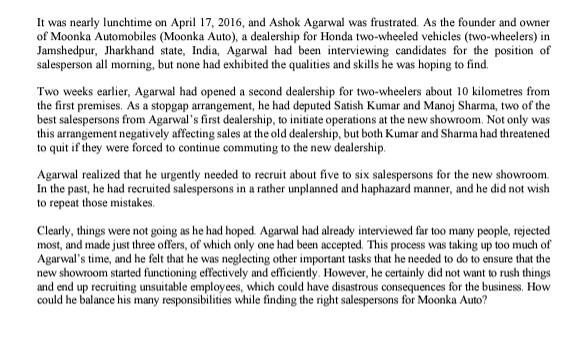
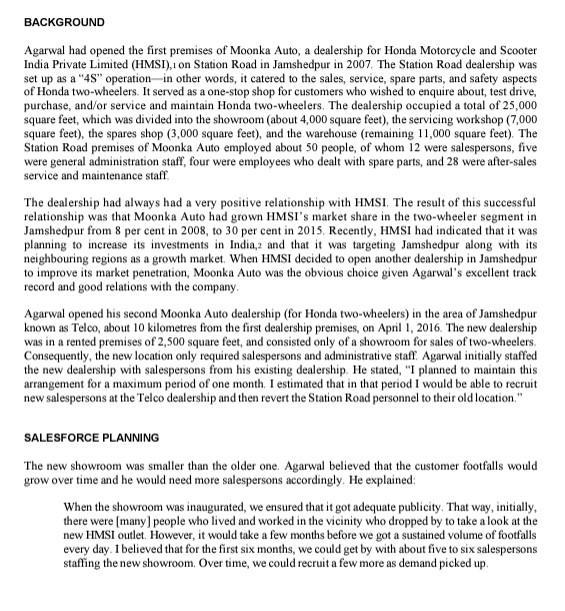
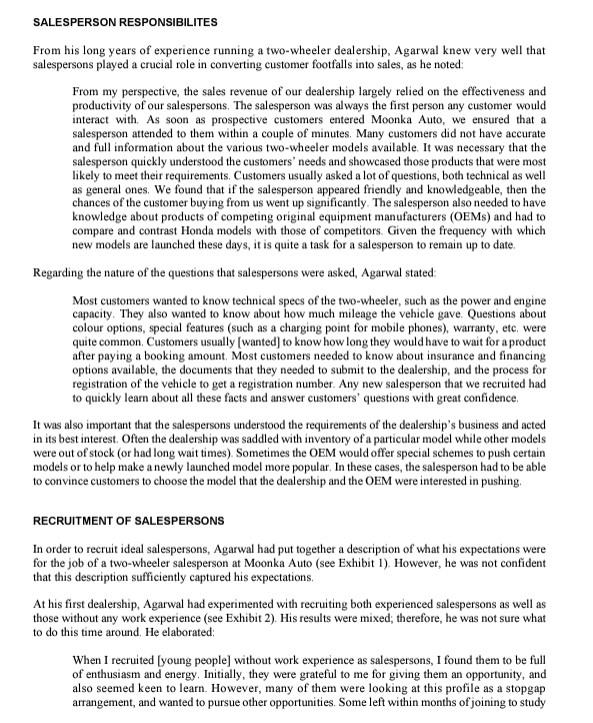
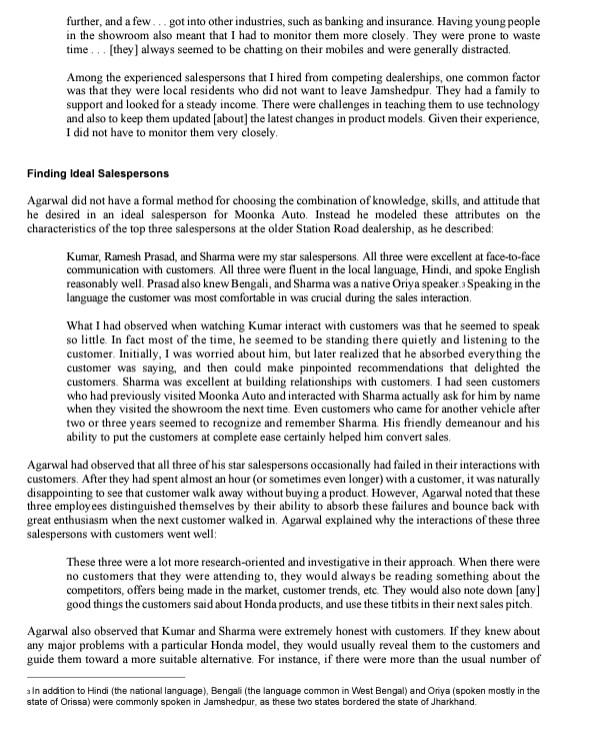
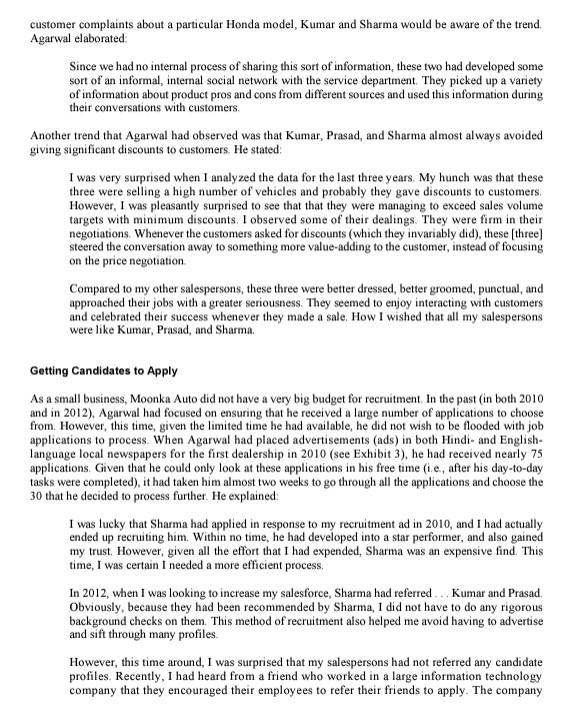
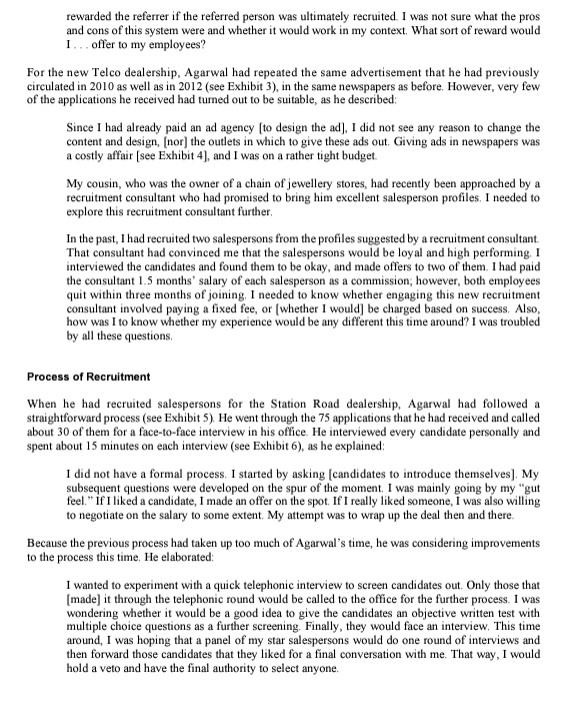
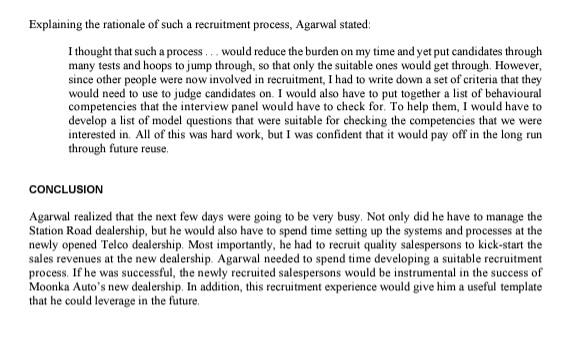
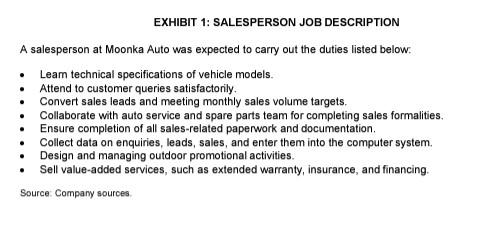
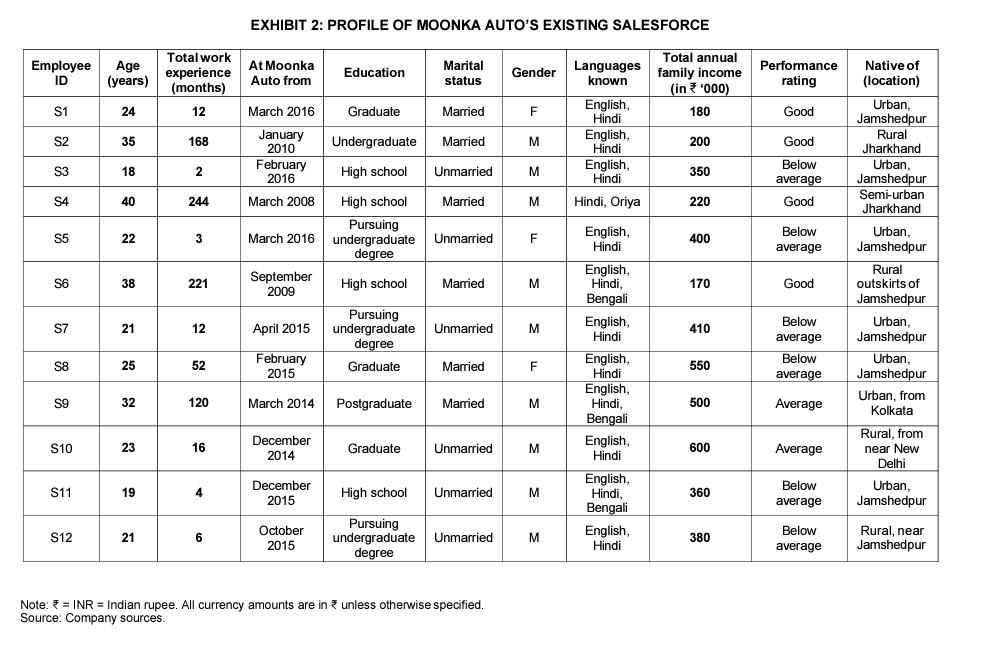
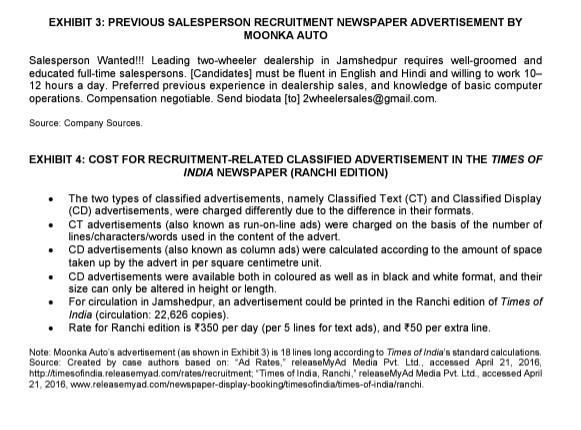
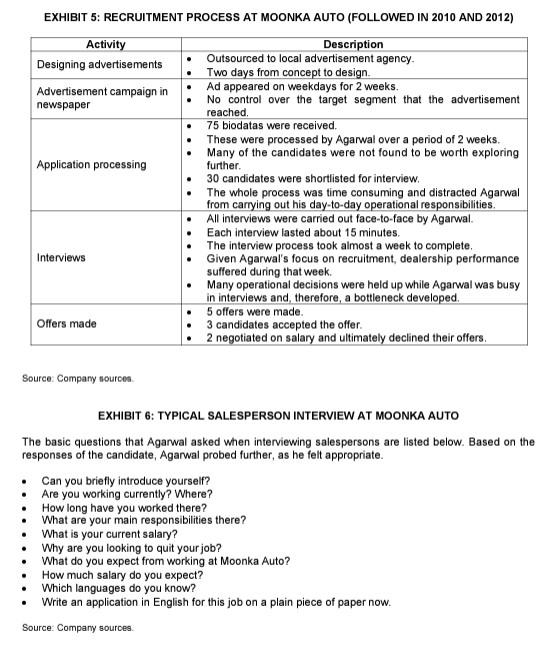
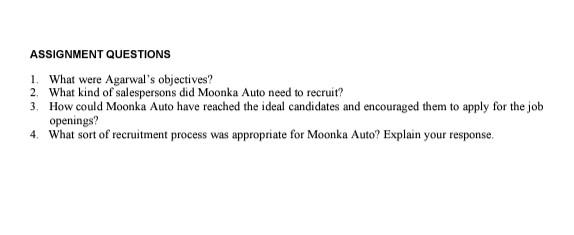
It was nearly lunchtime on April 17, 2016, and Ashok Agarwal was frustrated. As the founder and owner of Moonka Automobiles (Moonka Auto), a dealership for Honda two-wheeled vehicles (two-wheelers) in Jamshedpur, Jharkhand state, India, Agarwal had been interviewing candidates for the position of salesperson all morning, but none had exhibited the qualities and skills he was hoping to find Two weeks earlier, Agarwal had opened a second dealership for two-wheelers about 10 kilometres from the first premises. As a stopgap arrangement, he had deputed Satish Kumar and Manoj Sharma, two of the best salespersons from Agarwal's first dealership, to initiate operations at the new showroom. Not only was this arrangement negatively affecting sales at the old dealership, but both Kumar and Sharma had threatened to quit if they were forced to continue commuting to the new dealership Agarwal realized that he urgently needed to recruit about five to six salespersons for the new showroom In the past, he had recruited salespersons in a rather unplanned and haphazard manner, and he did not wish to repeat those mistakes Clearly, things were not going as he had hoped Agarwal had already interviewed far too many people, rejected most, and made just three offers, of which only one had been accepted. This process was taking up too much of Agarwal's time, and he felt that he was neglecting other important tasks that he needed to do to ensure that the new showroom started functioning effectively and efficiently. However, he certainly did not want to rush things and end up recruiting unsuitable employees, which could have disastrous consequences for the business, How could he balance his many responsibilities while finding the right salespersons for Moonka Auto? BACKGROUND Agarwal had opened the first premises of Moonka Auto, a dealership for Honda Motorcycle and Scooter India Private Limited (HMSI),1 on Station Road in Jamshedpur in 2007. The Station Road dealership was set up as a "48" operation in other words, it catered to the sales, service, spare parts, and safety aspects of Honda two-wheelers. It served as a one-stop shop for customers who wished to enquire about, test drive, purchase, and/or service and maintain Honda two-wheelers. The dealership occupied a total of 25,000 square feet, which was divided into the showroom (about 4,000 square feet), the servicing workshop (7,000 square feet), the spares shop (3,000 square feet), and the warehouse (remaining 11,000 square feet), The Station Road premises of Moonka Auto employed about 50 people, of whom 12 were salespersons, five were general administration staff, four were employees who dealt with spare parts, and 28 were after-sales service and maintenance staff The dealership had always had a very positive relationship with HMSI. The result of this successful relationship was that Moonka Auto had grown HMSI's market share in the two-wheeler segment in Jamshedpur from 8 per cent in 2008, to 30 per cent in 2015. Recently, HMSI had indicated that it was planning to increase its investments in India, and that it was targeting Jamshedpur along with its neighbouring regions as a growth market. When HMSI decided to open another dealership in Jamshedpur to improve its market penetration, Moonka Auto was the obvious choice given Agarwal's excellent track record and good relations with the company. Agarwal opened his second Moonka Auto dealership (for Honda two-wheelers) in the area of Jamshedpur known as Telco, about 10 kilometres from the first dealership premises, on April 1, 2016. The new dealership was in a rented premises of 2,500 square feet, and consisted only of a showroom for sales of two-wheelers, Consequently, the new location only required salespersons and administrative staff Agarwal initially staffed the new dealership with salespersons from his existing dealership. He stated, "I planned to maintain this arrangement for a maximum period of one month. I estimated that in that period I would be able to recruit new salespersons at the Telco dealership and then revert the Station Road personnel to their old location." SALESFORCE PLANNING The new showroom was smaller than the older one. Agarwal believed that the customer footfalls would grow over time and he would need more salespersons accordingly. He explained When the showroom was inaugurated, we ensured that it got adequate publicity. That way, initially, there were many people who lived and worked in the vicinity who dropped by to take a look at the new HIMSI outlet. However, it would take a few months before we got a sustained volume of footfalls every day. I believed that for the first six months, we could get by with about five to six salespersons staffing the new showroom. Over time, we could recruit a few more as demand picked up SALESPERSON RESPONSIBILITES From his long years of experience running a two-wheeler dealership, Agarwal knew very well that salespersons played a crucial role in converting customer footfalls into sales, as he noted: From my perspective, the sales revenue of our dealership largely relied on the effectiveness and productivity of our salespersons. The salesperson was always the first person any customer would interact with. As soon as prospective customers entered Moonka Auto, we ensured that a salesperson attended to them within a couple of minutes. Many customers did not have accurate and full information about the various two-wheeler models available. It was necessary that the salesperson quickly understood the customers' needs and showcased those products that were most likely to meet their requirements. Customers usually asked a lot of questions, both technical as well as general ones. We found that if the salesperson appeared friendly and knowledgeable, then the chances of the customer buying from us went up significantly. The salesperson also needed to have knowledge about products of competing original equipment manufacturers (OEMs) and had to compare and contrast Honda models with those of competitors. Given the frequency with which new models are launched these days, it is quite a task for a salesperson to remain up to date. Regarding the nature of the questions that salespersons were asked, Agarwal stated Most customers wanted to know technical specs of the two-wheeler, such as the power and engine capacity. They also wanted to know about how much mileage the vehicle gave Questions about colour options, special features (such as a charging point for mobile phones), warranty, etc. were quite common. Customers usually wanted to know how long they would have to wait for a product 4) after paying a booking amount. Most customers needed to know about insurance and financing options available, the documents that they needed to submit to the dealership, and the process for registration of the vehicle to get a registration number. Any new salesperson that we recruited had to quickly learn about all these facts and answer customers' questions with great confidence, It was also important that the salespersons understood the requirements of the dealership's business and acted in its best interest. Often the dealership was saddled with inventory of a particular model while other models were out of stock (or had long wait times). Sometimes the OEM would offer special schemes to push certain models or to help make a newly launched model more popular. In these cases, the salesperson had to be able to convince customers to choose the model that the dealership and the OEM were interested in pushing, RECRUITMENT OF SALESPERSONS In order to recruit ideal salespersons, Agarwal had put together a description of what his expectations were for the job of a two-wheeler salesperson at Moonka Auto (see Exhibit 1). However, he was not confident that this description sufficiently captured his expectations. At his first dealership, Agarwal had experimented with recruiting both experienced salespersons as well as those without any work experience (see Exhibit 2). His results were mixed; therefore, he was not sure what to do this time around. He elaborated: When I recruited (young people without work experience as salespersons, I found them to be full of enthusiasm and energy. Initially, they were grateful to me for giving them an opportunity, and also seemed keen to learn. However, many of them were looking at this profile as a stopgap arrangement, and wanted to pursue other opportunities. Some left within months of joining to study further, and a few got into other industries, such as banking and insurance. Having young people in the showroom also meant that I had to monitor them more closely. They were prone to waste time (they always seemed to be chatting on their mobiles and were generally distracted. Among the experienced salespersons that I hired from competing dealerships, one common factor was that they were local residents who did not want to leave Jamshedpur. They had a family to support and looked for a steady income. There were challenges in teaching them to use technology and also to keep them updated about the latest changes in product models. Given their experience, I did not have to monitor them very closely Finding Ideal Salespersons Agarwal did not have a formal method for choosing the combination of knowledge, skills, and attitude that he desired in an ideal salesperson for Moonka Auto Instead he modeled these attributes on the characteristics of the top three salespersons at the older Station Road dealership, as he described: Kumar, Ramesh Prasad, and Sharma were my star salespersons. All three were excellent at face-to-face communication with customers. All three were fluent in the local language, Hindi, and spoke English reasonably well. Prasad also knew Bengali, and Sharma was a native Oriya speaker. Speaking in the language the customer was most comfortable in was crucial during the sales interaction What I had observed when watching Kumar interact with customers was that he seemed to speak so little. In fact most of the time, he seemed to be standing there quietly and listening to the customer. Initially, I was worried about him, but later realized that he absorbed everything the customer was saying, and then could make pinpointed recommendations that delighted the customers. Sharma was excellent at building relationships with customers. I had seen customers who had previously visited Moonka Auto and interacted with Sharma actually ask for him by name when they visited the showroom the next time. Even customers who came for another vehicle after two or three years seemed to recognize and remember Sharma His friendly demeanour and his ability to put the customers at complete ease certainly helped him convert sales Agarwal had observed that all three of his star salespersons occasionally had failed in their interactions with customers. After they had spent almost an hour or sometimes even longer) with a customer, it was naturally disappointing to see that customer walk away without buying a product. However, Agarwal noted that these three employees distinguished themselves by their ability to absorb these failures and bounce back with great enthusiasm when the next customer walked in. Agarwal explained why the interactions of these three salespersons with customers went well These three were a lot more research-oriented and investigative in their approach. When there were no customers that they were attending to, they would always be reading something about the competitors, offers being made in the market, customer trends, etc. They would also note down (any] good things the customers said about Honda products, and use these titbits in their next sales pitch Agarwal also observed that Kumar and Sharma were extremely honest with customers. If they knew about any major problems with a particular Honda model, they would usually reveal them to the customers and guide them toward a more suitable alternative. For instance, if there were more than the usual number of a In addition to Hindi (the national language), Bengali (the language common in West Bengal) and Oriya (spoken mostly in the state of Orissa) were commonly spoken in Jamshedpur, as these two states bordered the state of Jharkhand customer complaints about a particular Honda model, Kumar and Sharma would be aware of the trend. Agarwal elaborated Since we had no internal process of sharing this sort of information, these two had developed some sort of an informal, internal social network with the service department. They picked up a variety of information about product pros and cons from different sources and used this information during their conversations with customers Another trend that Agarwal had observed was that Kumar, Prasad, and Sharma almost always avoided giving significant discounts to customers. He stated: I was very surprised when I analyzed the data for the last three years. My hunch was that these three were selling a high number of vehicles and probably they gave discounts to customers. However, I was pleasantly surprised to see that that they were managing to exceed sales volume targets with minimum discounts. I observed some of their dealings. They were firm in their negotiations. Whenever the customers asked for discounts (which they invariably did), these three) steered the conversation away to something more value-adding to the customer, instead of focusing on the price negotiation Compared to my other salespersons, these three were better dressed, better groomed, punctual, and approached their jobs with a greater seriousness. They seemed to enjoy interacting with customers and celebrated their success whenever they made a sale, How I wished that all my salespersons were like Kumar, Prasad, and Sharma a Getting Candidates to Apply As a small business, Moonka Auto did not have a very big budget for recruitment. In the past (in both 2010 and in 2012), Agarwal had focused on ensuring that he received a large number of applications to choose from. However, this time, given the limited time he had available, he did not wish to be flooded with job applications to process. When Agarwal had placed advertisements (ads) in both Hindi and English- language local newspapers for the first dealership in 2010 (see Exhibit 3), he had received nearly 75 applications. Given that he could only look at these applications in his free time (ie, after his day-to-day tasks were completed), it had taken him almost two weeks to go through all the applications and choose the 30 that he decided to process further. He explained I was lucky that Sharma had applied in response to my recruitment ad in 2010, and I had actually ended up recruiting him. Within no time, he had developed into a star performer, and also gained my trust . However, given all the effort that I had expended, Sharma was an expensive find. This time, I was certain I needed a more efficient process. In 2012, when I was looking to increase my salesforce, Sharma had referred Kumar and Prasad, Obviously, because they had been recommended by Sharma, I did not have to do any rigorous background checks on them. This method of recruitment also helped me avoid having to advertise and sift through many profiles However, this time around, I was surprised that my salespersons had not referred any candidate profiles. Recently, I had heard from a friend who worked in a large information technology company that they encouraged their employees to refer their friends to apply. The company rewarded the referrer if the referred person was ultimately recruited I was not sure what the pros and cons of this system were and whether it would work in my context. What sort of reward would 1... offer to my employees? For the new Telco dealership, Agarwal had repeated the same advertisement that he had previously circulated in 2010 as well as in 2012 (see Exhibit 3), in the same newspapers as before. However, very few of the applications he received had turned out to be suitable, as he described: Since I had already paid an ad agency (to design the ad), 1 did not see any reason to change the content and design, (nor the outlets in which to give these ads out. Giving ads in newspapers was a costly affair (see Exhibit 4), and I was on a rather tight budget. My cousin, who was the owner of a chain of jewellery stores, had recently been approached by a recruitment consultant who had promised to bring him excellent salesperson profiles. I needed to explore this recruitment consultant further In the past, I had recruited two salespersons from the profiles suggested by a recruitment consultant That consultant had convinced me that the salespersons would be loyal and high performing. I interviewed the candidates and found them to be okay, and made offers to two of them. I had paid the consultant 1.5 months salary of each salesperson as a commission, however, both employees quit within three months of joining, I needed to know whether engaging this new recruitment consultant involved paying a fixed fee, or (whether I would be charged based on success. Also, how was I to know whether my experience would be any different this time around? I was troubled by all these questions Process of Recruitment When he had recruited salespersons for the Station Road dealership, Agarwal had followed a straightforward process (see Exhibit 5) He went through the 75 applications that he had received and called about 30 of them for a face-to-face interview in his office. He interviewed every candidate personally and spent about 15 minutes on each interview (see Exhibit 6), as he explained I did not have a formal process. I started by asking (candidates to introduce themselves). My subsequent questions were developed on the spur of the moment. I was mainly going by my "gut feel." if I liked a candidate, I made an offer on the spot . If I really liked someone, I was also willing to negotiate on the salary to some extent. My attempt was to wrap up the deal then and there. Because the previous process had taken up too much of Agarwal's time, he was considering improvements to the process this time. He elaborated I wanted to experiment with a quick telephonic interview to screen candidates out Only those that (made it through the telephonic round would be called to the office for the further process. I was wondering whether it would be a good idea to give the candidates an objective written test with multiple choice questions as a further screening. Finally, they would face an interview. This time around, I was hoping that a panel of my star salespersons would do one round of interviews and then forward those candidates that they liked for a final conversation with me. That way, I would hold a veto and have the final authority to select anyone. Explaining the rationale of such a recruitment process, Agarwal stated I thought that such a process would reduce the burden on my time and yet put candidates through many tests and hoops to jump through, so that only the suitable ones would get through. However, since other people were now involved in recruitment, I had to write down a set of criteria that they would need to use to judge candidates on. I would also have to put together a list of behavioural competencies that the interview panel would have to check for. To help them, I would have to develop a list of model questions that were suitable for checking the competencies that we were interested in All of this was hard work, but I was confident that it would pay off in the long run through future reuse CONCLUSION Agarwal realized that the next few days were going to be very busy, Not only did he have to manage the Station Road dealership, but he would also have to spend time setting up the systems and processes at the newly opened Telco dealership. Most importantly, he had to recruit quality salespersons to kick-start the sales revenues at the new dealership Agarwal needed to spend time developing a suitable recruitment process. If he was successful, the newly recruited salespersons would be instrumental in the success of Moonka Auto's new dealership In addition, this recruitment experience would give him a useful template that he could leverage in the future, EXHIBIT 1: SALESPERSON JOB DESCRIPTION A salesperson at Moonka Auto was expected to carry out the duties listed below. Leam technical specifications of vehicle models. Attend to customer queries satisfactorily. Convert sales leads and meeting monthly sales volume targets. Collaborate with auto service and spare parts team for completing sales formalities. Ensure completion of all sales-related paperwork and documentation Collect data on enquiries, leads, sales, and enter them into the computer system. Design and managing outdoor promotional activities. Sell value-added services, such as extended warranty, insurance, and financing Source: Company sources EXHIBIT 2: PROFILE OF MOONKA AUTO'S EXISTING SALESFORCE Employee ID Age Total work experience (months) At Moonka Auto from Education Marital status Gender Performance rating (years) S1 24 12 March 2016 Graduate Married F Good Total annual Languages family income known (in '000) English, 180 Hindi English, 200 Hindi English, 350 Hindi S2 35 168 Undergraduate Married M S3 18 2 January 2010 February 2016 March 2008 High school Unmarried M Good Below average Good S4 40 244 Married Hindi, Oriya 220 High school Pursuing undergraduate degree S5 22 3 March 2016 Unmarried F 400 Below average S6 38 221 September 2009 High school Married M 170 Good Native of (location) Urban, Jamshedpur Rural Jharkhand Urban Jamshedpur Semi-urban Jharkhand Urban, Jamshedpur Rural outskirts of Jamshedpur Urban Jamshedpur Urban, Jamshedpur Urban, from Kolkata Rural, from near New Delhi Urban, Jamshedpur S7 21 12 April 2015 Unmarried M 410 Pursuing undergraduate degree Graduate Below average Below average S8 25 52 February 2015 Married F English, Hindi English, Hindi, Bengali English, Hindi English, Hindi English, Hindi, Bengali English, Hindi English, Hindi, Bengali English, Hindi 550 S9 32 120 March 2014 Postgraduate Married M 500 Average S10 23 16 December 2014 Graduate Unmarried M 600 Average S11 19 4 December 2015 High school Unmarried M 360 Below average S12 21 6 October 2015 Pursuing undergraduate degree Unmarried M 380 Below average Rural, near Jamshedpur Note: * = INR - Indian rupee. All currency amounts are in unless otherwise specified. Source: Company sources EXHIBIT 3: PREVIOUS SALESPERSON RECRUITMENT NEWSPAPER ADVERTISEMENT BY MOONKA AUTO Salesperson Wanted!!! Leading two-wheeler dealership in Jamshedpur requires well-groomed and educated full-time salespersons. Candidates) must be fluent in English and Hindi and willing to work 10- 12 hours a day. Preferred previous experience in dealership sales, and knowledge of basic computer operations. Compensation negotiable. Send biodata (to] 2wheelersales@gmail.com Source: Company Sources . EXHIBIT 4: COST FOR RECRUITMENT-RELATED CLASSIFIED ADVERTISEMENT IN THE TIMES OF INDIA NEWSPAPER (RANCHI EDITION) The two types of classified advertisements, namely Classified Text (CT) and Classified Display (CD) advertisements, were charged differently due to the difference in their formats. CT advertisements (also known as run-on-line ads) were charged on the basis of the number of lines/characters/words used in the content of the advert. CD advertisements (also known as column ads) were calculated according to the amount of space taken up by the advert in per square centimetre unit. CD advertisements were available both in coloured as well as in black and white format, and their size can only be altered in height or length. For circulation in Jamshedpur, an advertisement could be printed in the Ranchi edition of Times of India (circulation: 22,626 copies). Rate for Ranchi edition is 1350 per day (per 5 lines for text ads), and 250 per extra line, Note: Moonka Auto's advertisement as shown in Exhibit 3)is 18 lines long according to Times of India's standard calculations Source: Created by cme authors based on "Ad Rates' release MyAd Media Pvt Ltd, accessed April 21, 2016 http://imesofindia releasemyad.com/rates/recruitment, 'Times of India, Ranchi,"release MyAd Media Pvt Ltd, accessed April 21, 2016, www.reloasemyad.comewspaper-display-bookingtimesofindiatimes-of-india/ranchi. EXHIBIT 5: RECRUITMENT PROCESS AT MOONKA AUTO (FOLLOWED IN 2010 AND 2012) Activity Description Designing advertisements Outsourced to local advertisement agency. Two days from concept to design Advertisement campaign in Ad appeared on weekdays for 2 weeks. newspaper No control over the target segment that the advertisement reached 75 biodatas were received, These were processed by Agarwal over a period of 2 weeks. Many of the candidates were not found to be worth exploring Application processing further. 30 candidates were shortlisted for interview. The whole process was time consuming and distracted Agarwal from carrying out his day-to-day operational responsibilities. All interviews were carried out face-to-face by Agarwal Each interview lasted about 15 minutes. The interview process took almost a week to complete, Interviews Given Agarwal's focus on recruitment, dealership performance suffered during that week. Many operational decisions were held up while Agarwal was busy in interviews and therefore, a bottleneck developed, 5 offers were made. Offers made 3 candidates accepted the offer. 2 negotiated on salary and ultimately declined their offers. Source Company sourcen EXHIBIT 6: TYPICAL SALESPERSON INTERVIEW AT MOONKA AUTO The basic questions that Agarwal asked when interviewing salespersons are listed below. Based on the responses of the candidate, Agarwal probed further, as he felt appropriate. . Can you briefly introduce yourself? Are you working currently? Where? How long have you worked there? What are your main responsibilities there? What is your current salary? Why are you looking to quit your job? What do you expect from working at Moonka Auto? How much salary do you expect? Which languages do you know? Write an application in English for this job on a plain piece of paper now. Source: Company sources ASSIGNMENT QUESTIONS 1. What were Agarwal's objectives? 2. What kind of salespersons did Moonka Auto need to recruit? 3. How could Moonka Auto have reached the ideal candidates and encouraged them to apply for the job openings? 4. What sort of recruitment process was appropriate for Moonka Auto? Explain your responseStep by Step Solution
There are 3 Steps involved in it
1 Expert Approved Answer
Step: 1 Unlock

Question Has Been Solved by an Expert!
Get step-by-step solutions from verified subject matter experts
Step: 2 Unlock
Step: 3 Unlock
 Study Help