Question: please read the case study and answer the question given at the end and make sure its atleast 2 pages. thank you!!! As the founder
please read the case study and answer the question given at the end and make sure its atleast 2 pages. thank you!!!
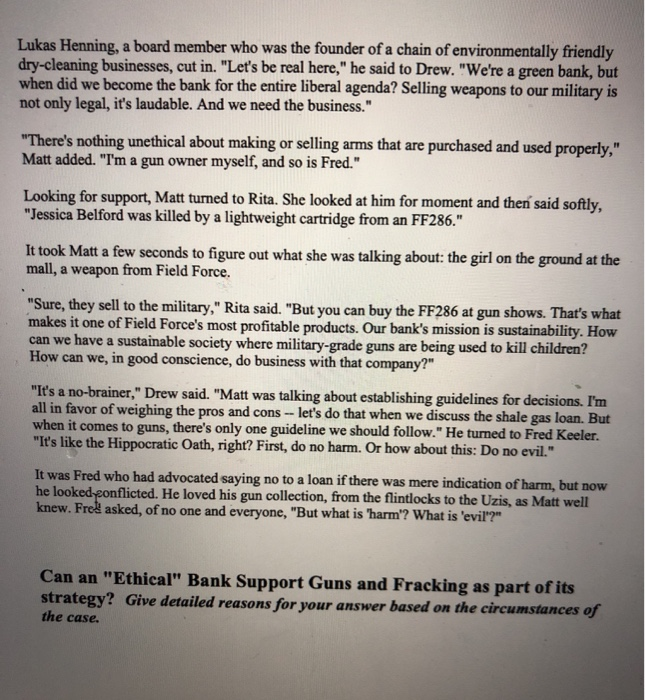
As the founder and president of a new ethical bank focused on environmental sustainability, Matt Dyson realized that he and his board needed to set guidelines about which loans to approve and which to reject on "values" grounds -- and fast. In his eagerness to get the business started, he'd put the issue off. But now the bank was facing two problematic requests: one from a company involved in fracking, the other from a gun maker. Without clear ethics rules, Matt worried that his already divided directors would fall into bitter squabbling, leading to resignations, negative media attention, and a flight of investors. Ethical banking had seemed so benign when Matt had decided to enter the industry. Now it seemed like a hornet's nest. A Green Vision Matt didn't need this job. At age 50, he had years of entrepreneurship behind him. He had founded a bank in Maryland, expanded it to six branches and $400 million in assets, and sold it for a substantial profit. While looking for his next project, he happened to see the movie An Inconvenient Truth and decided, during the sleepless night afterward, to build something meaningful out of his concern for the environment, his love of his native Colorado, and his knowledge of banking. The result was Silver Lake Green Bank, a company with a mission to promote environmersal stewardship. He established himself in Colorado Springs and assembled a board of directors: Four successful entrepreneurs, a lawyer, an ex-mayor of the city, a former executive in the Maryland bank, a doctor who was a school friend and sometime hunting partner, and an evangelical (and ardently environmentalist) leader of a megachurch Matt attended occasionally. To drive home its mission, the board hired a famous architect to make the bank's headquarters an environmental showcase, with prototype solar-power windows, a set of wind turbines, and a butterfly roof that channeled rain and meltwater into underground cisterns. Articles and TV segments about the building and about Matt, the returned native son and environmental crusader, helped attract local depositors and small borrowers, who'd grown disenchanted with the big national and global banks. Deposits grew at a healthy rate, but to succeed financially, the bank needed to make big loans to a few strong companies. So far, that hadn't happened. Moreover, the values-based approach was proving harder to implement than Matt had anticipated. Rifts among the directors had started to appear. The first sign of conflict came up in a discussion of what Matt thought was a nonissue: a gym for employees. "Oh, come on," Rita Williams said, shaking her head. "Are you going to have a personal trainer on-site, too?" "Actually, yes," Matt said. "Two afternoons a week." She rolled her eyes. "Since when does a gym or a personal trainer have anything to do with being green?" An avid fly fisher and former bouldering champion, Rita considered herself a pragmatic environmentalist, and she detested the idea of the "nanny state." She actively campaigned for Libertarian candidates -- in fact, she had been at a rally at a mall when a shooter had gone after a Congressional candidate and the people waiting to shake his hand. A picture of her giving CPR to a wounded child, who later died, had been all over the internet, though she refused to discuss the incident Two other board members agreed with her about the gym, so Matt had scaled back those plans. Twin Debates Rita had been the one to solicit the first problematic loan application. She'd been talking to the head of a Colorado engineering company that developed pumping systems used in hydraulic fracturing -- fracking -- and wanted to expand into making the polymers, emulsions, and surfactants the industry relies on. These materials, the executive said, would be significantly less toxic than those currently in use. Though ambivalent about fracking in general, Rita had recommended that the executive approach Silver Lake Green Bank. But on hearing about the opportunity, Rita's fellow directors were divided. One side touted the economic and employment benefits of fracking, while the other insisted that the risks outweighed any good that could come from it. The 300-million-year-old sedimentary rock under the Denver Basin in eastern Colorado contained one of the country's largest gas deposits, and a number of local engineering firms were working on solutions for drilling, injecting, and waste disposal. It was a growth industry, but warnings from experts about the risks of ground water contamination and seismic instability seemed to increase every day. "Look, let's not get worked up about a loan application we haven't even received," Matt said, trying to lower the temperature in the room. "But when we are approached by a company like this one, we have to be ready. We need to be talking about how to make loans that reflect our mission." Matt promised that he would research the guidelines other ethical companies used to make values-based decisions, solicit opinions from each director individually, and come back to the group with a proposal The next day, he visited the board member he knew best, Fred Keeler, a gastroenterologist. "I'm a believer in the precautionary principle," he told Matt. "It's the idea that in order to act, all you need is partial evidence -- not proof." Bans on smoking in public areas were a perfect example, he said: Many of them went into effect before the dangers of secondhand smoke had been proved. So if it looks bad, it is bad, Matt thought ruefully. Hoping for a more nuanced perspective, Matt went next to the pastor, the Reverend Drew Schafer, who, to Matt's surprise, advocated a completely evidence-based approach: "Make two columns, one for adverse environmental impacts, one for the positives," he said matter-of-factly. "Figure out a way to quantify the effects, then do the math." Simple. It was while wrapping up his meeting with Drew that Matt received an e-mail from the bank's chief loan officer. "Wow -- 3 million dollars," he blurted out. "What's this?" Drew asked. Matt wished he hadn't said anything: The e-mail was about an official application from Field Force, a large, local firm that had been talking informally with Matt about a multimillion-dollar loan to expand its business. In some ways, it was just the type of loan the bank needed: Field Force was a solid performer, a growing source of local jobs, and a good corporate citizen. "A gun manufacturer?" Drew asked in horror. "A military contractor," Matt said. "A gun manufacturer," Drew repeated. "In the state of Colorado? After Columbine and Aurora and Arapahye High School? You'd better not do anything on that without a board decision. I'd put it on the agenda for next week's meeting if I were you." Changing the Subject Matt didn't share the aversion that some of his directors felt toward guns, and it seemed to him that weapons had nothing to do with environmentalism. But Drew was right about the necessity of a board discussion, so he notified the directors about the Field Force application and planned his strategy for the meeting. "As you all know," he said to the group a few days later, "I got into this business because I was excited by the environmental mission. And I think you all felt the same." Heads nodded. "But," he continued, "the regulators made it very clear that we were to be a profit-making bank first and a green bank second. To get our charter, we had to demonstrate that our mission wouldn't add significant costs or impose significant limits on our banking operations, that we wouldn't let the mission wag the dog. I remember telling them that even if we wanted to lend only to businesses aligned with our environmental mission, we couldn't -- we'd go broke in a month. "I'm not always happy with this situation," he added. "I didn't get into this just to run another bank, but I accept it as the price to play." Mark Loman, Matt's former employee from the Maryland bank, provided a few facts and figures to support Matt's point: "Green" loans -- to green-certified builders and consultants, as well as landscapers, farms, nurseries, organic-food companies, and solar energy firms -- constituted only 7% of the bank's total; deposits from green businesses and from customers drawn by the bank's mission accounted for just 1.8%, the data showed. "Probably our biggest impact on sustainability comes not through the loans we make," Matt said, "but through media coverage of our mission. By being a successful green bank -- with an emphasis on 'successful' -- we pave the way for more capital to flow to green causes. "As I said last week, I think we need to create a decision-making framework so that we don't have to reinvent the wheel every time a loan application falls into what some of us might see as an ethically gray area. I've made a little progress on that front by talking to Fred and Drew here.. Drew interrupted him. "With all due respect, Matt, we have one of those applications on the table. It's from Field Force." Apparently, Drew had recruited several other directors to his position, and together they had drafted a statement categorically rejecting business from gun makers. Drew began to read aloud: "Point number one: The economic considerations..." The statement comparedigun makers with tobacco companies, arguing that their stocks would quickly lose value as the public became more concerned about violence. The statement cited Cerberus Capital Management's unsuccessful attempts to shed its investment in the company that made the weapon used in the 2012 Newtown elementary-school shooting. Under pressure from investors, Cerberus had finally allowed clients to sell their individual stakes. Matt was irritated. "No one would ever advocate that our military do without weapons," he said. "And as long as there's demand from the Pentagon, Field Force's stock will be fine." Drew put down the statement and looked at Matt. "Silver Lake Green Bank is supposed to be founded on ethical principles," he said. "What is 'green' if not an ethical principle? That's why we're part of the Global Alliance for Banking on Values. Last time I looked, it wasn't the 'Global Alliance for Banking on Selected Values.' What would other alliance members think about our lending to a gun maker? "You say that our main impact is through media coverage," he continued. "What will the media say if we lend to Field Force? That certainly trumps our fancy LEED-certified office building. A loan to a gun manufacturer would announce to the world that we really have no principles and that the green thing is just a marketing gimmick. If that happens, I'll have to leave this board." Lukas Henning, a board member who was the founder of a chain of environmentally friendly dry-cleaning businesses, cut in. "Let's be real here," he said to Drew. "We're a green bank, but when did we become the bank for the entire liberal agenda? Selling weapons to our military is not only legal, it's laudable. And we need the business." "There's nothing unethical about making or selling arms that are purchased and used properly," Matt added. "I'm a gun owner myself, and so is Fred." Looking for support, Matt turned to Rita. She looked at him for moment and then said softly, "Jessica Belford was killed by a lightweight cartridge from an FF286." It took Matt a few seconds to figure out what she was talking about the girl on the ground at the mall, a weapon from Field Force. "Sure, they sell to the military," Rita said. "But you can buy the FF286 at gun shows. That's what makes it one of Field Force's most profitable products. Our bank's mission is sustainability. How can we have a sustainable society where military-grade guns are being used to kill children? How can we, in good conscience, do business with that company?" "It's a no-brainer," Drew said. "Matt was talking about establishing guidelines for decisions. I'm all in favor of weighing the pros and cons -- let's do that when we discuss the shale gas loan. But when it comes to guns, there's only one guideline we should follow." He turned to Fred Keeler. "It's like the Hippocratic Oath, right? First, do no harm. Or how about this: Do no evil." It was Fred who had advocated saying no to a loan if there was mere indication of harm, but now he looked conflicted. He loved his gun collection, from the flintlocks to the Uzis, as Matt well knew. Fred asked, of no one and everyone, "But what is 'harm'? What is 'evil?" Can an "Ethical" Bank Support Guns and Fracking as part of its strategy? Give detailed reasons for your answer based on the circumstances of the case









 Study Help