Question: Please read the case study below and answer the end of case questions(total 9 questions). Case study And the winner is Sony's Blu-ray the high-definition
Please read the case study below and answer the end of case questions(total 9 questions).
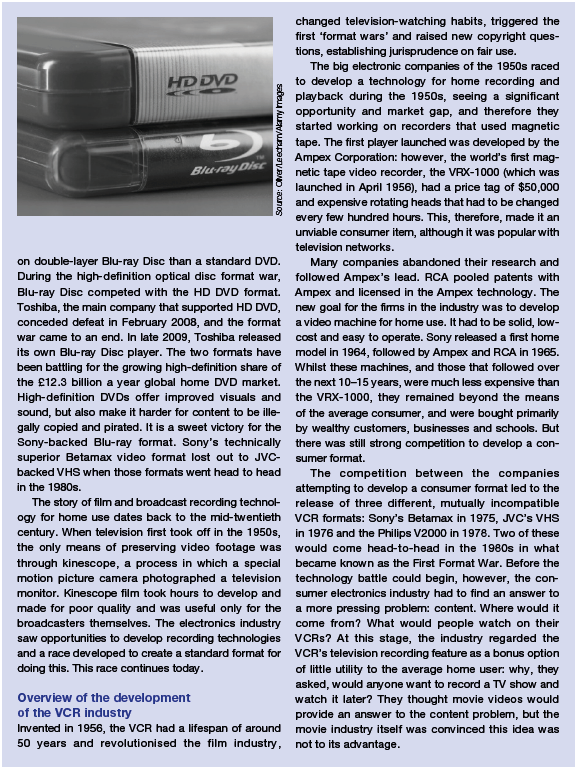
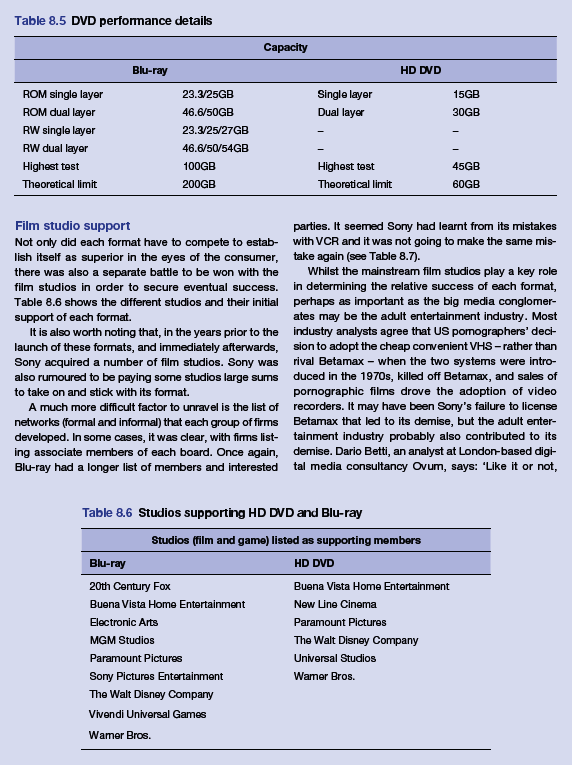
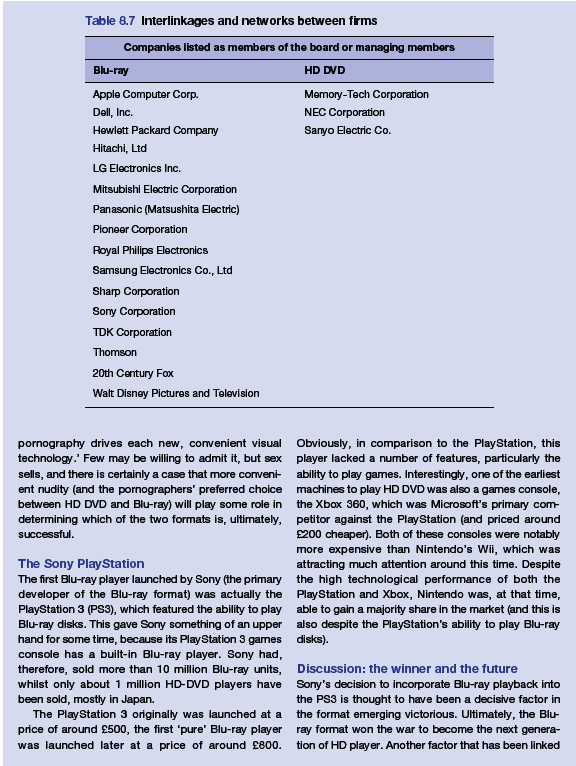
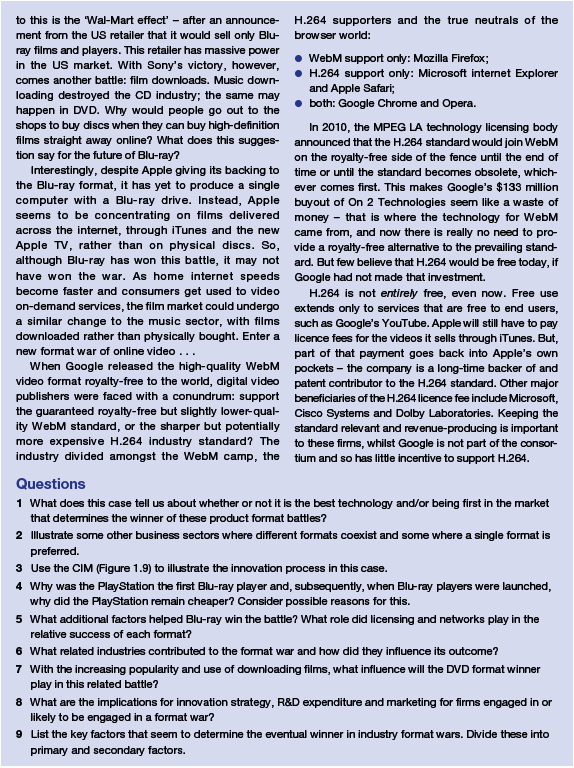
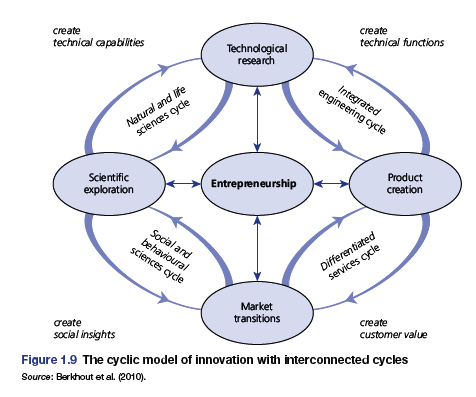
Case study And the winner is Sony's Blu-ray the high-definition DVD format war Christopher Simms and Paul Trott more of this track had been laid, but trains today could be travelling much faster, if the wider gauge This case study explores the development of high- had been adopted. definition video and the format war between Sony's Blu-ray and Toshiba's HD DVD. A format war The story of the VCR, Betamax, DVD, describes competition between mutually incompati- HD DVD and Blu-ray ble proprietary formats that compete for the same Blu-ray Disc (popularly known simply as Blu-ray) is an market, typically for data storage devices and record- optical disc storage medium designed to supersede ing formats for electronic media. A useful historical the standard DVD format. Its main uses are for stor- example of one of the first format wars was between ing high-definition video, PlayStation 3 video games railway width gauges in the United Kingdom during and other data. Blu-ray Disc was developed by the the Industrial Revolution of the early 1800s. Isambard Blu-ray Disc Association, a group representing mak- Kingdom Brunel developed a 2.1 m width gauge for ers of consumer electronics, computer hardware and his Great Western Railway because it offered greater motion pictures. The discs have the same physical stability and capacity at high speed. Whilst George dimensions as standard DVDs and CDs. The name Stephenson developed a 1.44 m width gauge for the Blu-ray Disc derives from the 'blue laser' used to read first mainline railway, the Liverpool to Manchester the disc. Whilst a standard DVD uses a 650 nanome- Railway; the de facto standard for the colliery rail- ter (nm) red laser, Blu-ray Disc uses a shorter wave- ways where Stephenson had worked. Needless to length 405 nm laser, and allows for over five times say, the narrower 1.44 m gauge won simply because more data storage on single-layer and over 10 times Source: Olver/Leechar Alarnymages Bluray Disc changed television-watching habits, triggered the first 'format wars' and raised new copyright ques- tions, establishing Jurisprudence on fair use. The big electronic companies of the 1950s raced HD DVD to develop a technology for home recording and playback during the 1950s, seeing a significant opportunity and market gap, and therefore they started working on recorders that used magnetic tape. The first player launched was developed by the Ampex Corporation: however, the world's first mag- netic tape video recorder, the VRX-1000 (which was launched in April 1956), had a price tag of $50,000 and expensive rotating heads that had to be changed every few hundred hours. This, therefore, made it an unviable consumer item, although it was popular with television networks. on double-layer Blu-ray Disc than a standard DVD. Many companies abandoned their research and During the high-definition optical disc format war, followed Ampex's lead. RCA pooled patents with Blu-ray Disc competed with the HD DVD format. Ampex and licensed in the Ampex technology. The Toshiba, the main company that supported HD DVD, new goal for the firms in the industry was to develop conceded defeat in February 2008, and the format a video machine for home use. It had to be solid, low- war came to an end. In late 2009, Toshiba released cost and easy to operate. Sony released a first home its own Blu-ray Disc player. The two formats have model in 1964, followed by Ampex and RCA in 1965. been battling for the growing high-definition share of Whilst these machines, and those that followed over the 12.3 billion a year global home DVD market the next 10-15 years, were much less expensive than High-definition DVDs offer improved visuals and the VRX-1000, they remained beyond the means sound, but also make it harder for content to be ille- of the average consumer, and were bought primarily gally copied and pirated. It is a sweet victory for the by wealthy customers, businesses and schools. But Sony-backed Blu-ray format. Sony's technically there was still strong competition to develop a con- superior Betamax video format lost out to JVC sumer format. backed VHS when those formats went head to head The competition between the companies in the 1980s. attempting to develop a consumer format led to the The story of film and broadcast recording technot release of three different, mutually incompatible ogy for home use dates back to the mid-twentieth VCR formats: Sony's Betamax in 1975, NC's VHS century. When television first took off in the 1950s, in 1976 and the Philips V2000 in 1978. Two of these the only means of preserving video footage was would come head-to-head in the 1980s in what through kinescope, a process in which a special became known as the First Format War. Before the motion picture camera photographed a television technology battle could begin, however, the con- monitor. Kinescope film took hours to develop and sumer electronics industry had to find an answer to made for poor quality and was useful only for the a more pressing problem: content. Where would it broadcasters themselves. The electronics industry come from? What would people watch on their saw opportunities to develop recording technologies VCRs? At this stage, the industry regarded the and a race developed to create a standard format for VCR's television recording feature as a bonus option doing this. This race continues today. of little utility to the average home user. why, they asked, would anyone want to record a TV show and Overview of the development watch it later? They thought movie videos would of the VCR industry provide an answer to the content problem, but the Invented in 1956, the VCR had a lifespan of around movie industry itself was convinced this idea was 50 years and revolutionised the film industry, not to its advantage. Copyright issues for the VCR went to market with its VHS format. In the European Home video sent the movie industry into a spin market, Philips did not play along either, but technical Television had already stolen a big part of its market, problems were to take Philips out of the fight almost and it saw the VCR as a massive new threat. before it began. Copyright, the film industry argued, was at stake. Did From where Sony stood, the only clear advantage not the mere recording of a television show constitute of the VHS format was its longer recording time. So, an infringement of the copyright owner's rights over Sony doubled the Betamax recording time and JVC reproduction? The studios took the issue to court. In followed suit. This continued until recording times 1976, the year after Sony's release of the Betamax were no longer an issue for potential customers, and VCR, Universal City Studios and the Walt Disney marketing overtook superior technology as the key to Company sued Sony, seeking to have the VCR the battle. impounded as a tool of piracy. Betamax was, arguably, a superior technology New communications technology - then as now- (although debate on this continues today, and many has always challenged previous assumptions and argue that the difference in quality was relevant only jurisprudence in the area of copyright. The first court really those using machines commercially); decision in 1979 went against the studios, ruling that Beta SP was still used by professional videographers use of the VCR for non-commercial recording was until relatively recently. But what Betamax really legal. The studios appealed and the decision was needed was market share. Morita (Sony's CEO) overturned in 1981. Sony then took the case to the blames Betamax's eventual defeat on insufficient US Supreme Court, who finally ruled that home licensing. Despite the fact that it was the better prod- recording of television programmes for later viewing uct, Betamax never achieved a large enough pres- constituted "fair use'. An important factor in the ence to create consumer preference. VHS had gravity Court's reasoning was that 'time-shifting' - i.e. and won the battle. recording a programme to watch at another time - The two companies were on a par for several did not represent any substantial harm to the copy- years, until JVC's VHS format pulled ahead. This was right holder, nor did it diminish the market for the due, in part, to JVC's broader licensing policy. product Counting on increased royalties to make money on By then, the VCR had become a popular con- its VHS machines, NC licensed the technology to big sumer product and, contrary to their fears, the film consumer electronics companies like Zenith and studios found themselves to be major beneficiaries of RCA (a company with significant presence in the the technology as the sale and rental of film videos United States at the time). As a result, VHS machines began generating huge new revenue streams. In became more abundant on the market and prices fell, 1986 alone, home video revenues added more than increasing their consumer appeal. $100 million of pure profit to Disney's bottom line. At about the same time, in the early 1980s, video The television stations, on the other hand, having rental shops started springing up on every street cor found that the 'useless' recording option was a big hit ner. Early on, the video shop owners recognised that with viewers, faced a different problem. They had to they would have to make VCRs available for cheap find new ways to keep their advertisers happy now rental to attract a larger client base. The high-quality that viewers could fast-forward through the commer- Betamax machines were more expensive, harder to cial breaks. repair, and the first models were compatible only with certain television sets. So, VHS became the obvious Setting the standard: VHS v. Betamax choice for the rental shops. Another factor that influ- Meanwhile, the format war between VHS and enced the outcome is the adult entertainment indus- Betamax was under way. When Sony released try (porn). The size of this industry is enormous and Betamax, it was confident of the superiority of its the porn studios' decision to use VHS may also have technology and assumed that the other companies influenced the outcome. This combined effect of would abandon their formats and accept Betamax as greater availability of machines and increased availa- the industry-wide technical standard. It was wrong. bility of content on VHS eventually squeezed out On its home turf in Japan, JVC refused to comply and Betamax Technology development, of course, did not stand the launch of the two competing formats of HD still. By 2003, DVD sales had overtaken those of the DVD and Blu-ray DVD, with both factions attempt- VCR, signalling the dying days of magnetic tape. Video ing to beat one another in order to 'reap the rental shops, sensitive to market trends, switched to rewards'. The Blu-ray and HD DVD formats were DVD, accelerating the demise of the VCR, eventually both launched in the early twentieth century, with leading to a sharp demise in sales of video recorders each format having been developed by competing (VHS). The DVD had advantages in terms of quality, electronics companies. Sony, alongside Royal although it lacked the same flexibility and ease of Philips Electronics, developed the Blu-ray format, recording that were the case for the VHS format. whilst HD DVD was developed by Toshiba, along- Today, few VCRs are sold (and it is very difficult to find side Hitachi. players, with most retailers having stopped selling such In 2005, what could be described as 'ongoing machines), and the format is close to being obsolete. peace talks' between the Blu-ray and HD DVD An ongoing issue that rumbles on in the background camps, finally dissolved after many attempts to of the format wars is the issue of copyright. It continues develop a compromise of the next-generation format. to be a key influence in firm's strategic decision making This meant that the two companies would have to towards the new formats of streaming and download compete head to head to become the standard for able media, as well as the HD disk formats. the next generation of video recording and reproduc- tion for the living room. The development of DVD The two formats are incompatible with one The development of the Laserdisc by Philips in 1969 another, despite using lasers of the same type. HD yielded many of the technologies Sony carried over DVD discs also have a different surface layer (the and utilised when it partnered with Philips to jointly cre- clear plastic layer on the surface of the data which is ate the CD in 1979. In the early 1990s, these two com- the bit you get fingerprints and scratches on) from panies then worked closely together again to develop a Blu-ray discs. HD DVD uses a 0.6 mm-thick surface new high-density disc called the Multimedia Compact layer, the same as DVD, while Blu-ray has a much Disc (MMCD was the original name), but their format smaller 0.1 mm layer to help enable the laser to was eventually more or less abandoned in favour of focus. Herein lie the issues associated with the Toshiba's competing Super Density Disc (SD), which higher cost of Blu-ray discs. This thinner surface had the vast majority of backers at the time, such as layer is what makes the discs more costly: because Hitachi, Matsushita (Panasonic), Mitsubishi, Pioneer, Blu-ray discs do not share the same surface layer Thomson and Time Wamer. The two factions cut a thickness of DVDs, costly production facilities must deal, brokered by IBM president Lou Gerstner, on a be modified or replaced in order to produce the new format: DVD. Toshiba wound up on top after the discs. A special hard coating must also be applied to dust settled in 1995-6, and Sony and Philips, who were Blu-ray discs, so their surface is sufficiently resilient not cut in on the standard (and royalties) nearly as enough to protect the data a mere 0.1 mm beneath - much as they would have liked, immediately started this also drives the cost up. Blu-ray, therefore, unlike work on a next generation system. The Professional HD DVD, requires a hard coating on its discs Disc for DATA (aka PDD or ProDATA), which was because data is 0.5 mm closer to the surface. The based on an optical disc system Sony had already polymer coating it uses, called Durabis, was devel- been developing alongside the existing project, even- oped by TDK and is supposedly extremely resilient tually would become the Blu-ray disc. Toshiba, not to and fingerprint resistant. The added benefit of keep- be outdone by Philips and Sony, also started work on a ing the data layer closer to the surface, however, is new generation system: the Advanced Optical Disc, more room for extra layers. This increased cost, which eventually evolved into the HD DVD. which would more than likely lead to increased prices to the consumer, was an issue that would Blu-ray DVD v. HD DVD threaten the potential success of the Blu-ray, After 35 years of optical audio/video disc develop- although the format does hold more data (as shown ment, history seems to have repeated itself with in Table 8.5). Table 8.5 DVD performance details Capacity Blu-ray HD DVD Single layer Dual layer 15GB 30GB ROM single layer ROM dual layer RW single layer RW dual layer Highest test Theoretical limit 23.3/25GB 46.6/50GB 23.3/25/27GB 46.6/50/54GB 100GB 200GB Highest test Theoretical limit 45GB 60GB Film studio support parties. It seemed Sony had learnt from its mistakes Not only did each format have to compete to estab- with VCR and it was not going to make the same mis- lish itself as superior in the eyes of the consumer, take again (see Table 8.7). there was also a separate battle to be won with the Whilst the mainstream film studios play a key role film studios in order to secure eventual success. in determining the relative success of each format, Table 8.6 shows the different studios and their initial perhaps as important as the big media conglomer- support of each format. ates may be the adult entertainment industry. Most It is also worth noting that, in the years prior to the industry analysts agree that US pomographers' deci launch of these formats, and immediately afterwards, sion to adopt the cheap convenient VHS - rather than Sony acquired a number of film studios. Sony was rival Betamax - when the two systems were intro- also rumoured to be paying some studios large sums duced in the 1970s, killed off Betamax, and sales of to take on and stick with its format. pornographic films drove the adoption of video A much more difficult factor to unravel is the list of recorders. It may have been Sony's failure to license networks (formal and informal) that each group of firms Betamax that led to its demise, but the adult enter- developed. In some cases, it was clear, with firms list- tainment industry probably also contributed to its ing associate members of each board. Once again, demise. Dario Betti, an analyst at London-based digi- Blu-ray had a longer list of members and interested tal media consultancy Ovum, says: 'Like it or not, Table 8.6 Studios supporting HD DVD and Blu-ray Studios (film and game) listed as supporting members Blu-ray HD DVD 20th Century Fox Buena Vista Home Entertainment Buena Vista Home Entertainment New Line Cinema Electronic Arts Paramount Pictures MGM Studios The Walt Disney Company Paramount Pictures Universal Studios Sony Pictures Entertainment The Walt Disney Company Vivendi Universal Games Warner Bros. Wamer Bros. Table 8.7 Interlinkages and networks between firms Companies listed as members of the board or managing members Blu-ray HD DVD Apple Computer Corp. Memory-Tech Corporation Dell, Inc. NEC Corporation Hewlett Packard Company Sanyo Electric Co. Hitachi, Ltd LG Electronics Inc. Mitsubishi Electric Corporation Panasonic (Matsushita Electric) Pioneer Corporation Royal Philips Electronics Samsung Electronics Co., Ltd Sharp Corporation Sony Corporation TDK Corporation Thomson 20th Century Fox Walt Disney Pictures and Television pornography drives each new, convenient visual Obviously, in comparison to the PlayStation, this technology.' Few may be willing to admit it, but sex player lacked a number of features, particularly the sells, and there is certainly a case that more conveni- ability to play games. Interestingly, one of the earliest ent nudity (and the pornographers' preferred choice machines to play HD DVD was also a games console, between HD DVD and Blu-ray) will play some role in the Xbox 360, which was Microsoft's primary com- determining which of the two formats is, ultimately, petitor against the PlayStation (and priced around successful. 200 cheaper). Both of these consoles were notably more expensive than Nintendo's Wii, which was The Sony PlayStation attracting much attention around this time. Despite The first Blu-ray player launched by Sony (the primary the high technological performance of both the developer of the Blu-ray format) was actually the PlayStation and Xbox, Nintendo was, at that time, PlayStation 3 (PS3), which featured the ability to play able to gain a majority share in the market (and this is Blu-ray disks. This gave Sony something of an upper also despite the PlayStation's ability to play Blu-ray hand for some time, because its PlayStation 3 games disks). console has a built-in Blu-ray player. Sony had, therefore, sold more than 10 million Blu-ray units, Discussion: the winner and the future whilst only about 1 million HD-DVD players have Sony's decision to incorporate Blu-ray playback into been sold, mostly in Japan. the PS3 is thought to have been a decisive factor in The PlayStation 3 originally was launched at a the format emerging victorious. Ultimately, the Blu- price of around 500, the first 'pure' Blu-ray player ray format won the war to become the next genera- was launched later at a price of around 800. tion of HD player. Another factor that has been linked to this is the 'Wal-Mart effect - after an announce- H.264 supporters and the true neutrals of the ment from the US retailer that it would sell only Blu- browser world: ray films and players. This retailer has massive power in the US market. With Sony's victory, however, WebM support only: Mozilla Firefox; comes another battle: film downloads. Music down- H.264 support only: Microsoft internet Explorer loading destroyed the CD industry; the same may and Apple Safari; happen in DVD. Why would people go out to the both: Google Chrome and Opera. shops to buy discs when they can buy high-definition In 2010, the MPEG LA technology licensing body films straight away online? What does this sugges- announced that the H.264 standard would join WebM tion say for the future of Blu-ray? on the royalty-free side of the fence until the end of Interestingly, despite Apple giving its backing to time or until the standard becomes obsolete, which the Blu-ray format, it has yet to produce a single ever comes first. This makes Google's $133 million computer with a Blu-ray drive. Instead, Apple buyout of On 2 Technologies seem like a waste of seems to be concentrating on films delivered money - that is where the technology for WebM across the internet, through iTunes and the new came from, and now there is really no need to pro- Apple TV, rather than on physical discs. So, vide a royalty-free alternative to the prevailing stand- although Blu-ray has won this battle, it may notard. But few believe that H.264 would be free today, if have won the war. As home internet speeds Google had not made that investment. become faster and consumers get used to video H.264 is not entirely free, even now. Free use on-demand services, the film market could undergo extends only to services that are free to end users, a similar change to the music sector, with films such as Google's YouTube. Apple will still have to pay downloaded rather than physically bought. Enter a licence fees for the videos it sells through iTunes. But, new format war of online video ... part of that payment goes back into Apple's own When Google released the high-quality WebM pockets - the company is a long-time backer of and video format royalty-free to the world, digital video patent contributor to the H.264 standard. Other major publishers were faced with a conundrum: support beneficiaries of the H.264 licence fee include Microsoft, the guaranteed royalty-free but slightly lower-qual- Cisco Systems and Dolby Laboratories. Keeping the ity WebM standard, or the sharper but potentially standard relevant and revenue-producing is important more expensive H.264 industry standard? The to these firms, whilst Google is not part of the consor- industry divided amongst the WebM camp, the tium and so has little incentive to support H.264. Questions 1 What does this case tell us about whether or not it is the best technology and/or being first in the market that determines the winner of these product format battles? 2 llustrate some other business sectors where different formats coexist and some where a single format is preferred. 3 Use the CIM (Figure 1.9) to illustrate the innovation process in this case. 4 Why was the PlayStation the first Blu-ray player and subsequently, when Blu-ray players were launched, why did the PlayStation remain cheaper? Consider possible reasons for this. 5 What additional factors helped Blu-ray win the battle? What role did licensing and networks play in the relative success of each format? 6 What related industries contributed to the format war and how did they influence its outcome? 7 With the increasing popularity and use of downloading films, what influence will the DVD format winner play in this related battle? 8 What are the implications for innovation strategy, R&D expenditure and marketing for firms engaged in or likely to be engaged in a format war? 9 List the key factors that seem to determine the eventual winner in industry format wars. Divide these into primary and secondary factors. create technical capabilities create technical functions Technological research Integrated engineering cycle Natural and life sciences de Scientific exploration Entrepreneurship Product creation Social and behavioural sciences cycle Differentiated Services cycle Market create transitions create social insights customer value Figure 1.9 The cyclic model of innovation with interconnected cycles Source: Berkhout et al. (2010)









 Study Help