







Question: please read the following article and answer the question at the end Why zero interest rates might lead to currency volatility There is little scope
please read the following article and answer the question at the end
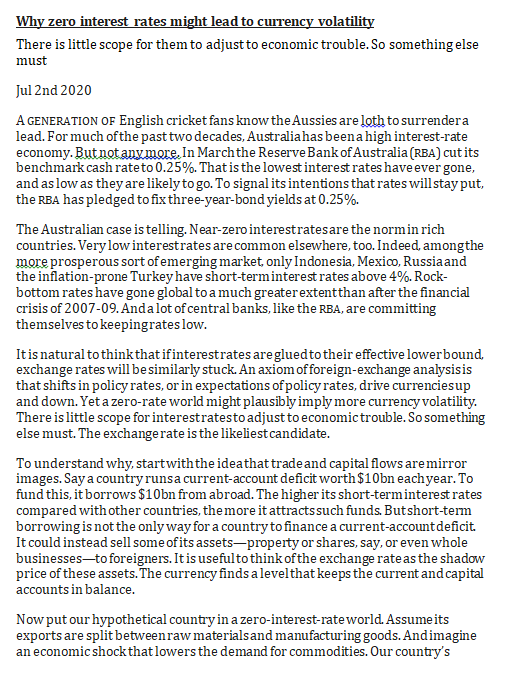
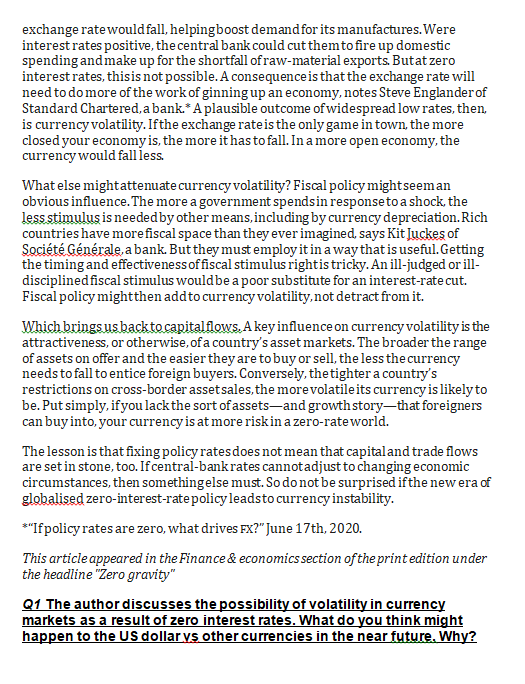
Why zero interest rates might lead to currency volatility There is little scope for them to adjust to economic trouble. So something else must Jul 2nd 2020 A GENERATION OF English cricket fans know the Aussies are loth to surrendera lead. For much of the past two decades, Australiahas been a high interest-rate economy. But not anymore. In March the Reserve Bank of Australia (RBA) cut its benchmark cash rate to 0.25%. That is the lowest interest rates have ever gone, and as low as they are likely to go. To signal its intentions that rates will stay put, the RBA has pledged to fix three-year-bond yields at 0.25%. The Australian case is telling. Near-zero interestratesare the normin rich countries. Very low interestrates are common elsewhere, too. Indeed, amongthe more prosperous sort of emerging market, only Indonesia, Mexico, Russia and the inflation-prone Turkey have short-term interest rates above 4%. Rock- bottom rates have gone global to a much greaterextent than after the financial crisis of 2007-09. Anda lot of central banks, like the RBA, are committing themselves to keepingrates low. It is natural to think that if interestrates are glued to their effective lower bound, exchange rates will be similarly stuck. An axiom of foreign-exchange analysisis that shifts in policy rates, or in expectations of policy rates, drive currenciesup and down. Yet a zero-rate world might plausibly imply more currency volatility. There is little scope for interestratesto adjust to economic trouble. So something else must. The exchange rate is the likeliest candidate. To understand why, startwith the ideathat trade and capital flows are mirror images. Say a country runsa current-account deficit worth $10bn each year. To fund this, it borrows $10bn from abroad. The higher its short-term interest rates compared with other countries, the more it attracts such funds. But short-term borrowing is not the only way for a country to finance a current-account deficit It could instead sell some of its assets-property or shares, say, or even whole businessesto foreigners. It is usefulto think of the exchange rate as the shadow price of these assets. The currency finds a levelthat keeps the current and capital accounts in balance. Now put our hypothetical country in a zero-interest-rate world. Assume its exports are split betweenraw materials and manufacturing goods. Andimagine an economic shock that lowers the demand for commodities. Our country's exchange rate would fall, helpingboost demand for its manufactures.Were interest rates positive, the central bank could cut them to fire up domestic spending and make up for the shortfall of raw material exports. Butat zero interest rates, thisis not possible. A consequence is that the exchange rate will need to do more of the work of ginning up an economy, notes Steve Englander of Standard Chartered, a bank.* A plausible outcome of widespread low rates, then, is currency volatility.Ifthe exchange rate is the only game in town, the more closed your economy is, the more it has to fall. In a more open economy, the currency would fall less. What else mightattenuate currency volatility? Fiscal policy might seeman obvious influence. The more a government spendsin response to a shock, the less stimulus is needed by other means, including by currency depreciation. Rich countries have more fiscal space than they ever imagined, says Kit Juckes of Socit Gnrale, a bank. But they must employ it in a way that is useful. Getting the timing and effectiveness offiscal stimulus rightis tricky. An ill-judged or ill- disciplined fiscal stimulus would be a poor substitute for an interest-rate cut. Fiscal policy mightthen add to currency volatility,not detract from it. Which brings us back to capitalflows. A key influence on currency volatility is the attractiveness, or otherwise, of a country's asset markets. The broader the range of assets on offer and the easier they are to buy or sell, the less the currency needs to fall to entice foreign buyers. Conversely, the tighter a country's restrictions on cross-border asset sales, the morevolatile its currency is likely to be. Put simply, ifyou lack the sort of assetsand growth storythat foreigners can buy into your currency is at more riskin a zero-rate world. The lesson is that fixing policy rates does not mean that capital and trade flows are set in stone, too. If central-bankrates cannotadjust to changing economic circumstances, then somethingelse must. So do not be surprised ifthe new era of globalised zero-interest-rate policy leadstocurrency instability. *"Ifpolicy rates are zero, what drives Fx?" June 17th, 2020. This article appeared in the Finance & economics section of the print edition under the headline "Zero gravity" Q1 The author discusses the possibility of volatility in currency markets as a result of zero interest rates. What do you think might happen to the US dollar ys other currencies in the near future. Why? Why zero interest rates might lead to currency volatility There is little scope for them to adjust to economic trouble. So something else must Jul 2nd 2020 A GENERATION OF English cricket fans know the Aussies are loth to surrendera lead. For much of the past two decades, Australiahas been a high interest-rate economy. But not anymore. In March the Reserve Bank of Australia (RBA) cut its benchmark cash rate to 0.25%. That is the lowest interest rates have ever gone, and as low as they are likely to go. To signal its intentions that rates will stay put, the RBA has pledged to fix three-year-bond yields at 0.25%. The Australian case is telling. Near-zero interestratesare the normin rich countries. Very low interestrates are common elsewhere, too. Indeed, amongthe more prosperous sort of emerging market, only Indonesia, Mexico, Russia and the inflation-prone Turkey have short-term interest rates above 4%. Rock- bottom rates have gone global to a much greaterextent than after the financial crisis of 2007-09. Anda lot of central banks, like the RBA, are committing themselves to keepingrates low. It is natural to think that if interestrates are glued to their effective lower bound, exchange rates will be similarly stuck. An axiom of foreign-exchange analysisis that shifts in policy rates, or in expectations of policy rates, drive currenciesup and down. Yet a zero-rate world might plausibly imply more currency volatility. There is little scope for interestratesto adjust to economic trouble. So something else must. The exchange rate is the likeliest candidate. To understand why, startwith the ideathat trade and capital flows are mirror images. Say a country runsa current-account deficit worth $10bn each year. To fund this, it borrows $10bn from abroad. The higher its short-term interest rates compared with other countries, the more it attracts such funds. But short-term borrowing is not the only way for a country to finance a current-account deficit It could instead sell some of its assets-property or shares, say, or even whole businessesto foreigners. It is usefulto think of the exchange rate as the shadow price of these assets. The currency finds a levelthat keeps the current and capital accounts in balance. Now put our hypothetical country in a zero-interest-rate world. Assume its exports are split betweenraw materials and manufacturing goods. Andimagine an economic shock that lowers the demand for commodities. Our country's exchange rate would fall, helpingboost demand for its manufactures.Were interest rates positive, the central bank could cut them to fire up domestic spending and make up for the shortfall of raw material exports. Butat zero interest rates, thisis not possible. A consequence is that the exchange rate will need to do more of the work of ginning up an economy, notes Steve Englander of Standard Chartered, a bank.* A plausible outcome of widespread low rates, then, is currency volatility.Ifthe exchange rate is the only game in town, the more closed your economy is, the more it has to fall. In a more open economy, the currency would fall less. What else mightattenuate currency volatility? Fiscal policy might seeman obvious influence. The more a government spendsin response to a shock, the less stimulus is needed by other means, including by currency depreciation. Rich countries have more fiscal space than they ever imagined, says Kit Juckes of Socit Gnrale, a bank. But they must employ it in a way that is useful. Getting the timing and effectiveness offiscal stimulus rightis tricky. An ill-judged or ill- disciplined fiscal stimulus would be a poor substitute for an interest-rate cut. Fiscal policy mightthen add to currency volatility,not detract from it. Which brings us back to capitalflows. A key influence on currency volatility is the attractiveness, or otherwise, of a country's asset markets. The broader the range of assets on offer and the easier they are to buy or sell, the less the currency needs to fall to entice foreign buyers. Conversely, the tighter a country's restrictions on cross-border asset sales, the morevolatile its currency is likely to be. Put simply, ifyou lack the sort of assetsand growth storythat foreigners can buy into your currency is at more riskin a zero-rate world. The lesson is that fixing policy rates does not mean that capital and trade flows are set in stone, too. If central-bankrates cannotadjust to changing economic circumstances, then somethingelse must. So do not be surprised ifthe new era of globalised zero-interest-rate policy leadstocurrency instability. *"Ifpolicy rates are zero, what drives Fx?" June 17th, 2020. This article appeared in the Finance & economics section of the print edition under the headline "Zero gravity" Q1 The author discusses the possibility of volatility in currency markets as a result of zero interest rates. What do you think might happen to the US dollar ys other currencies in the near future. Why
Step by Step Solution
There are 3 Steps involved in it

Get step-by-step solutions from verified subject matter experts
 Study Help