Question: Please read the question Question : What is your opinion of Gardner's theory of multiple intelligences? What learning styles most resonate with you as a
Please read the question
Question: What is your opinion of Gardner's theory of multiple intelligences? What learning styles most resonate with you as a learner? Why? How should this theory influence our teaching?
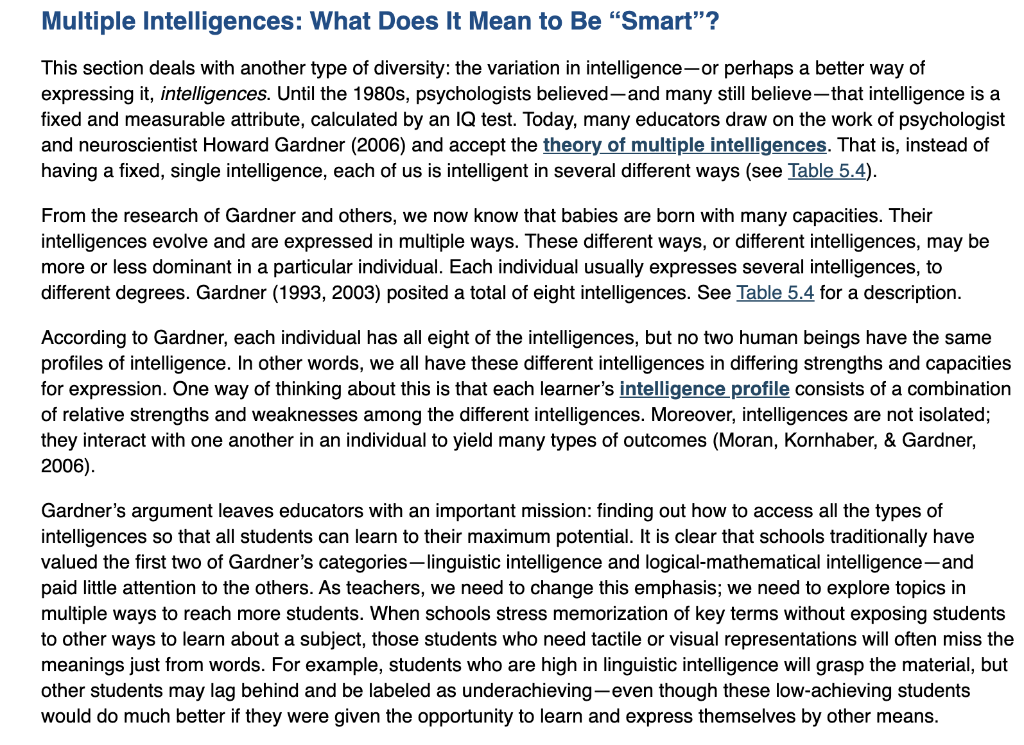
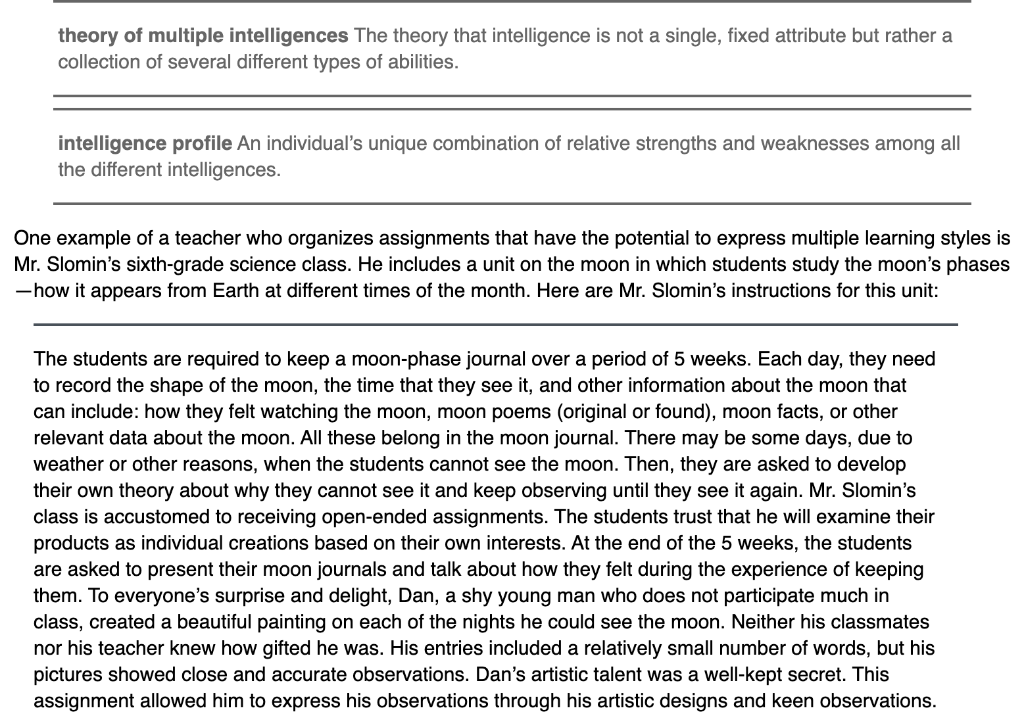
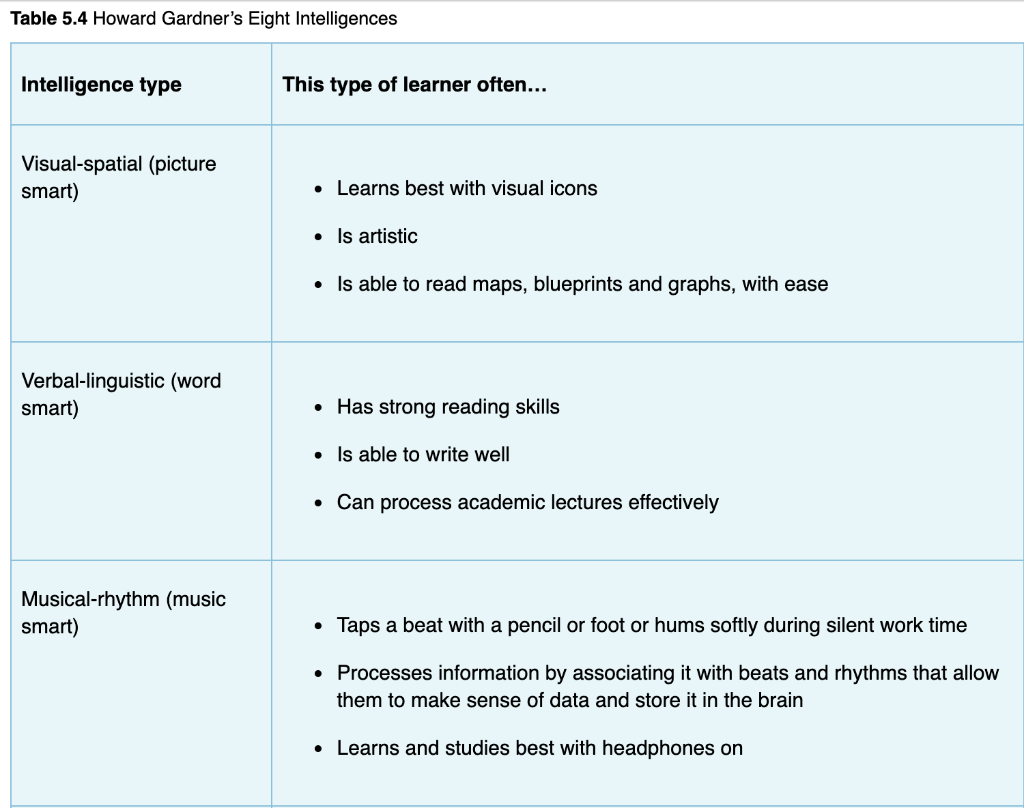
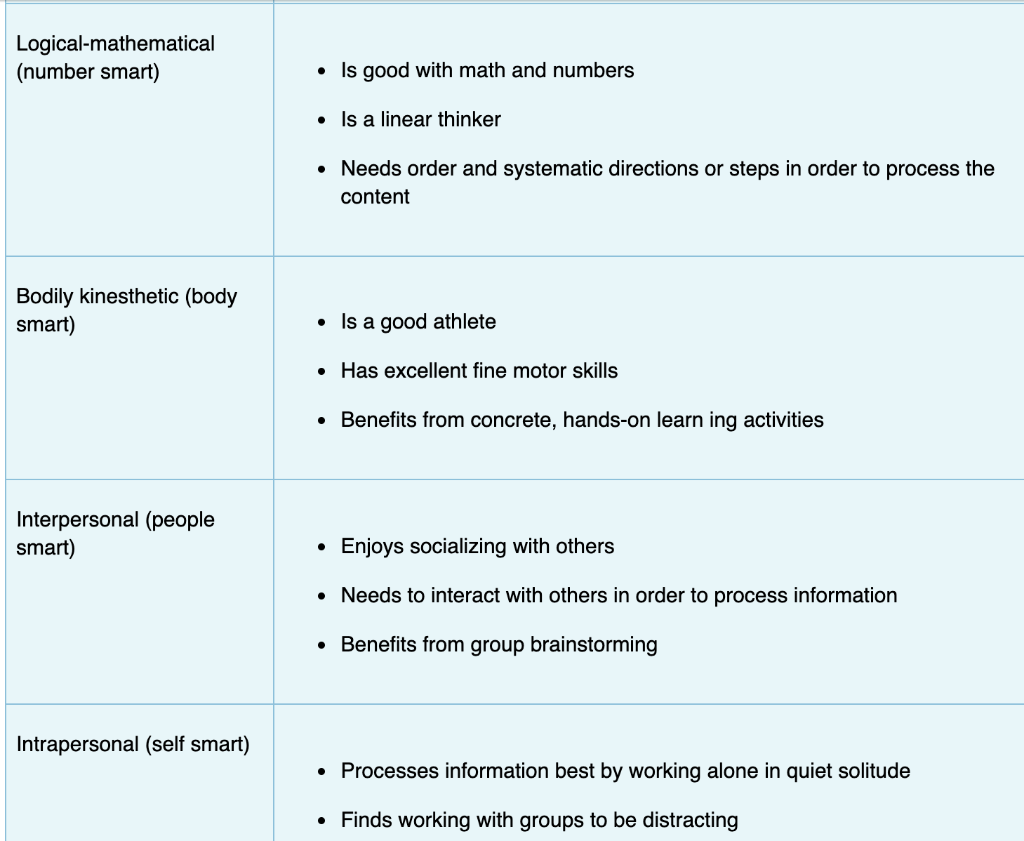
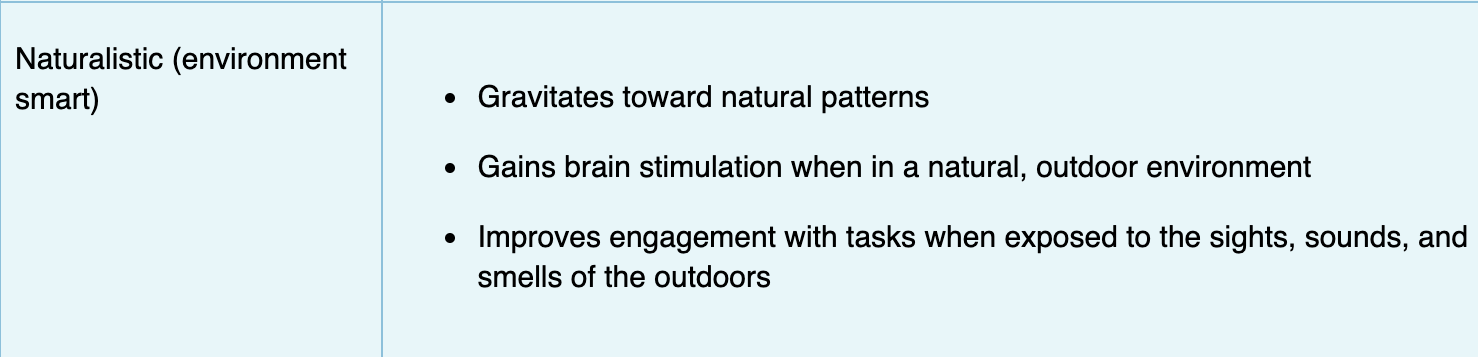
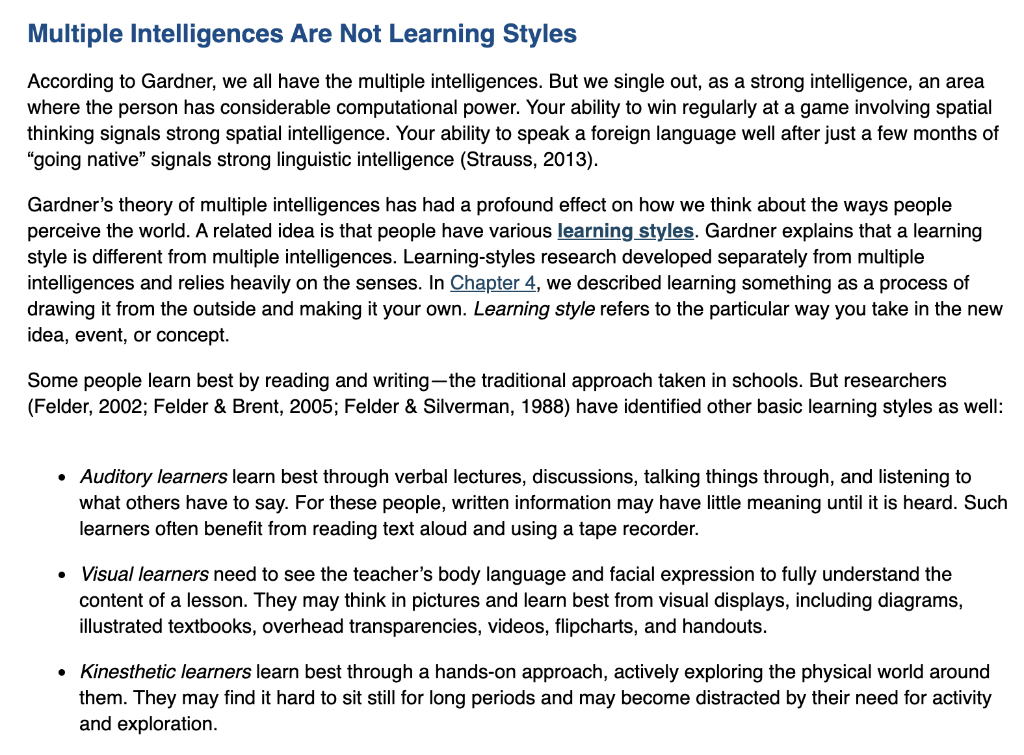
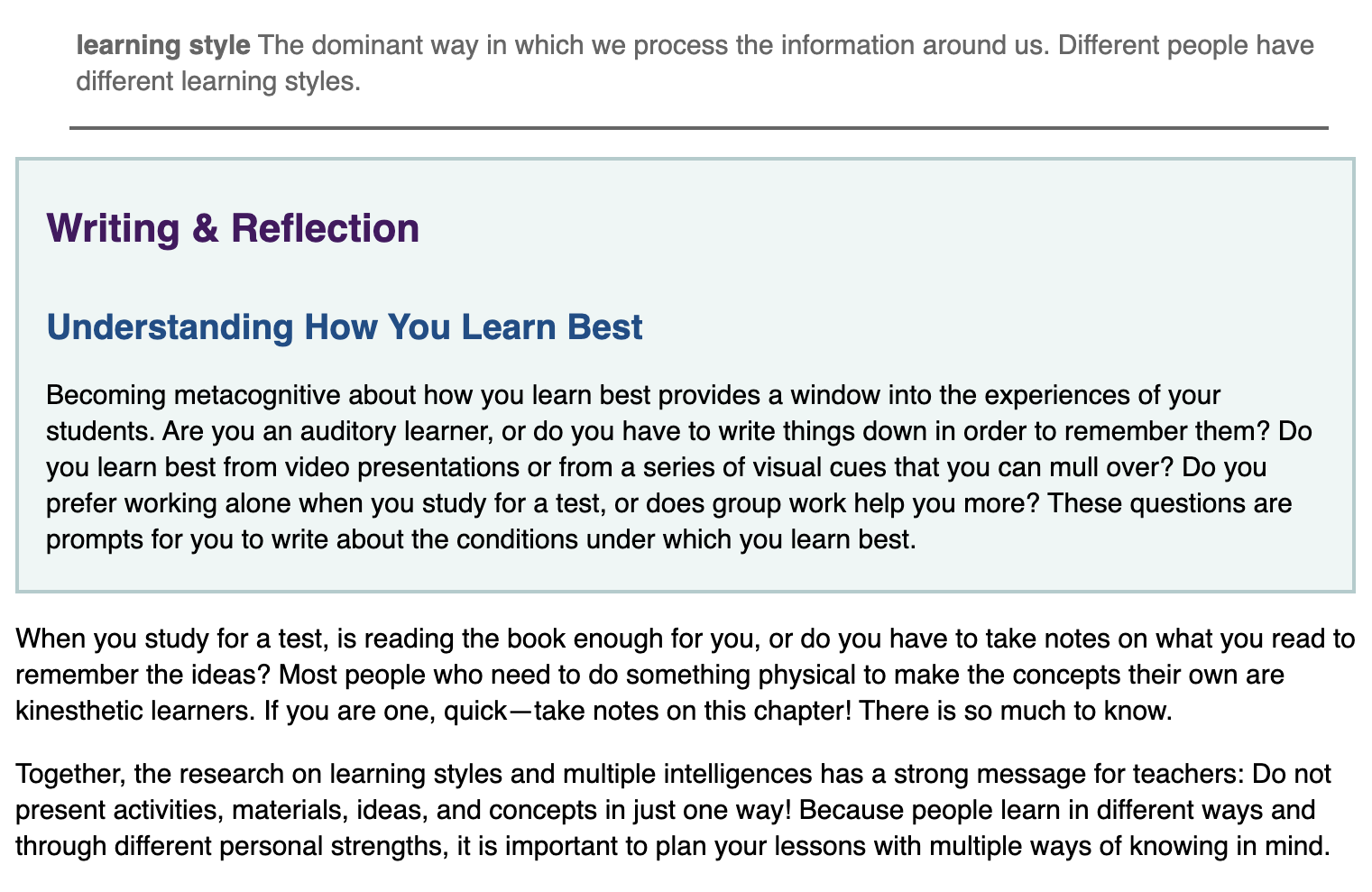
Multiple Intelligences: What Does It Mean to Be Smart? This section deals with another type of diversity: the variation in intelligence-or perhaps a better way of expressing it, intelligences. Until the 1980s, psychologists believed - and many still believe-that intelligence is a fixed and measurable attribute, calculated by an IQ test. Today, many educators draw on the work of psychologist and neuroscientist Howard Gardner (2006) and accept the theory of multiple intelligences. That is, instead of having a fixed, single intelligence, each of us is intelligent in several different ways (see Table 5.4). From the research of Gardner and others, we now know that babies are born with many capacities. Their intelligences evolve and are expressed in multiple ways. These different ways, or different intelligences, may be more or less dominant in a particular individual. Each individual usually expresses several intelligences, to different degrees. Gardner (1993, 2003) posited a total of eight intelligences. See Table 5.4 for a description. According to Gardner, each individual has all eight of the intelligences, but no two human beings have the same profiles of intelligence. In other words, we all have these different intelligences in differing strengths and capacities for expression. One way of thinking about this is that each learner's intelligence profile consists of a combination of relative strengths and weaknesses among the different intelligences. Moreover, intelligences are not isolated; they interact with one another in an individual to yield many types of outcomes (Moran, Kornhaber, & Gardner, 2006). Gardner's argument leaves educators with an important mission: finding out how to access all the types of intelligences so that all students can learn to their maximum potential. It is clear that schools traditionally have valued the first two of Gardner's categories-linguistic intelligence and logical-mathematical intelligence-and paid little attention to the others. As teachers, we need to change this emphasis; we need to explore topics in multiple ways to reach more students. When schools stress memorization of key terms without exposing students to other ways to learn about a subject, those students who need tactile or visual representations will often miss the meanings just from words. For example, students who are high in linguistic intelligence will grasp the material, but other students may lag behind and be labeled as underachieving-even though these low-achieving students would do much better if they were given the opportunity to learn and express themselves by other means. theory of multiple intelligences The theory that intelligence is not a single, fixed attribute but rather a collection of several different types of abilities. intelligence profile An individual's unique combination of relative strengths and weaknesses among all the different intelligences. One example of a teacher who organizes assignments that have the potential to express multiple learning styles is Mr. Slomin's sixth-grade science class. He includes a unit on the moon in which students study the moon's phases -how it appears from Earth at different times of the month. Here are Mr. Slomin's instructions for this unit: The students are required to keep a moon-phase journal over a period of 5 weeks. Each day, they need to record the shape of the moon, the time that they see it, and other information about the moon that can include: how they felt watching the moon, moon poems (original or found), moon facts, or other relevant data about the moon. All these belong in the moon journal. There may be some days, due to weather or other reasons, when the students cannot see the moon. Then, they are asked to develop their own theory about why they cannot see it and keep observing until they see it again. Mr. Slomin's class is accustomed to receiving open-ended assignments. The students trust that he will examine their products as individual creations based on their own interests. At the end of the 5 weeks, the students are asked to present their moon journals and talk about how they felt during the experience of keeping them. To everyone's surprise and delight, Dan, a shy young man who does not participate much in class, created a beautiful painting on each of the nights he could see the moon. Neither his classmates nor his teacher knew how gifted he was. His entries included a relatively small number of words, but his pictures showed close and accurate observations. Dan's artistic talent was a well-kept secret. This assignment allowed him to express his observations through his artistic designs and keen observations. Table 5.4 Howard Gardner's Eight Intelligences Intelligence type This type of learner often... Visual-spatial (picture smart) Learns best with visual icons ls artistic Is able to read maps, blueprints and graphs, with ease Verbal-linguistic (word smart) Has strong reading skills Is able to write well Can process academic lectures effectively Musical-rhythm (music smart) . Taps a beat with a pencil or foot or hums softly during silent work time Processes information by associating it with beats and rhythms that allow them to make sense of data and store it in the brain Learns and studies best with headphones on Logical-mathematical (number smart) Is good with math and numbers Is a linear thinker Needs order and systematic directions or steps in order to process the content Bodily kinesthetic (body smart) Is a good athlete Has excellent fine motor skills Benefits from concrete, hands-on learn ing activities Interpersonal (people smart) Enjoys socializing with others Needs to interact with others in order to process information Benefits from group brainstorming Intrapersonal (self smart) Processes information best by working alone in quiet solitude Finds working with groups to be distracting Naturalistic (environment smart) Gravitates toward natural patterns Gains brain stimulation when in a natural, outdoor environment Improves engagement with tasks when exposed to the sights, sounds, and smells of the outdoors Multiple Intelligences Are Not Learning Styles According to Gardner, we all have the multiple intelligences. But we single out, as a strong intelligence, an area where the person has considerable computational power. Your ability to win regularly at a game involving spatial thinking signals strong spatial intelligence. Your ability to speak a foreign language well after just a few months of "going native" signals strong linguistic intelligence (Strauss, 2013). Gardner's theory of multiple intelligences has had a profound effect on how we think about the ways people perceive the world. A related idea is that people have various learning styles. Gardner explains that a learning style is different from multiple intelligences. Learning-styles research developed separately from multiple intelligences and relies heavily on the senses. In Chapter 4, we described learning something as a process of drawing it from the outside and making it your own. Learning style refers to the particular way you take in the new idea, event, or concept. Some people learn best by reading and writing the traditional approach taken in schools. But researchers (Felder, 2002; Felder & Brent, 2005; Felder & Silverman, 1988) have identified other basic learning styles as well: Auditory learners learn best through verbal lectures, discussions, talking things through, and listening to what others have to say. For these people, written information may have little meaning until it is heard. Such learners often benefit from reading text aloud and using a tape recorder. Visual learners need to see the teacher's body language and facial expression to fully understand the content of a lesson. They may think in pictures and learn best from visual displays, including diagrams, illustrated textbooks, overhead transparencies, videos, flipcharts, and handouts. Kinesthetic learners learn best through a hands-on approach, actively exploring the physical world around them. They may find it hard to sit still for long periods and may become distracted by their need for activity and exploration. learning style The dominant way in which we process the information around us. Different people have different learning styles. Writing & Reflection Understanding How You Learn Best Becoming metacognitive about how you learn best provides a window into the experiences of your students. Are you an auditory learner, or do you have to write things down in order to remember them? Do you learn best from video presentations or from a series of visual cues that you can mull over? Do you prefer working alone when you study for a test, or does group work help you more? These questions are prompts for you to write about the conditions under which you learn best. When you study for a test, is reading the book enough for you, or do you have to take notes on what you read to remember the ideas? Most people who need to do something physical to make the concepts their own are kinesthetic learners. If you are one, quick-take notes on this chapter! There is so much to know. Together, the research on learning styles and multiple intelligences has a strong message for teachers: Do not present activities, materials, ideas, and concepts in just one way! Because people learn in different ways and through different personal strengths, it is important to plan your lessons with multiple ways of knowing in mind. Teaching the Broad Range of Diverse Students The prevailing question before us is not about what children need to succeed. The research is clear. They need supportive environments that nurture their social, emotional, physical, moral, civic, and cognitive development. Instead, the question becomes, who bears responsibility for creating this environment? -Gene Carter (2006) New teachers often draw on their own experiences as learners, and those experiences become the default mode for what is presumed normal or expected in the regular classroom. As we have seen, however, students today bring to the classroom a wide range of ethnic backgrounds, languages, religions, sexual orientations, learning styles, and intelligences. All of these are embedded in their culture and upbringing. You also have your own identity, embedded in a particular culture with norms and traditions that are dear to you. To be a successful teacher, you need to become a student of your students. Start to view "difference" from the point of view of a learner and ask yourself, How am I enriched by learning more about my students? How does that contribute to my understanding of the human condition?" In this way, teaching becomes a never-ending story, a new adventure every year, just as Jessica remarked in Chapter 2. Part of your job each year will be to learn about your students and the ways in which they and their backgrounds, languages, learning styles, sexual orientations, and lifestyles prepare them for your classroom









 Study Help