







Question: Please read this paragraph from the text book then answer the question below: 6. [1 point] Why is it a bad idea to use zero/one
Please read this paragraph from the text book then answer the question below:
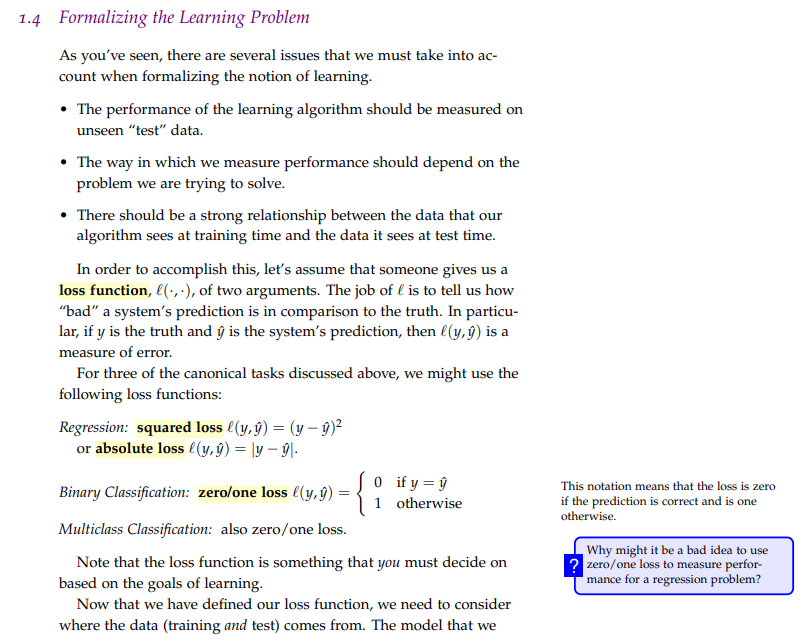
6. [1 point] Why is it a bad idea to use zero/one loss to measure performance for a regression problem?
1.4 Formalizing the Learning Problem As you've seen, there are several issues that we must take into ac- count when formalizing the notion of learning. The performance of the learning algorithm should be measured on unseen "test" data. The way in which we measure performance should depend on the problem we are trying to solve. There should be a strong relationship between the data that our algorithm sees at training time and the data it sees at test time. In order to accomplish this, let's assume that someone gives us a loss function, l(.,-), of two arguments. The job of l is to tell us how bad a system's prediction is in comparison to the truth. In particu- lar, if y is the truth and is the system's prediction, then l(y,) is a measure of error. For three of the canonical tasks discussed above, we might use the following loss functions: Regression: squared loss ly,y) = (y - y)2 or absolute loss lly,y) = \y - 9. Binary Classification: zero/one loss l(y,) so if y = y 1 otherwise Multiclass Classification: also zero/one loss. Note that the loss function is something that you must decide on based on the goals of learning. Now that we have defined our loss function, we need to consider where the data (training and test) comes from. The model that we { This notation means that the loss is zero if the prediction is correct and is one otherwise. Why might it be a bad idea to use ? zero/one loss to measure perfor- mance for a regression
Step by Step Solution
There are 3 Steps involved in it

Get step-by-step solutions from verified subject matter experts
 Study Help