







Question: Please read through and answer the questions 38 PARTI Introduction to Strategic Management Closing Case Shattered Dreams: Level 3 Communications In 1996 Jim Crowe sold
Please read through and answer the questions
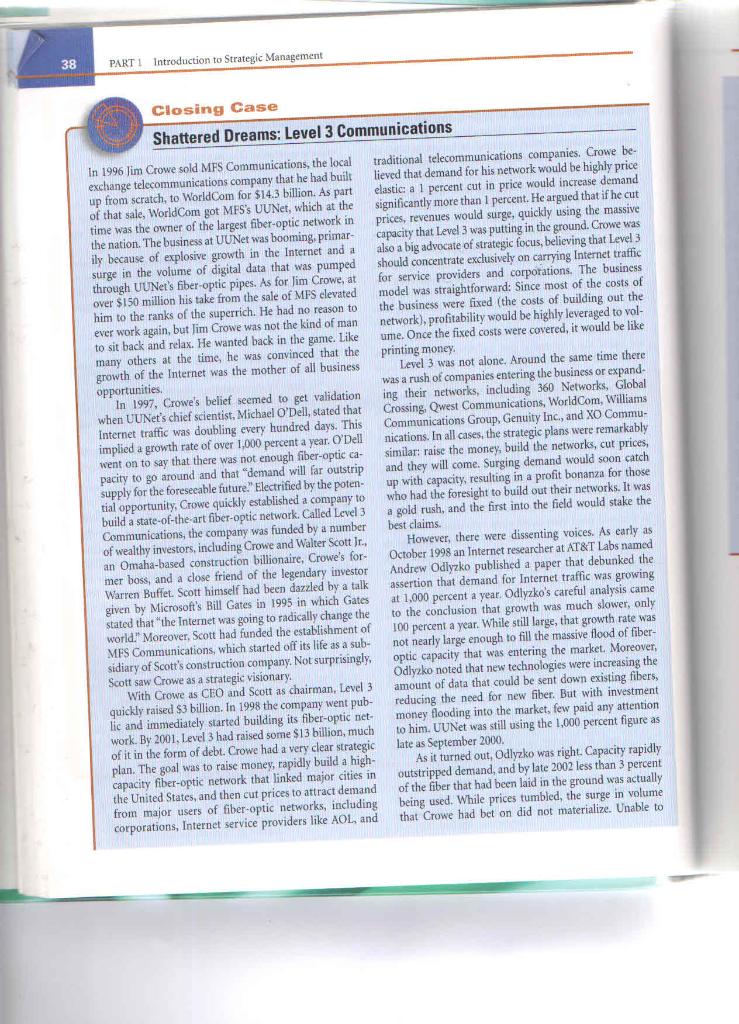
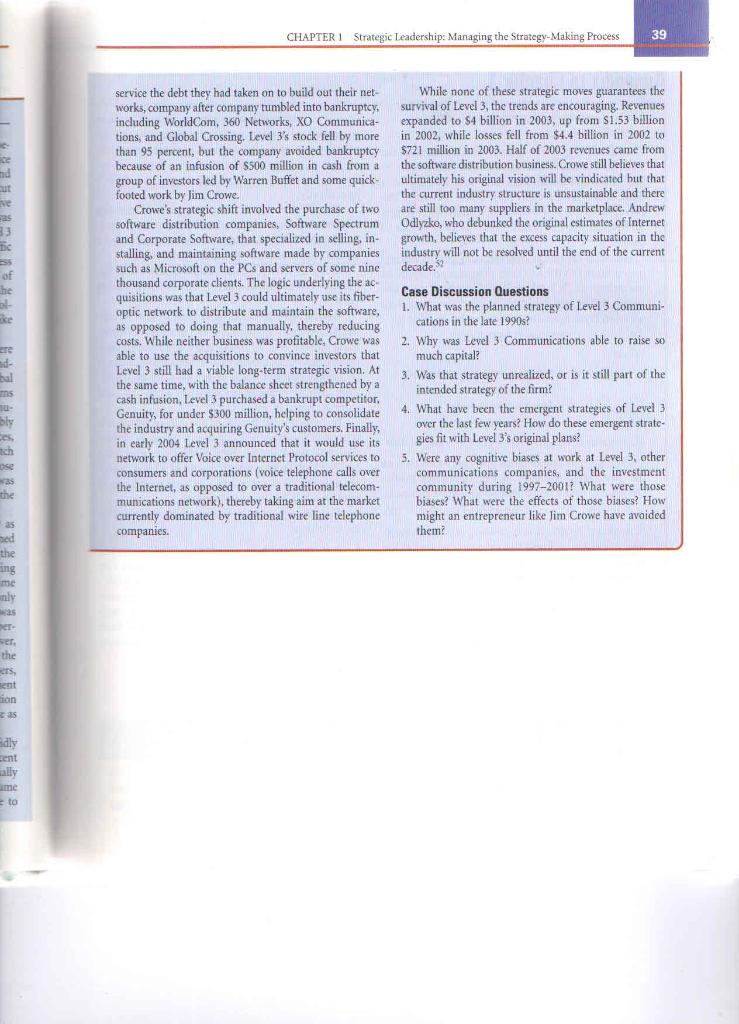
38 PARTI Introduction to Strategic Management Closing Case Shattered Dreams: Level 3 Communications In 1996 Jim Crowe sold MFS Communications, the local exchange telecommunications company that he had built up from scratch, to World Com for $14.3 billion. As part of that sale, World Com got MFS's UUNet, which at the time was the owner of the largest fiber optic network in the nation. The business at UUNet was booming, primar- ily because of explosive growth in the Internet and a surge in the volume of digital data that was pumped through UUNet's fiber optic pipes. As for Jim Crowe, at over $150 million his take from the sale of MFS elevated him to the ranks of the superrich. He had no reason to ever work again, but Jim Crowe was not the kind of man to sit back and relax. He wanted back in the game. Like many others at the time, he was convinced that the growth of the Internet was the mother of all business opportunities. In 1997, Crowe's belief seemed to get validation when UUNet's chief scientist. Michael O'Dell, stated that Internet traffic was doubling every hundred days. This implied a growth rate of over 1,000 percent a year. O'Dell went on to say that there was not enough fiber optic ca- pacity to go around and that "demand will far outstrip supply for the foreseeable future." Electrified by the poten tial opportunity, Crowe quickly established a company to build a state-of-the-art fiber optic network. Called Level 3 Communications, the company was funded by a number of wealthy investors, including Crowe and Walter Scott Jr., an Omaha-based construction billionaire, Crowe's for- mer boss, and a close friend of the legendary investor Warren Buffet. Scott himself had been dazzled by a talk given by Microsoft's Bill Gates in 1995 in which Gates stated that "the Internet was going to radically change the world." Moreover, Scott had funded the establishment of MFS Communications, which started off its life as a sub- sidiary of Scott's construction company. Not surprisingly, Scott saw Crowe as a strategic visionary With Crowe as CEO and Scott as chairman, Level 3 quickly raised $3 billion. In 1998 the company went pub- lic and immediately started building its fiber optic net- work. By 2001. Level 3 had raised some $13 billion, much of it in the form of debt. Crowe had a very clear strategic plan. The goal was to raise money, rapidly build a high- capacity fiber optic network that linked major cities in the United States, and then cut prices to attract demand from major users of fiber-optic networks, including corporations, Internet service providers like AOL, and traditional telecommunications companies. Crowe be- lieved that demand for his network would be highly price elastic: a 1 percent cut in price would increase demand significantly more than 1 percent. He argued that if he cut prices, revenues would surge, quickly using the massive capacity that Level 3 was putting in the ground. Crowe was also a big advocate of strategic focus, believing that Level 3 should concentrate exclusively on carrying Internet traffic for service providers and corporations. The business model was straightforward: Since most of the costs of the business were fixed (the costs of building out the network), profitability would be highly leveraged to vol- ume. Once the fixed costs were covered, it would be like printing money Level 3 was not alone. Around the same time there was a rush of companies entering the business or expand ing their networks, including 360 Networks, Global Crossing. Qwest Communications, World Com, Williams Communications Group, Genuity Inc., and XO Commu- nications. In all cases, the strategic plans were remarkably similar: raise the money, build the networks, cut prices, and they will come. Surging demand would soon catch up with capacity, resulting in a profit bonanza for those who had the foresight to build out their networks. It was a gold rush, and the first into the field would stake the best claims However, there were dissenting voices. As early as October 1998 an Internet researcher at AT&T Labs named Andrew Odlyzko published a paper that debunked the assertion that demand for Internet traffic was growing at 1,000 percent a year. Odlyzko's careful analysis came to the conclusion that growth was much slower, only 100 percent a year. While still large, that growth rate was not nearly large enough to fill the massive flood of fiber- optic capacity that was entering the market. Moreover, Odlyzko noted that new technologies were increasing the amount of data that could be sent down existing fibers, reducing the need for new fiber. But with investment money flooding into the market, few paid any attention to him. UUNet was still using the 1,000 percent figure as late as September 2000. As it turned out, Odlyzko was right. Capacity rapidly outstripped demand, and by late 2002 less than 3 percent of the fiber that had been laid in the ground was actually being used. While prices tumbled, the surge in volume that Crowe had bet on did not materialize. Unable toStep by Step Solution
There are 3 Steps involved in it
1 Expert Approved Answer
Step: 1 Unlock

Question Has Been Solved by an Expert!
Get step-by-step solutions from verified subject matter experts
Step: 2 Unlock
Step: 3 Unlock
 Study Help