Question: Please read through the text below posted, and answer the following questions. Please study the halo effect/stereotyping concepts, explaining the halo effect/stereotyping concepts briefly the
Please read through the text below posted, and answer the following questions.
Please study the halo effect/stereotyping concepts, explaining the halo effect/stereotyping concepts briefly the way the text below explains them, give a rationale for why you think the concepts are important/meaningful to interpersonal communication, and briefly give an example for each concept.
You may use examples from film or television, or further elaborate on your rationale/own ideas. The idea is to fully explain the relevance of the specific concept from the text's perspective and from your unique perspective.
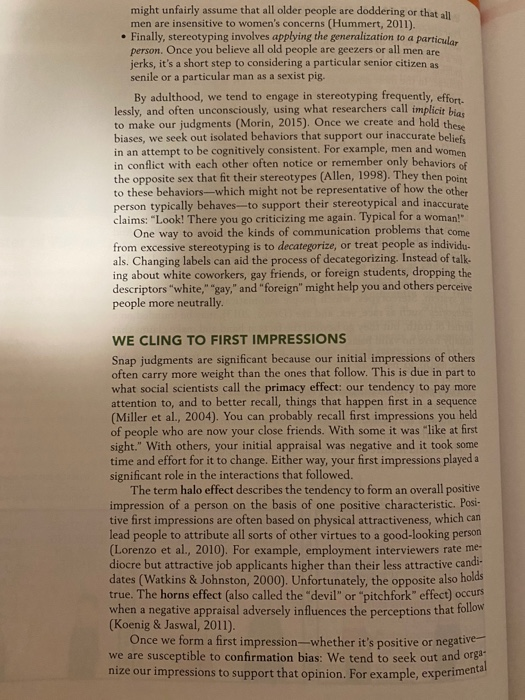
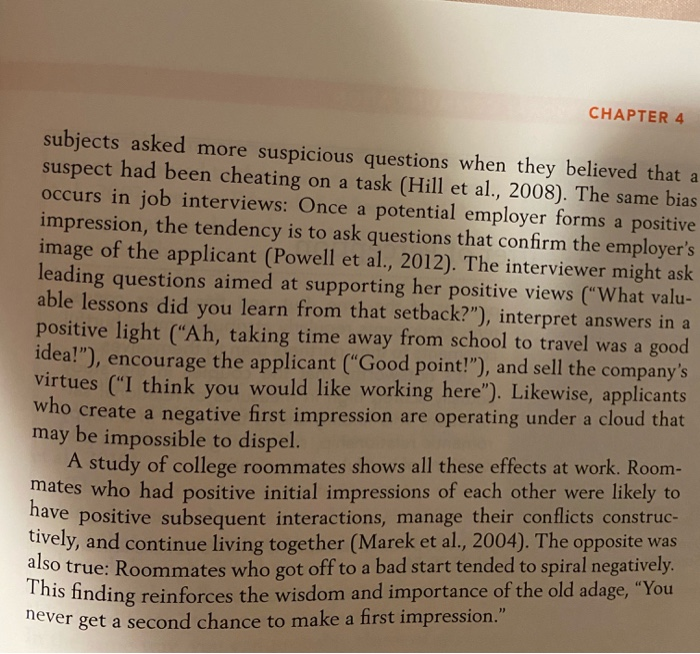
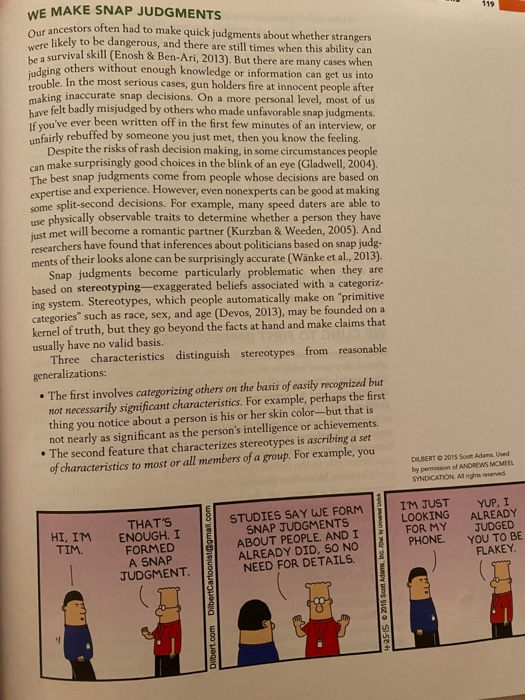
119 some WE MAKE SNAP JUDGMENTS Our ancestors often had to make quick judgments about whether strangers were likely to be dangerous, and there are still times when this ability can be a survival skill (Enosh & Ben-Ari, 2013). But there are many cases when judging others without enough knowledge or information can get us into trouble. In the most serious cases, gun holders fire at innocent people after making inaccurate snap decisions. On a more personal level, most of us have felt badly misjudged by others who made unfavorable snap judgments. If you've ever been written off in the first few minutes of an interview, or unfairly rebuffed by someone you just met, then you know the feeling. Despite the risks of rash decision making, in some circumstances people can make surprisingly good choices in the blink of an eye (Gladwell, 2004). The best snap judgments come from people whose decisions are based on expertise and experience. However, even nonexperts can be good at making e split-second decisions. For example, many speed daters are able to use physically observable traits to determine whether a person they have just met will become a romantic partner (Kurzban & Weeden, 2005). And researchers have found that inferences about politicians based on snap judg. ments of their looks alone can be surprisingly accurate (Wnke et al., 2013). Snap judgments become particularly problematic when they are based on stereotyping-exaggerated beliefs associated with a categoriz- ing system. Stereotypes, which people automatically make on "primitive categories such as race, sex, and age (Devos, 2013), may be founded on a kernel of truth, but they go beyond the facts at hand and make claims that abec usually have no valid basis. Three characteristics distinguish stereotypes from reasonable generalizations: The first involves categorizing others on the basis of easily recognized but not necessarily significant characteristics. For example, perhaps the first thing you notice about a person is his or her skin color-but that is not nearly as significant as the person's intelligence or achievements The second feature that characterizes stereotypes is ascribing a set of characteristics to most or all members of a group. For example, you DILBERTO 2015 Scott Adam Uued by permission of ANDREWS MCMIE SYNDICATION All rights reserved I'M JUST LOOKING FOR MY PHONE. THAT'S ENOUGH. I FORMED A SNAP JUDGMENT. HI, IM TIM YUP, I ALREADY JUDGED YOU TO BE FLAKEY STUDIES SAY WE FORM SNAP JUDGMENTS ABOUT PEOPLE AND I ALREADY DID, SO NO NEED FOR DETAILS. DilbertCartoonistgmail. LO SIS 1 owbert.com might unfairly assume that all older people are doddering or that all men are insensitive to women's concerns (Hummert, 2011). . Finally, stereotyping involves applying the generalization to a particular person. Once you believe all old people are geezers or all men are jerks, it's a short step to considering a particular senior citizen as senile or a particular man as a sexist pig. By adulthood, we tend to engage in stereotyping frequently, effort lessly, and often unconsciously, using what researchers call implicit bias to make our judgments (Morin, 2015). Once we create and hold these biases, we seek out isolated behaviors that support our inaccurate beliefs in an attempt to be cognitively consistent. For example, men and women in conflict with each other often notice or remember only behaviors of the opposite sex that fit their stereotypes (Allen, 1998). They then point to these behaviors--which might not be representative of how the other person typically behaves--to support their stereotypical and inaccurate claims: "Look! There you go criticizing me again. Typical for a woman!" One way to avoid the kinds of communication problems that come from excessive stereotyping is to decategorize, or treat people as individu- als. Changing labels can aid the process of decategorizing. Instead of talk. ing about white coworkers, gay friends, or foreign students, dropping the descriptors "white," "gay," and "foreign" might help you and others perceive people more neutrally. WE CLING TO FIRST IMPRESSIONS Snap judgments are significant because our initial impressions of others often carry more weight than the ones that follow. This is due in part to what social scientists call the primacy effect: our tendency to pay more attention to, and to better recall, things that happen first in a sequence (Miller et al., 2004). You can probably recall first impressions you held of people who are now your close friends. With some it was "like at first sight." With others, your initial appraisal was negative and it took some time and effort for it to change. Either way, your first impressions played a significant role in the interactions that followed. The term halo effect describes the tendency to form an overall positive impression of a person on the basis of one positive characteristic. Posi- tive first impressions are often based on physical attractiveness, which can lead people to attribute all sorts of other virtues to a good-looking person (Lorenzo et al., 2010). For example, employment interviewers rate me diocre but attractive job applicants higher than their less attractive candi- dates (Watkins & Johnston, 2000). Unfortunately, the opposite also holds true. The horns effect (also called the "devil" or "pitchfork effect) occurs when a negative appraisal adversely influences the perceptions that follow (Koenig & Jaswal, 2011). Once we form a first impression-whether it's positive or negative we are susceptible to confirmation bias: We tend to seek out and orga nize our impressions to support that opinion. For example, experimental CHAPTER 4 subjects asked more suspicious questions when they believed that a suspect had been cheating on a task (Hill et al., 2008). The same bias occurs in job interviews: Once a potential employer forms a positive impression, the tendency is to ask questions that confirm the employer's image of the applicant (Powell et al., 2012). The interviewer might ask leading questions aimed at supporting her positive views ("What valu- able lessons did you learn from that setback?"), interpret answers in a positive light ("Ah, taking time away from school to travel was a good idea!"), encourage the applicant ("Good point!"), and sell the company's virtues (I think you would like working here"). Likewise, applicants who create a negative first impression are operating under a cloud that may be impossible to dispel. A study of college roommates shows all these effects at work. Room- mates who had positive initial impressions of each other were likely to have positive subsequent interactions, manage their conflicts construc- tively, and continue living together (Marek et al., 2004). The opposite was also true: Roommates who got off to a bad start tended to spiral negatively. This finding reinforces the wisdom and importance of the old adage, "You never get a second chance to make a first impression









 Study Help