



Question: please refer to the page below to answer the question 2. Briefly discuss the three key activities in the strategic management process. Why is it

please refer to the page below to answer the question
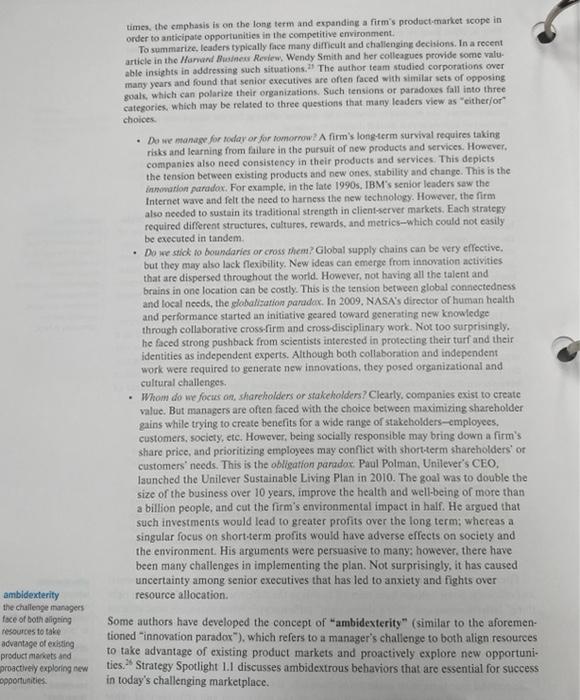
2. Briefly discuss the three key activities in the strategic management process. Why is it important for manag- ers to recognize the interdependent nature of these activities? times, the emphasis is on the long term and expanding a firm's product-market scope in order to anticipate opportunities in the competitive environment. To summarize, leaders typically free many difficult and challenging decisions. In a recent article in the Hanand Business Review, Wendy Smith and her colleagues provide some valu able insights in addressing such situations. The author team studied corporations over many years and found that senior executives are often faced with similar sets of opposing goals, which can polarize their organizations. Such tensions or paradoxes fall into three categories, which may be related to three questions that many leaders view as either/or choices Do we manager for rodar or for tomorrow? A firm's long-term survival requires taking risks and learning from failure in the pursuit of new products and services. However, companies also need consistency in their products and services. This depicts the tension between existing products and new ones, stability and change. This is the Innovation paradox. For example, in the late 1990s, IBM's senior leaders saw the Internet wave and felt the need to harness the new technology. However, the firm also needed to sustain its traditional strength in client-server markets. Each strategy required different structures, cultures, rewards, and metrics-which could not easily be executed in tandem Do we stick to boundaries or cross them? Global supply chains can be very effective, but they may also lack flexibility. New ideas can emerge from innovation activities that are dispersed throughout the world. However, not having all the talent and brains in one location can be costly. This is the tension between global connectedness and local needs, the globalization parudex. In 2009, NASA's director of human health and performance started an initiative geared toward generating new knowledge through collaborative crossfirm and cross-disciplinary work. Not too surprisingly. he faced strong pushback from scientists interested in protecting their turf and their identities as independent experts. Although both collaboration and independent work were required to generate new innovations, they posed organizational and cultural challenges Whom do we focus or shareholders or stakeholders? Clearly, companies exist to create value. But managers are often faced with the choice between maximizing shareholder gains while trying to create benefits for a wide range of stakeholders-employees, customers, society, etc. However, being socially responsible may bring down a firm's Share price, and prioritizing employees may conflict with short-term shareholders' or customers' needs. This is the obligation paradox Paul Polman, Unilever's CEO. launched the Unilever Sustainable Living Plan in 2010. The goal was to double the size of the business over 10 years, improve the health and well-being of more than a billion people, and cut the firm's environmental impact in half. He argued that such investments would lead to greater profits over the long term; whereas a singular focus on short-term profits would have adverse effects on society and the environment. His arguments were persuasive to many: however, there have been many challenges in implementing the plan. Not surprisingly, it has caused uncertainty among senior executives that has led to anxiety and fights over resource allocation. ambidexterity the challenge managers face of both allting resources to take advantage of existing product markets and proactively exploring new opportunities Some authors have developed the concept of "ambidexterity" (similar to the aforemen- tioned innovation paradox"), which refers to a manager's challenge to both align resources to take advantage of existing product markets and proactively explore new opportuni- ties. Strategy Spotlight 1.1 discusses ambidextrous behaviors that are essential for success in today's challenging marketplace
Step by Step Solution
There are 3 Steps involved in it
1 Expert Approved Answer
Step: 1 Unlock

Question Has Been Solved by an Expert!
Get step-by-step solutions from verified subject matter experts
Step: 2 Unlock
Step: 3 Unlock