







Question: Please reference the question below. Crop Yield per acre (Ibs) Deposit Amounts 0% 50% 100% Average 1,800 P-place an order 90% 75% 60% An orchard
Please reference the question below.
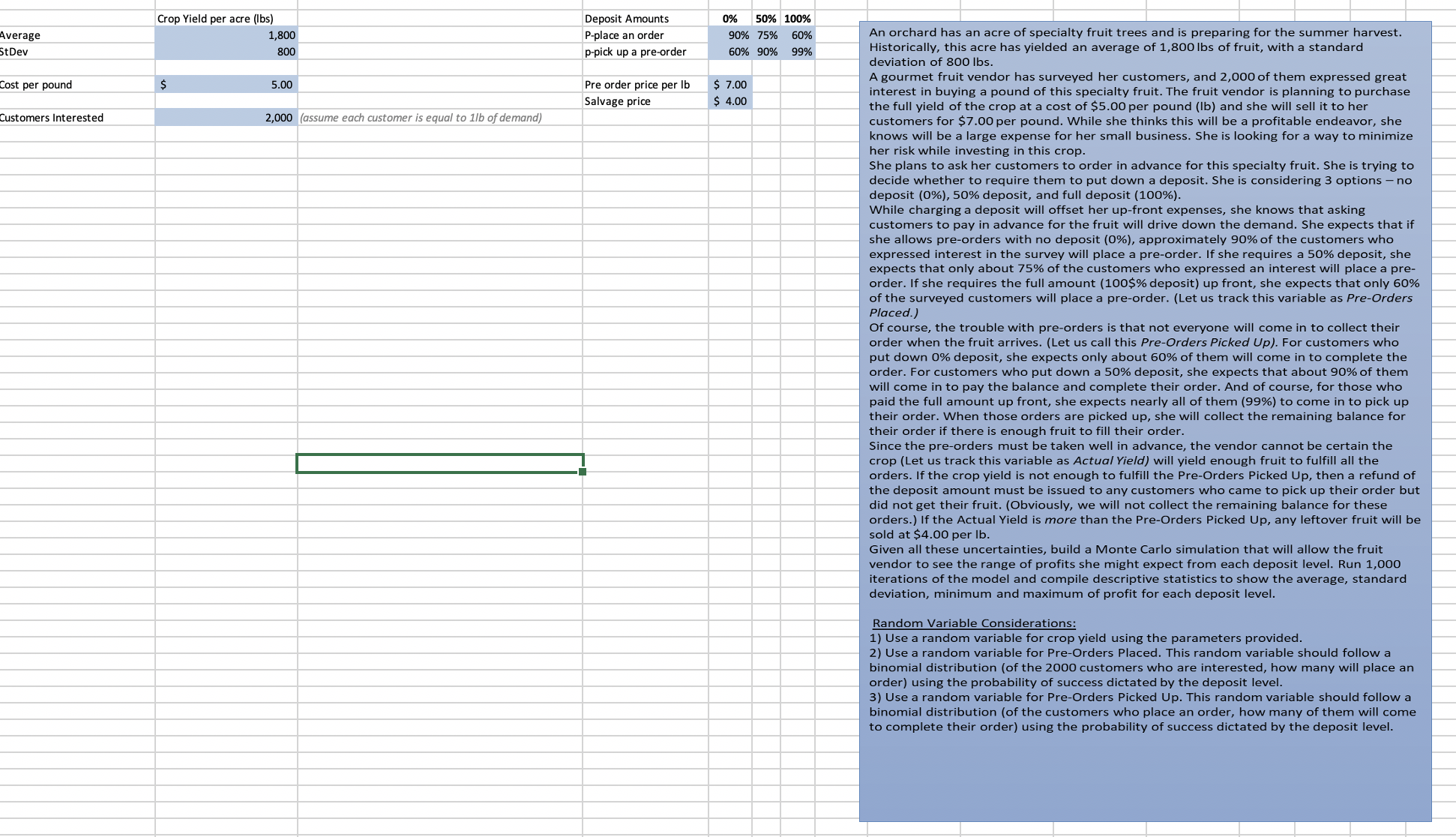
Crop Yield per acre (Ibs) Deposit Amounts 0% 50% 100% Average 1,800 P-place an order 90% 75% 60% An orchard has an acre of specialty fruit trees and is preparing for the summer harvest. St Dev 800 p-pick up a pre-order 60% 90% 99% Historically, this acre has yielded an average of 1,800 lbs of fruit, with a standard deviation of 800 lbs. Cost per pound $ 5.00 Pre order price per lb $ 7.00 A gourmet fruit vendor has surveyed her customers, and 2,000 of them expressed great Salvage price $ 4.00 interest in buying a pound of this specialty fruit. The fruit vendor is planning to purchase Customers Interested 2,000 (assume each customer is equal to 1lb of demand) the full yield of the crop at a cost of $5.00 per pound (lb) and she will sell it to her customers for $7.00 per pound. While she thinks this will be a profitable endeavor, she knows will be a large expense for her small business. She is looking for a way to minimize her risk while investing in this crop. She plans to ask her customers to order in advance for this specialty fruit. She is trying to decide whether to require them to put down a deposit. She is considering 3 options - no deposit (0%), 50% deposit, and full deposit (100%). While charging a deposit will offset her up-front expenses, she knows that asking customers to pay in advance for the fruit will drive down the demand. She expects that if she allows pre-orders with no deposit (0%), approximately 90% of the customers who expressed interest in the survey will place a pre-order. If she requires a 50% deposit, she expects that only about 75% of the customers who expressed an interest will place a pre- order. If she requires the full amount (100$% deposit) up front, she expects that only 60% Placed.) of the surveyed customers will place a pre-order. (Let us track this variable as Pre-Orders Of course, the trouble with pre-orders is that not everyone will come in to collect their order when the fruit arrives. (Let us call this Pre-Orders Picked Up). For customers who put down 0% deposit, she expects only about 60% of them will come in to complete the order. For customers who put down a 50% deposit, she expects that about 90% of them will come in to pay the balance and complete their order. And of course, for those who paid the full amount up front, she expects nearly all of them (99%) to come in to pick up their order. When those orders are picked up, she will collect the remaining balance for their order if there is enough fruit to fill their order. Since the pre-orders must be taken well in advance, the vendor cannot be certain the crop (Let us track this variable as Actual Yield) will yield enough fruit to fulfill all the orders. If the crop yield is not enough to fulfill the Pre-Orders Picked Up, then a refund of the deposit amount must be issued to any customers who came to pick up their order but did not get their fruit. (Obviously, we will not collect the remaining balance for these orders.) If the Actual Yield is more than the Pre-Orders Picked Up, any leftover fruit will be sold at $4.00 per lb. Given all these uncertainties, build a Monte Carlo simulation that will allow the fruit vendor to see the range of profits she might expect from each deposit level. Run 1,000 iterations of the model and compile descriptive statistics to show the average, standard deviation, minimum and maximum of profit for each deposit level. Random Variable Considerations: 1) Use a random variable for crop yield using the parameters provided. 2) Use a random variable for Pre-Orders Placed. This random variable should follow a binomial distribution (of the 2000 customers who are interested, how many will place an order) using the probability of success dictated by the deposit level. 3) Use a random variable for Pre-Orders Picked Up. This random variable should follow a binomial distribution (of the customers who place an order, how many of them will come to complete their order) using the probability of success dictated by the deposit level
Step by Step Solution
There are 3 Steps involved in it

Get step-by-step solutions from verified subject matter experts
 Study Help