Question: Please remember to type or word process and submit a hard copy on the due date indicated above. Remember to attach your SPSS output for
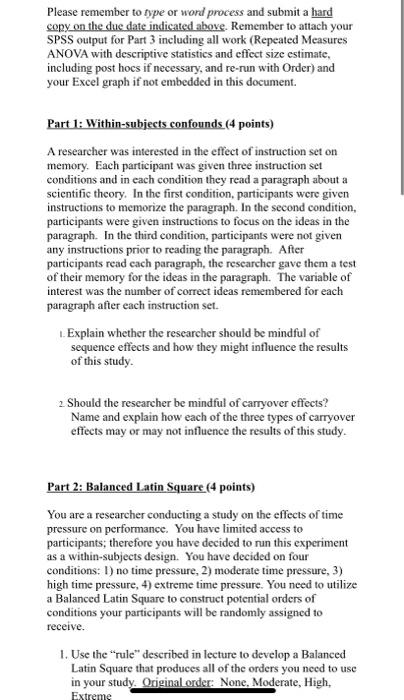
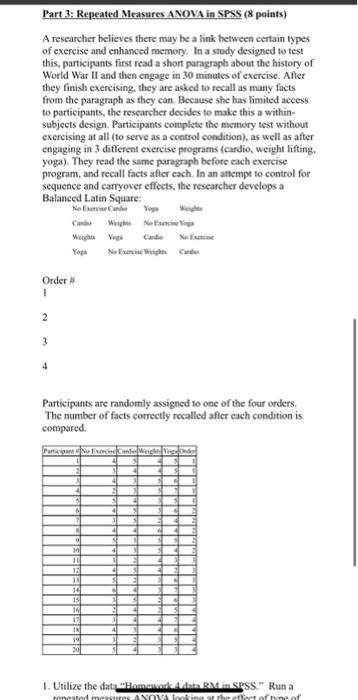
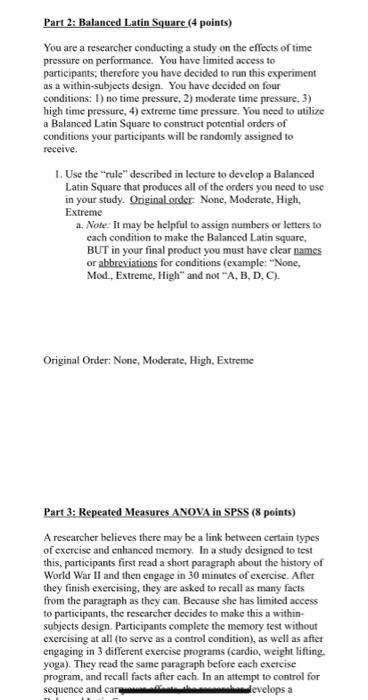
Please remember to type or word process and submit a hard copy on the due date indicated above. Remember to attach your SPSS output for Part 3 including all work (Repeated Measures ANOVA with descriptive statistics and effect size estimate, including post hocs if necessary, and re-run with Order) and your Excel graph if not embedded in this document. Part 1: Within-subjects confounds (4 points) A researcher was interested in the effect of instruction set on memory. Each participant was given three instruction set conditions and in each condition they read a paragraph about a scientific theory. In the first condition, participants were given instructions to memorize the paragraph. In the second condition, participants were given instructions to focus on the ideas in the paragraph. In the third condition, participants were not given any instructions prior to reading the paragraph. After participants read cach paragraph, the researcher gave them a test of their memory for the ideas in the paragraph. The variable of interest was the number of correct ideas remembered for each paragraph after each instruction set. 1. Explain whether the researcher should be mindful of sequence effects and how they might influence the results of this study. 2 Should the researcher be mindful of carryover effects? Name and explain how each of the three types of carryover effects may or may not influence the results of this study. Part 2: Balanced Latin Square (4 points) You are a researcher conducting a study on the effects of time pressure on performance. You have limited access to participants; therefore you have decided to run this experiment as a within-subjects design. You have decided on four conditions: 1) no time pressure, 2) moderate time pressure, 3) high time pressure, 4) extreme time pressure. You need to utilize a Balanced Latin Square to construct potential orders of conditions your participants will be randomly assigned to receive. 1. Use the "rule" described in lecture to develop a Balanced Latin Square that produces all of the orders you need to use in your study. Original order: None, Moderate, High, Extreme Part 3: Repeated Measures ANOVA in SPSS (8 points) A researcher believes there may be a link between certain types of exercise and enhanced memory. In a study designed to test this, participants first read a short paragraph about the history of World War II and then engage in 30 minutes of exercise. After they finish exercising, they are asked to recall as many facts from the paragraph as they can. Because she has limited access to participants, the researcher decides to make this a within subjects design. Participants complete the memory test without exercising at all (to serve as a control condition, as well as after engaging in 3 different exercise programs (cardio, weight lifting, yoga). They read the same paragraph before each exercise program, and recall facts after cach. In an attempt to control for sequence and carryover effects, the researcher develops a Balanced Latin Square: No Brinde Yap Cat Weights News Weight Yoga Yes Order # 1 2 3 Participants are randomly assigned to one of the four orders. The number of facts correctly recalled after each condition is compared Participant Nind and 11 18 22 15 14 13 11 19 1. Utilize the data omarek Adata RM SPSS. Run a Teated me ANOVA Part 2: Balanced Latin Square (4 points) You are a researcher conducting a study on the effects of time pressure on performance. You have limited access to participants, therefore you have decided to run this experiment as a within-subjects design. You have decided on four conditions: 1) no time pressure, 2) moderate time pressure. 3) high time pressure, 4) extreme time pressure. You need to utilize a Balanced Latin Square to construct potential orders of conditions your participants will be randomly assigned to receive 1. Use the rule" described in lecture to develop a Balanced Latin Square that produces all of the orders you need to use in your study. Original order: None, Moderate, High, Extreme a. Note: It may be helpful to assign numbers or letters to cach condition to make the Balanced Latin square, BUT in your final product you must have clear names or abbreviations for conditions (example: "None, Mod., Extreme, High" and not "A,B,D.. Original Order: None, Moderate, High, Extreme Part 3: Repeated Measures ANOVA in SPSS (8 points) A researcher believes there may be a link between certain types of exercise and enhanced memory. In a study designed to test this participants first read a short paragraph about the history of World War II and then engage in 30 minutes of exercise. After they finish exercising, they are asked to recall as many facts from the paragraph as they can. Because she has limited access to participants, the researcher decides to make this a within subjects design. Participants complete the memory test without exercising at all (to serve as a control condition), as well as after engaging in 3 different exercise programs (cardio, weight lifting. yoga). They read the same paragraph before each exercise program, and recall facts after cach. In an attempt to control for sequence and care develops a









 Study Help