







Question: Please Respond to the two Class Mates' posts below. I Just Need Help With Responding to The Two Classmate's Posts Below. A Small Paragraph for
Please Respond to the two Class Mates' posts below. I Just Need Help With Responding to The Two Classmate's Posts Below. A Small Paragraph for each will be helpful. Thank You!
This was the question they had to answer: "Risk management is a critical aspect of project management.The supply chain decisions that are made have risks involved, like any other project decision. Comment on two examples of risks that can occur in the supply chain that can affect a project. What can a project manager suggest to reduce or eliminate the risks that you defined? Provide professional examples, if at all possible, from a project you have managed or of which you have been a team member.
Post 1
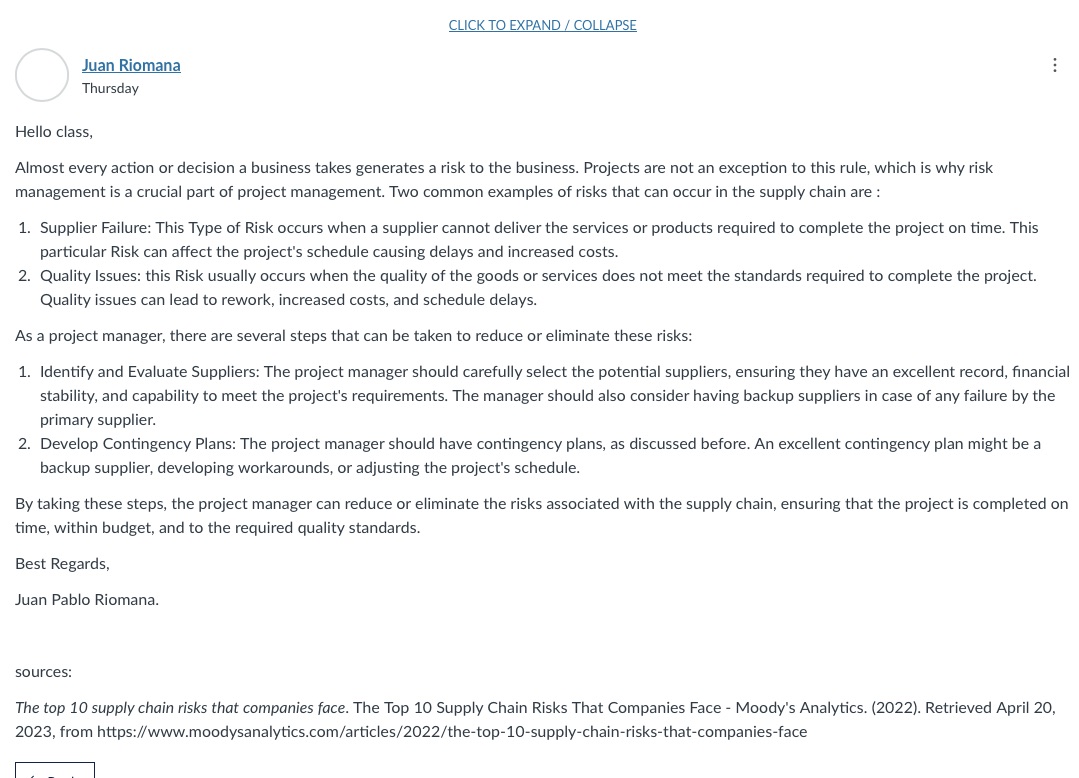
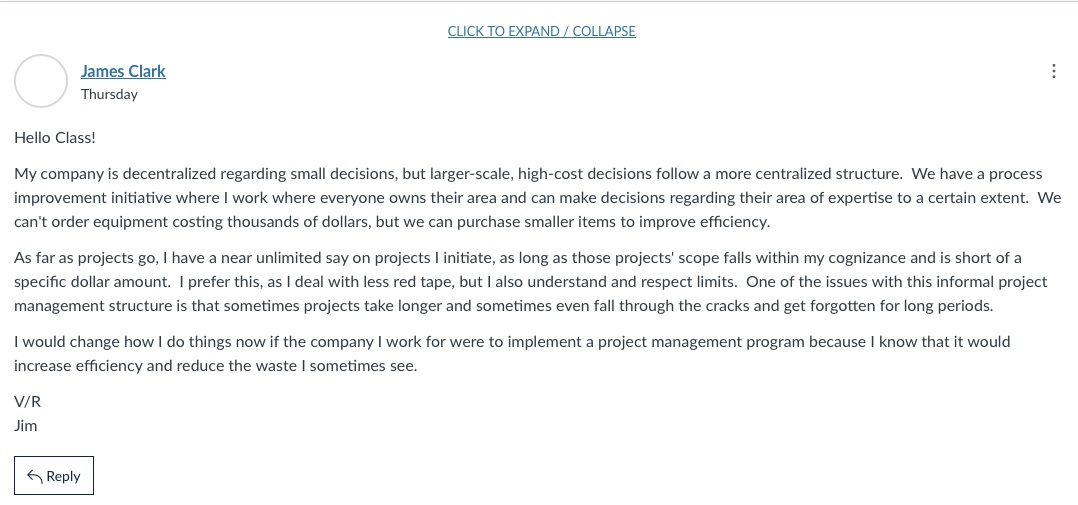
CLICK TO EXPAND f COLLAPSE Juan Rio mana Thursday Hello class, Almost every action or decision a business takes generates a risk to the business. Projects are not an exception to this rule, which is why risk management is a crucial part of project management. Two common examples of risks that can occur in the supply chain are: 1. Supplier Failure: This Type of Risk occurs when a supplier cannot deliver the services or products required to complete the project on time. This particular Risk can affect the project's schedule causing delays and increased costs. 2. Quality Issues: this Risk usually occurs when the quality of the goods or services does not meet the standards required to complete the project. Quality issues can lead to rework, increased costs, and schedule delays. As a project manager, there are several steps that can be taken to reduce or eliminate these risks: 1. Identify and Evaluate Suppliers: The project manager should carefully select the potential suppliers, ensuring they have an excellent record, nancial stability, and capability to meet the project's requirements. The manager should also consider having backup suppliers in case of any failure by the primary supplier. 2. Develop Contingency Plans: The project manager should have contingency plans, as discussed before. An excellent contingency plan might be a backup supplier, developing workarounds, or adjusting the project's schedule. By taking these steps, the project manager can reduce or eliminate the risks associated with the supply chain, ensuring that the project is completed on time, within budget, and to the required quality standards. Best Regards, Juan Pablo Riomana. sources: The top 10 supply chain risks that companies face. The Top 10 Supply Chain Risks That Companies Face Moody's Analytics, {2022}. Retrieved April 20, 2023, from https://www.moodysanalytics.comfarticles/2022/thetop10supplychainrisksthatcompanies'iace ._. CLICK TO EXPAND / COLLAPSE O James Clark Thursday Hello Class! My company is decentralized regarding small decisions, but larger-scale, high-cost decisions follow a more centralized structure. We have a process improvement initiative where I work where everyone owns their area and can make decisions regarding their area of expertise to a certain extent. We can't order equipment costing thousands of dollars, but we can purchase smaller items to improve efficiency. As far as projects go, I have a near unlimited say on projects I initiate, as long as those projects' scope falls within my cognizance and is short of a specific dollar amount. I prefer this, as I deal with less red tape, but I also understand and respect limits. One of the issues with this informal project management structure is that sometimes projects take longer and sometimes even fall through the cracks and get forgotten for long periods. I would change how I do things now if the company I work for were to implement a project management program because I know that it would increase efficiency and reduce the waste I sometimes see. V/R Jim Reply
Step by Step Solution
There are 3 Steps involved in it

Get step-by-step solutions from verified subject matter experts
 Study Help