Question: Please respond to this discussion post and create dialogue with sharing similarities and differences with our leadership style and share any additional thoughts Michael Sanders
Please respond to this discussion post and create dialogue with sharing similarities and differences with our leadership style and share any additional thoughts
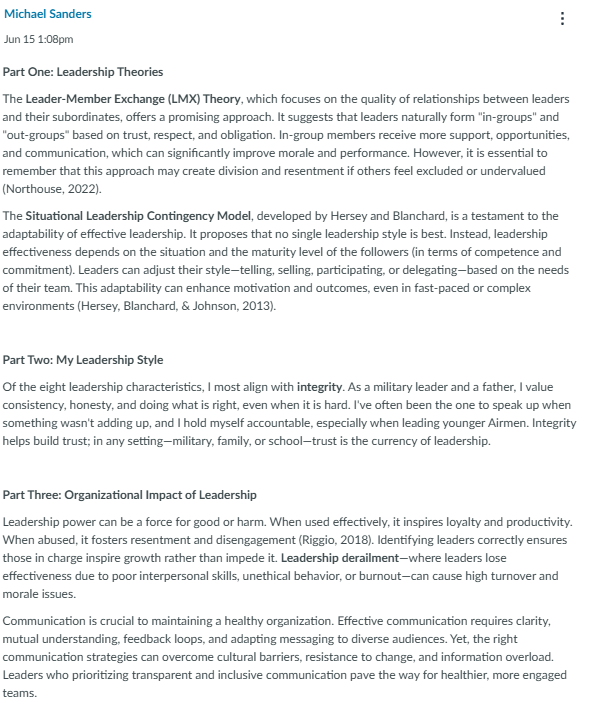
Michael Sanders : Jun 15 1:08pm Part One: Leadership Theories The Leader-Member Exchange (LMX) Theory, which focuses on the quality of relationships between leaders and their subordinates, offers a promising approach. It suggests that leaders naturally form \"in-groups" and \"out-groups\" based on trust, respect, and obligation. In-group members receive more support, opportunities, and communication, which can significantly improve morale and performance. However, it is essential to remember that this approach may create division and resentment if others feel excluded or undervalued (Northouse, 2022). The Situational Leadership Contingency Model, developed by Hersey and Blanchard, is a testament to the adaptability of effective leadership. It proposes that no single leadership style is best. Instead, leadership effectiveness depends on the situation and the maturity level of the followers (in terms of competence and commitment). Leaders can adjust their styletelling, selling, participating, or delegatingbased on the needs of their team. This adaptability can enhance motivation and outcomes, even in fast-paced or complex environments (Hersey, Blanchard, & Johnson, 7013). Part Two: My Leadership Style Of the eight leadership characteristics, | most align with integrity. As a military leader and a father. | value consistency, honesty, and doing what is right, even when it is hard. I've often been the one to speak up when something wasn't adding up, and | hold myself accountable, especially when leading younger Airmen. Integrity helps build trust: in any settingmilitary, family, or schooltrust is the currency of leadership. Part Three: Organizational Impact of Leadership Leadership power can be a force for good or harm. When used effectively, it inspires loyalty and productivity. When abused, it fosters resentment and disengagement (Riggio, 20198). Identifying leaders correctly ensures those in charge inspire growth rather than impede it. Leadership derailmentwhere leaders lose effectiveness due to poor interpersonal skills, unethical behavior, or burmoutcan cause high turnover and morale issues. Communication is crucial to maintaining a healthy organization. Effective communication requires clarity, mutual understanding, feedback loops, and adapting messaging to diverse audiences. Yet, the right communication strategies can overcome cultural barriers, resistance to change, and information overload. Leaders who prioritizing transparent and inclusive communicaton pave the way for healthier, more engaged teams









 Study Help