







Question: Please review below data sources to answer the questions below it. Data : The possibility of having robots or mechanical assistants completing our laborious, dangerous,
Please review below data sources to answer the questions below it.
Data:
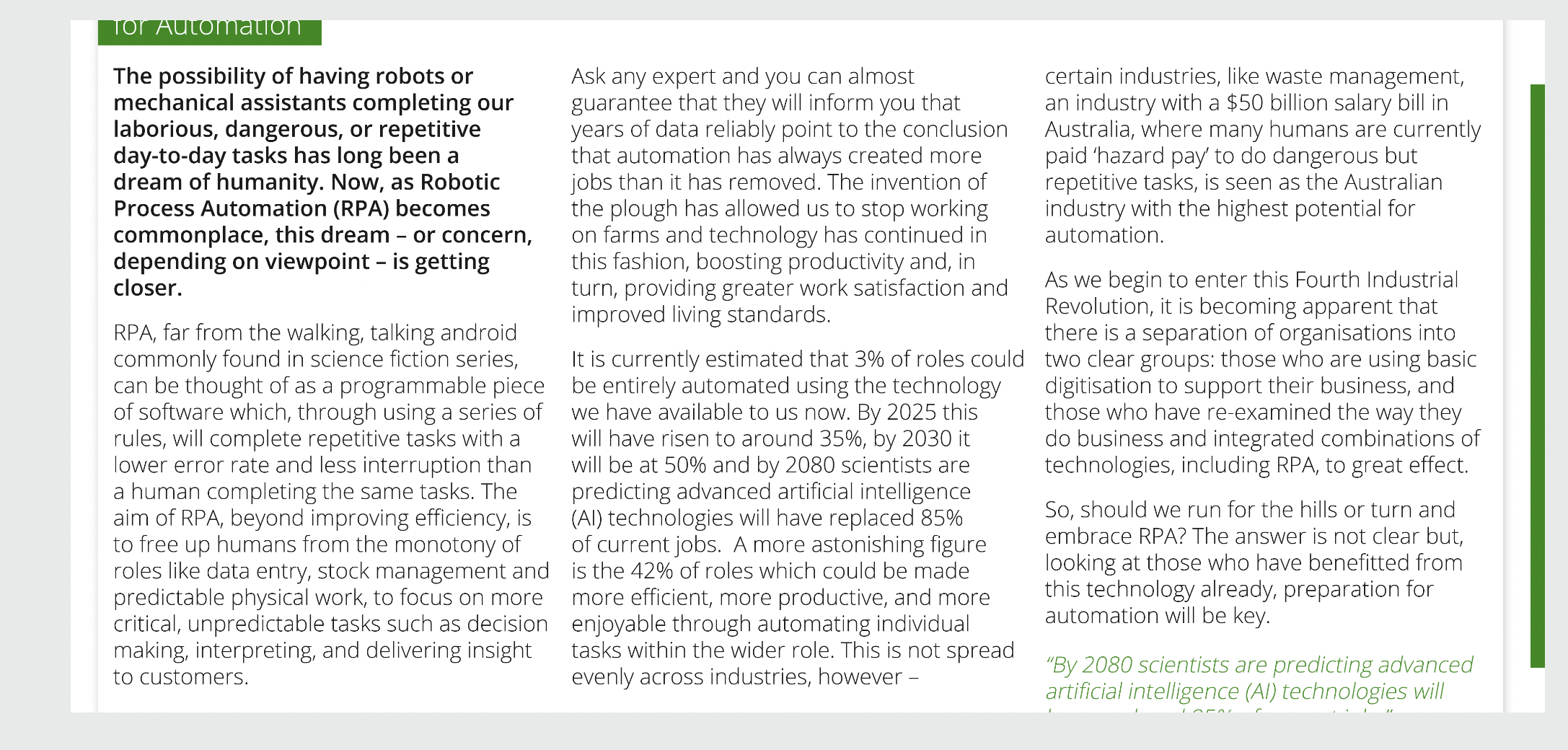
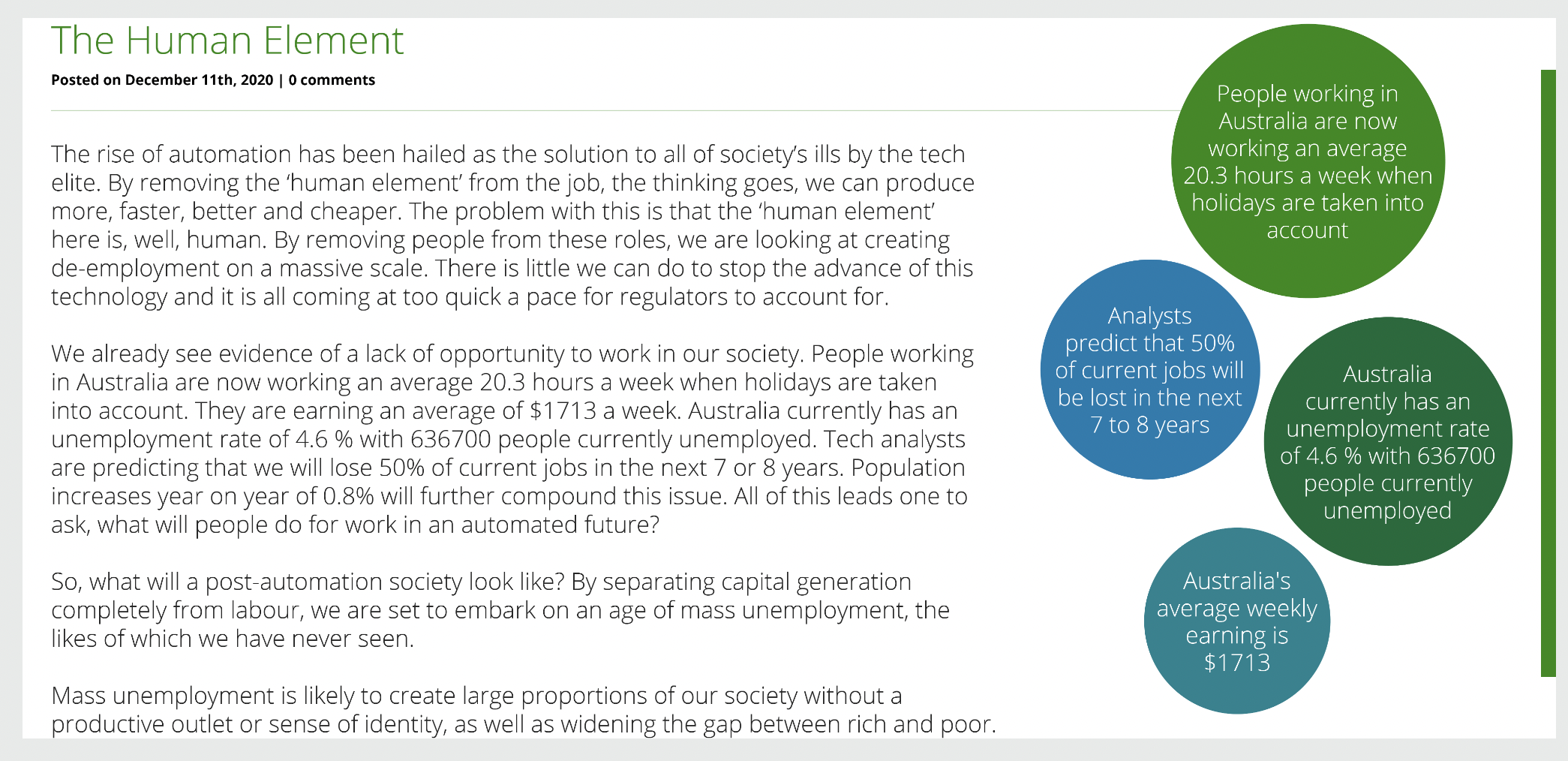
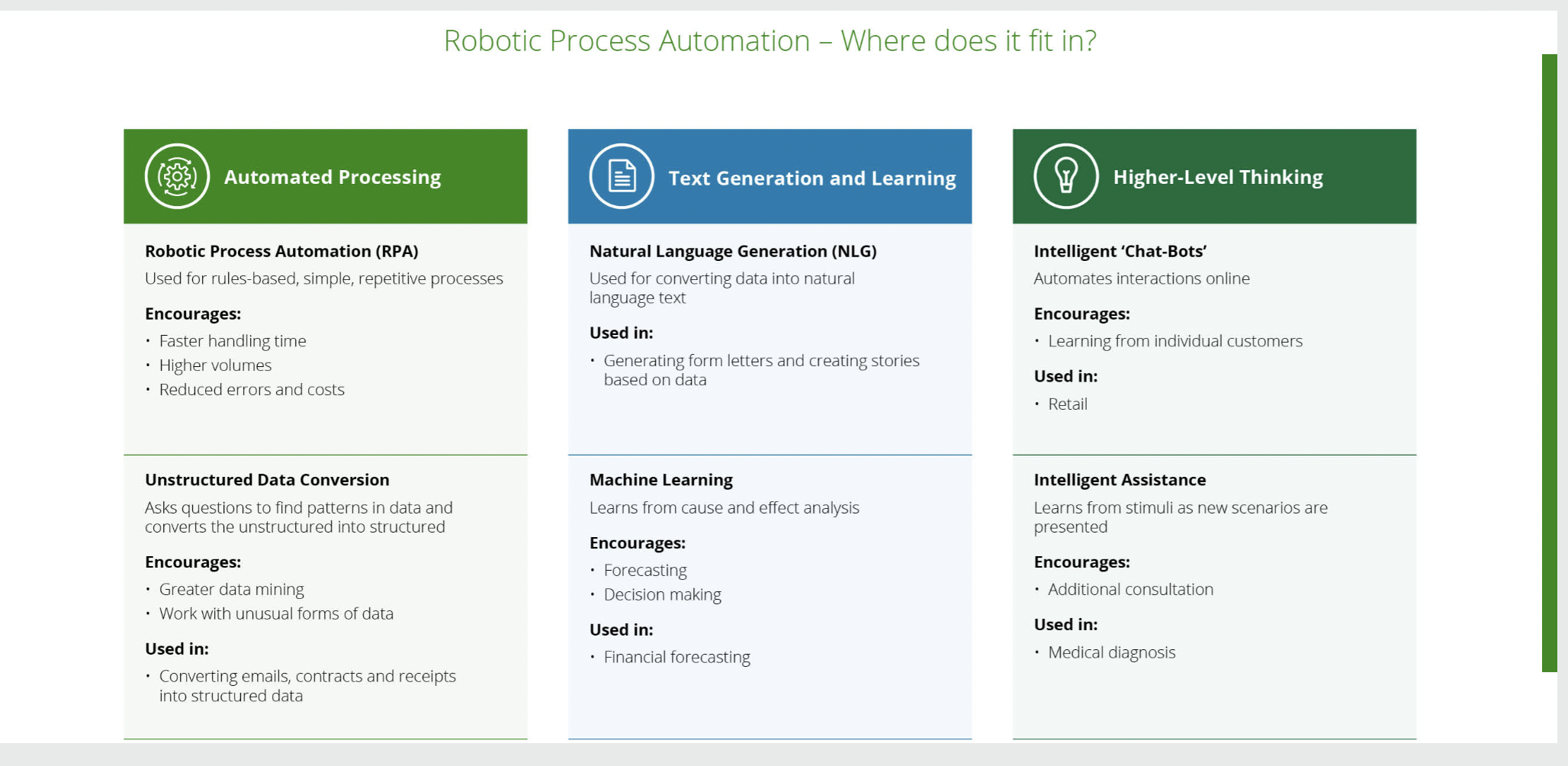
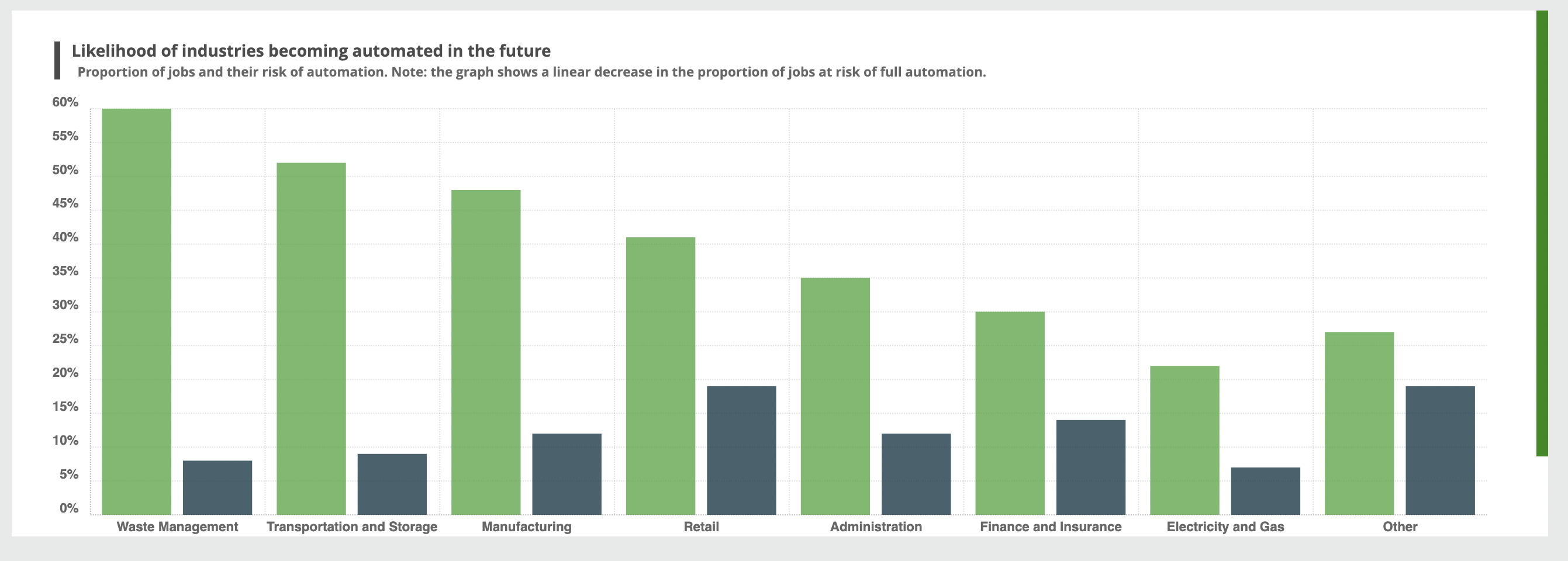
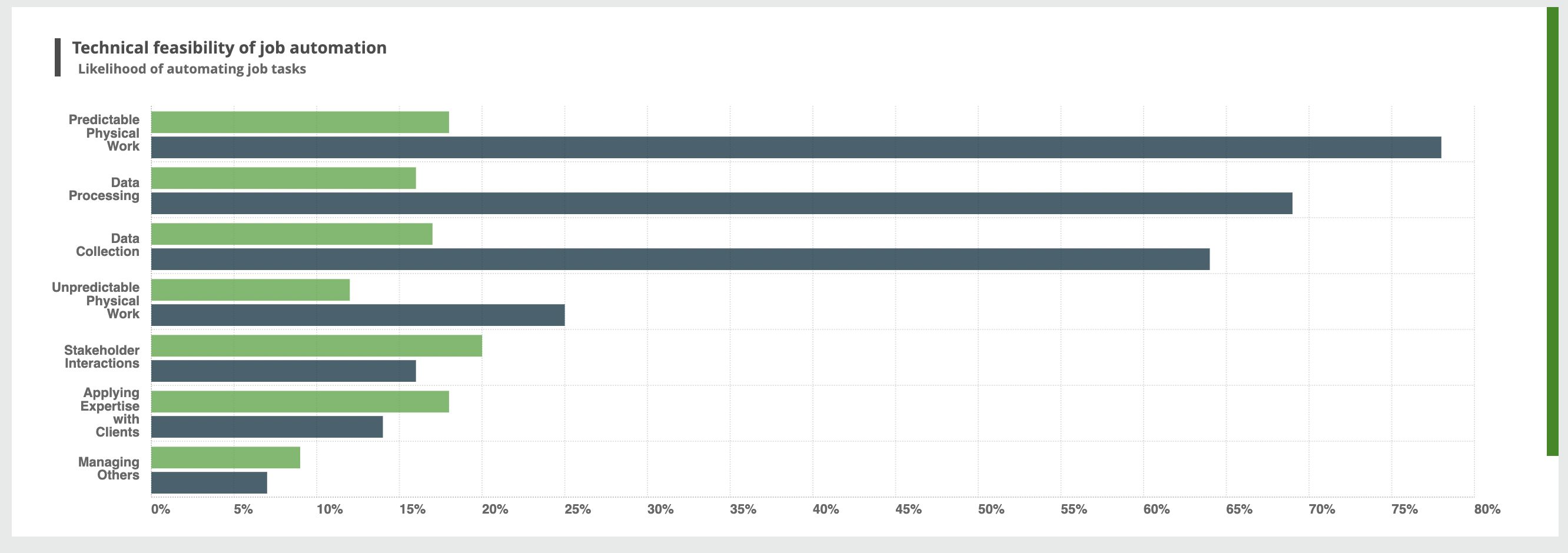
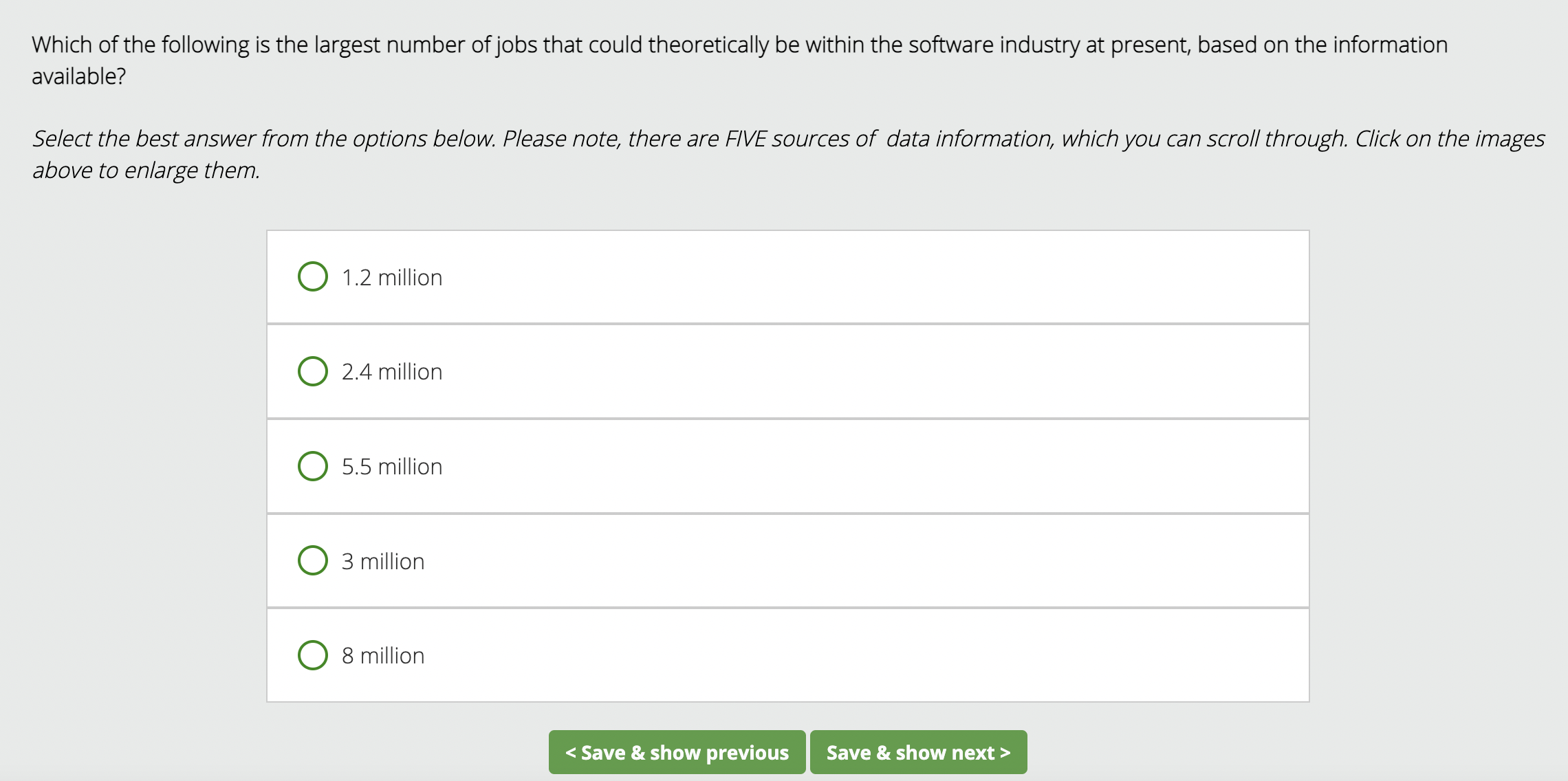
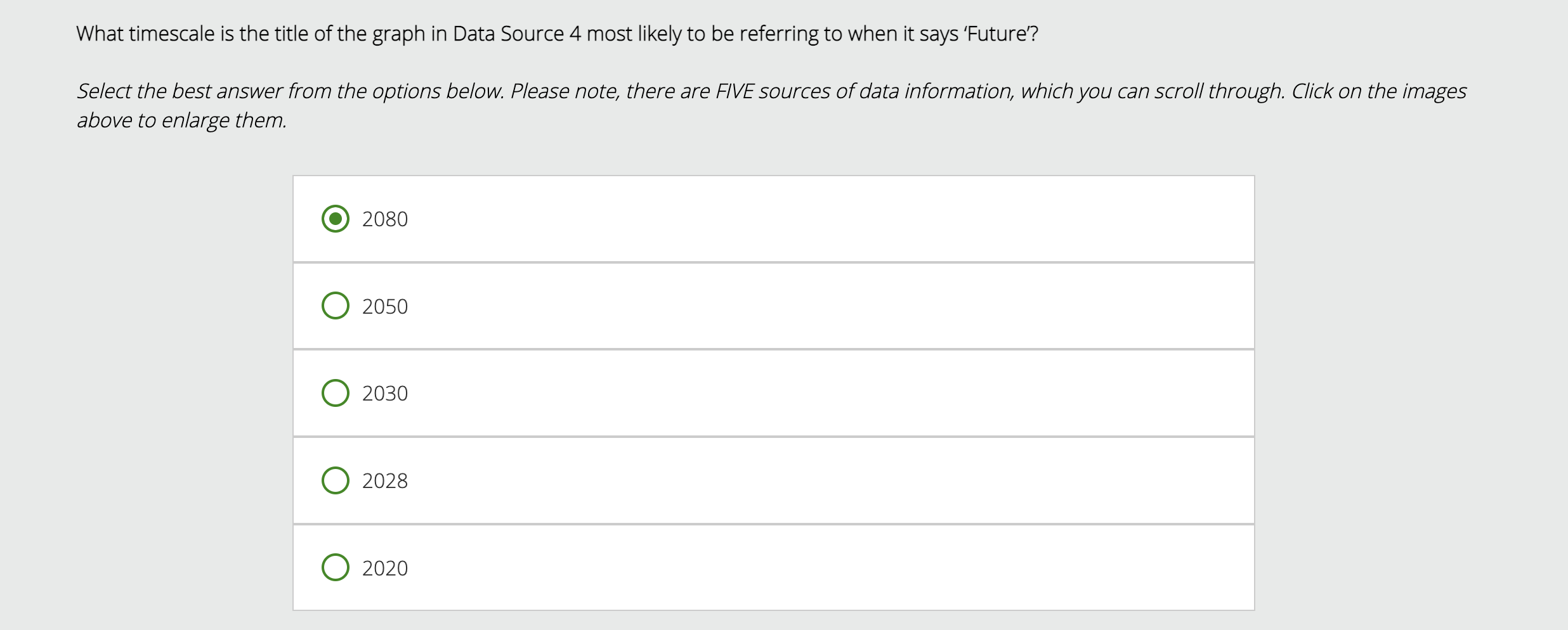
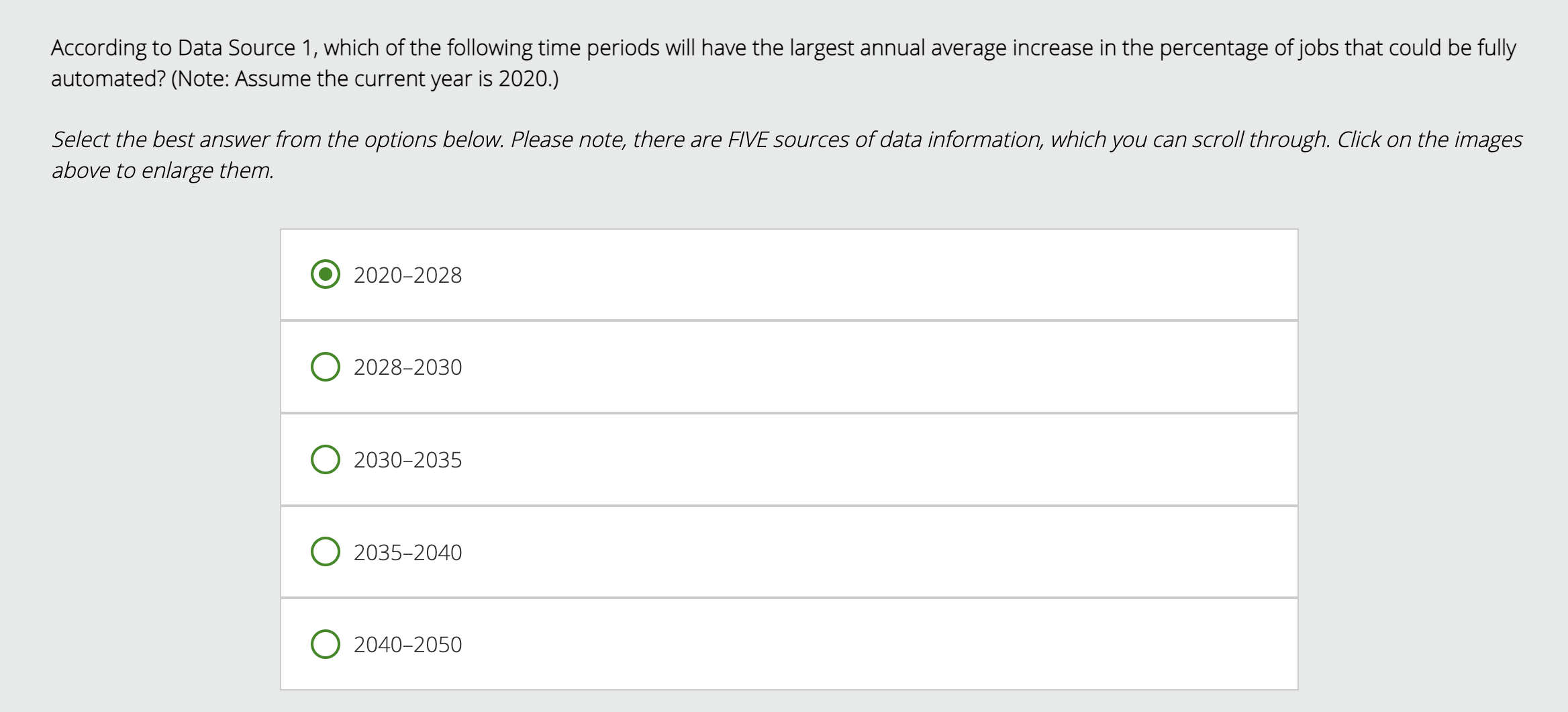
The possibility of having robots or mechanical assistants completing our laborious, dangerous, or repetitive day-to-day tasks has long been a dream of humanity. Now, as Robotic Process Automation (RPA) becomes commonplace, this dream or concern, depending on viewpoint is getting closer. RPA, far from the walking, talking android commonly found in science fiction series, can be thought of as a programmable piece of software which, through using a series of rules, will complete repetitive tasks with a lower error rate and less interruption than a human completing the same tasks. The aim of RPA, beyond improving efciency, is to free up humans from the monotony of roles like data entry, stock management and predictable physical work, to focus on more critical, unpredictable tasks such as decision making, interpreting, and delivering insight to customers. Ask any expert and you can almost guarantee that they will inform you that years ofdata reliably point to the conclusion that automation has always created more joas than it has removed. The invention of the plough has allowed us to stop working or farms and technology has continued in th's fashion, boosting productivity and, in turn, providing greater work satisfaction and irr proved living standards, It 's currently estimated that 3% of roles could be entirely automated using the technology we have available to us now. By 2025 this w' I have risen to around 35%, by 2030 it w I be at 50% and by 2080 scientists are predicting advanced artificial intelligence (A ) technologies will have replaced 85% of currentjobs. A more astonishing gure is he 42% of roles which could be made more efficient, more productive, and more enjoyable through automating individual tasks within the wider role. This is not spread evenly across industries, however a certain industries, like waste management, an industry with a $50 billion salary bill in Australia, where many humans are currently paid 'hazard pay' to do dangerous but repetitive tasks, is seen as the Australian industry with the highest potential for automation. As we begin to enter this Fourth Industrial Revolution, it is becoming apparent that there is a separation of organisations into two clear groups: those who are using basic digitisation to support their business, and those who have reexamined the way they do business and integrated combinations of technologies, including RPA, to great effect. So, should we run for the hills or turn and embrace RPA? The answer is not clear but, looking at those who have benefitted from this technology already, preparation for automation will be key. \"By 2080 scientists are predicting advanced articial intelligence (Al) technologies will The Human Element POStEd On December 11th, 2020 I 0 comments The rise ofautomation has been hailed as the solution to all of society's ills by the tech elite. By removing the 'human element' from the job, the thinking goes, we can produce more, faster, better and cheaper. The problem with this is that the 'human element' here is, well, human. By removing people from these roles, we are looking at creating deemployment on a massive scale. There is little we can do to stop the advance ofthis technology and it is all coming at too quick a pace for regulators to account for. We already see evidence ofa lack of opportunity to work in our society. People working in Australia are now working an average 20.3 hours a week when holidays are taken into account. They are earning an average of $1 71 3 a week. Australia currently has an unemployment rate of 4.6 % with 636700 people currently unemployed. Tech analysts are predicting that we will lose 50% of current jobs in the next 7 or 8 years. Population increases year on year of 0.8% will further compound this issue. All of this leads one to ask, what wiil people do for work in an automated future? So, what will a postautomation society look like? By separating capital generation completely from labour, we are set to embark on an age of mass unemployment, the likes of which we have never seen. Mass unemployment is likely to create large proportions of our society without a productive outlet or sense of identity, as well as widening the gap between rich and poor. People working in Australia are now working an average 20.3 hours a week when holidays are taken into account Analysts predict that 50% of current jobs will be lost in the next 7 to 8 years Australia currently has an unemt :yrnent rate of 4.6 .0 with 636700 people currently unemployed Australia's average weekly earning is $'l 7 'l 3 Robotic Process Automation Where does it t in? A. Automated Processing . Text Generation and Learning @ Higher-Level Thinking Robotic Process Automation (RPA) Natural Language Generation (NLG) Intelligent 'Chat-Bots' Used for rulesebased, simple, repetitive processes Used for converting data into natural Automates interactions online language text Encourages: Encourages: - Faster handling time Used "u - Learningfrom individual customers . Higher volumes - Generating form letters and creating stories _ based on data Used In: ~ Reduced errors and costs - Retail Unstructured Data Conversion Machine Learning Intelligent Assistance ASIG questions to nd patterns in data and Learns from cause and effect analysis Learns from stimuli as new scenarios are converts the unstructured into structured presented Encourages: Encourages: _ Forecasting Encourages: - Greater data mining . Decision making - Additional consultation - Work with unusual forms of data . . Used in: Used "'~ Used m: - Financial forecasting ' Medical diagnosis ' Converting emails, contracts and receipts into structured data Likelihood of industries becoming automated in the future Proportion of jobs and their risk of automation. Note: the graph shows a linear decrease in the proportion of jobs at risk of full automation. 60% 55% 50% 45% 40% 35% 30% 25% 20% 15% 10% 5% 0% Transportation and Storage Retail Administration Finance and Insurance Electricity and Gas Other Waste Management ManufacturingTechnical feasibility of job automation Likelihood of automating job tasks Predictable Physical Work Data Processing Data Collection Unpredictable Physical Work Stakeholder Interactions Applying Expertise with Clients Managing Others 70% 75% 80% 35% 40% 45% 50% 55% 60% 65% 15% 20% 25% 30% 0% 5% 10%Which of the following is the largest number of jobs that could theoretically be within the software industry at present, based on the information available? Select the best answer from the options below. Please note, there are FIVE sources of data information, which you can scroll through. Click on the images above to enlarge them. 1.2 million 2.4 million 5.5 million 3 million 8 million What timescale is the title of the graph in Data Source 4 most likely to be referring to when it says 'Future'? Select the best answer from the options below. Please note, there are FIVE sources of data information, which you can scroll through. Click on the images above to enlarge them. O 2080 2050 O 2030 O 2028 2020According to Data Source 1, which of the following time periods will have the largest annual average increase in the percentage of jobs that could be fully automated? (Note: Assume the current year is 2020.) Select the best answer from the options below. Please note, there are FIVE sources of data information, which you can scroll through. Click on the images above to enlarge them. O 2020-2028 2028-2030 2030-2035 2035-2040 2040-2050
Step by Step Solution
There are 3 Steps involved in it

Get step-by-step solutions from verified subject matter experts
 Study Help