Question: Please review the article below and post a one page (300-350 words) summary of the article to include: Relevance to supply chain management Article Summary
Please review the article below and post a one page (300-350 words) summary of the article to include:
Relevance to supply chain management
Article Summary Brief
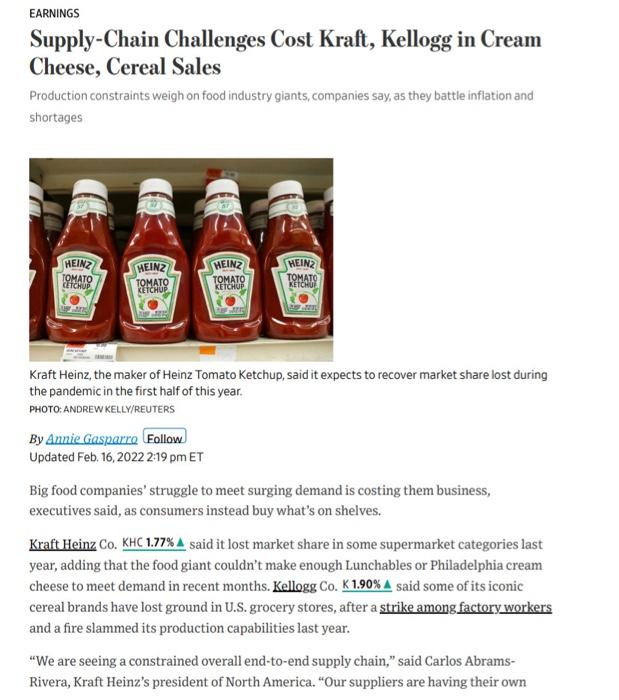
EARNINGS Supply-Chain Challenges Cost Kraft, Kellogg in Cream Cheese, Cereal Sales Production constraints weigh on food industry giants, companies say, as they battle inflation and shortages HEINZ TOMATO CETCHUP HEINZ TOMATO KETCHUP HEINZ TOMATO KETCHUP HEINZ TOMATO KETCHOE Kraft Heinz, the maker of Heinz Tomato Ketchup, said it expects to recover market share lost during the pandemic in the first half of this year. PHOTO: ANDREW KELLY/REUTERS By Annie Gasparre Follow Updated Feb. 16,2022 2:19 pm ET Big food companies' struggle to meet surging demand is costing them business, executives said, as consumers instead buy what's on shelves. Kraft Heinz Co. KHC 1.77% A said it lost market share in some supermarket categories last year, adding that the food giant couldn't make enough Lunchables or Philadelphia cream cheese to meet demand in recent months. Kellogg Co. K1.90% A said some of its iconic cereal brands have lost ground in U.S. grocery stores, after a strike among factory workers and a fire slammed its production capabilities last year. "We are seeing a constrained overall end-to-end supply chain," said Carlos Abrams- Rivera, Kraft Heinz's president of North America. Our suppliers are having their own shortages and labor problems also. We are making sure we can recover quickly." Sales for Kraft, Kellogg and other major food makers continue rising. But executives said production constraints have left room for their competitors to gain ground. As the U.S. moves on from the pandemic, food industry executives said they expect sales volumes to taper off somewhat. Food companies are trying to hang on to the revival they have experienced over the past two years, executives said, while lifting prices to keep up with rising costs. "Economywide bottlenecks and shortages persist," Kellogg Co. Chief Executive Officer Steve Cahillane said last week. "We are in the process of recovering production." Mr. Cahillane said he expects Kellogg to regain cereal market share in North America in the second half of the year, as it gets more Frosted Flakes, Froot Loops and other key brands back on shelves. "We are bound and determined to restore this business," Mr. Cahillane said. Kraft faced a shortage of packaging materials for its cream cheese in the fourth quarter. the company said, which constrained sales. The company said it expects to recover lost market share in Philadelphia cream cheese, Oscar Mayer bacon, Lunchables and other brands in the first half of the year. This will come at a cost, executives said, as Kraft invests in supply-chain improvements and refreshes some of its brands. "We are actually thinking through very creative ways in which we can actually satisfy that demand going forward," Mr. Abrams-Rivera said, such as getting new factory employees on production lines in about a week instead of three or four months. Kraft Heinz's stock rose about 5% on Wednesday after it reported better-than-expected fourth-quarter earnings and a 3.9% increase in comparable sales. Adjusted earnings were 79 cents a share, compared with 63 cents expected by analysts. Kellogg last week reported that its comparable sales rose 5.2% in the fourth quarter, though its adjusted operating profit declined almost 12%, primarily because of what the company said were supply disruptions world-wide. Kraft and Kellogg executives said they expect higher prices to temper consumers' demand this year. Many companies are planning additional price hikes this year to combat escalating commodity prices, labor costs and trucking expenses. So far, consumers haven't been deterred by higher grocery prices because inflation is affecting everything from food to couches to cars, and because people received government stimulus money last year, executives said. But Kraft and Kellogg said that as this year progresses, they expect more shoppers to switch what they buy because of higher prices In January, the U.S. consumer-price index, which measures how much people pay for goods and services, rose to 7.5% compared with the same month a year earlier-the biggest increase since February 1982. "We expect inflation to persist into this year with no real slowdown," Kellogg's Mr. Cahillane said. He said he's watching shoppers' reactions to the higher prices closely. "There comes a time when consumers are going to run up against their ability to manage their household budget," he said. Kellogg said it is looking at ways to offset its higher costs that won't hurt shoppers' perception of its brands. For instance, Kellogg's new Cheez-It Puff'd snacks carry a higher profit margin for the company-a key factor when it's deciding which new products to bring to shelves. Cheez-It Puff'd snacks sell at grocery stores for about 50 cents per ounce, while regular Cheez-It crackers are about 25 cents per ounce. Kraft said it's raising its prices more this year, on top of increases last year, to protect its profitability. The company is also looking for ways to reduce its costs, executives said, because affordability is a key selling point for its food. Kraft is switching out some ingredients and packaging materials to save money, for example, Mr. Abrams-Rivera said. "This is a new frontier we are in right now." Corrections & Amplifications Kraft Heinz's results benefited from a favorable currency-exchange rate. An earlier version of this article incorrectly said that unfavorable currency-exchange rates weighed on the company's results. (Corrected on Feb. 16)









 Study Help