







Question: Please see attached questions. Problem 4 (40 marks total; with 10 marks for item 4.1, and 30 marks for item 4.2) Consider the subset C
Please see attached questions.
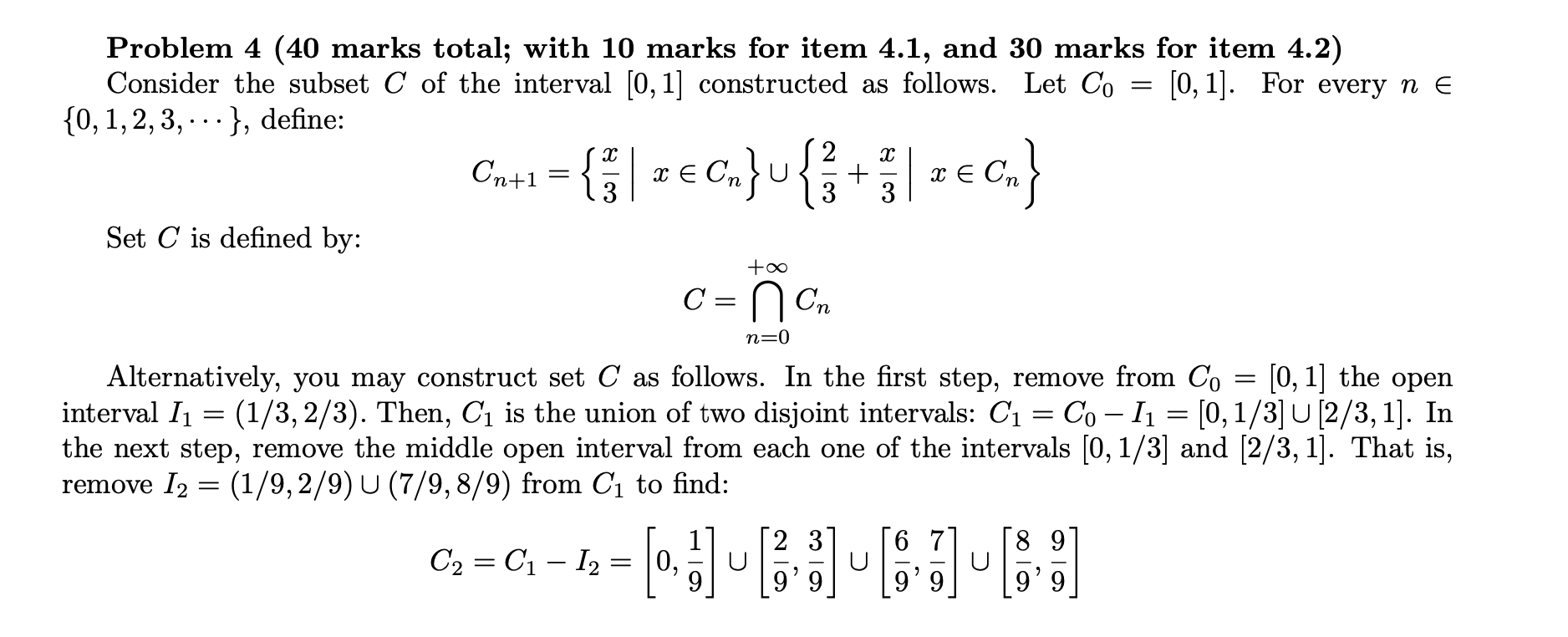
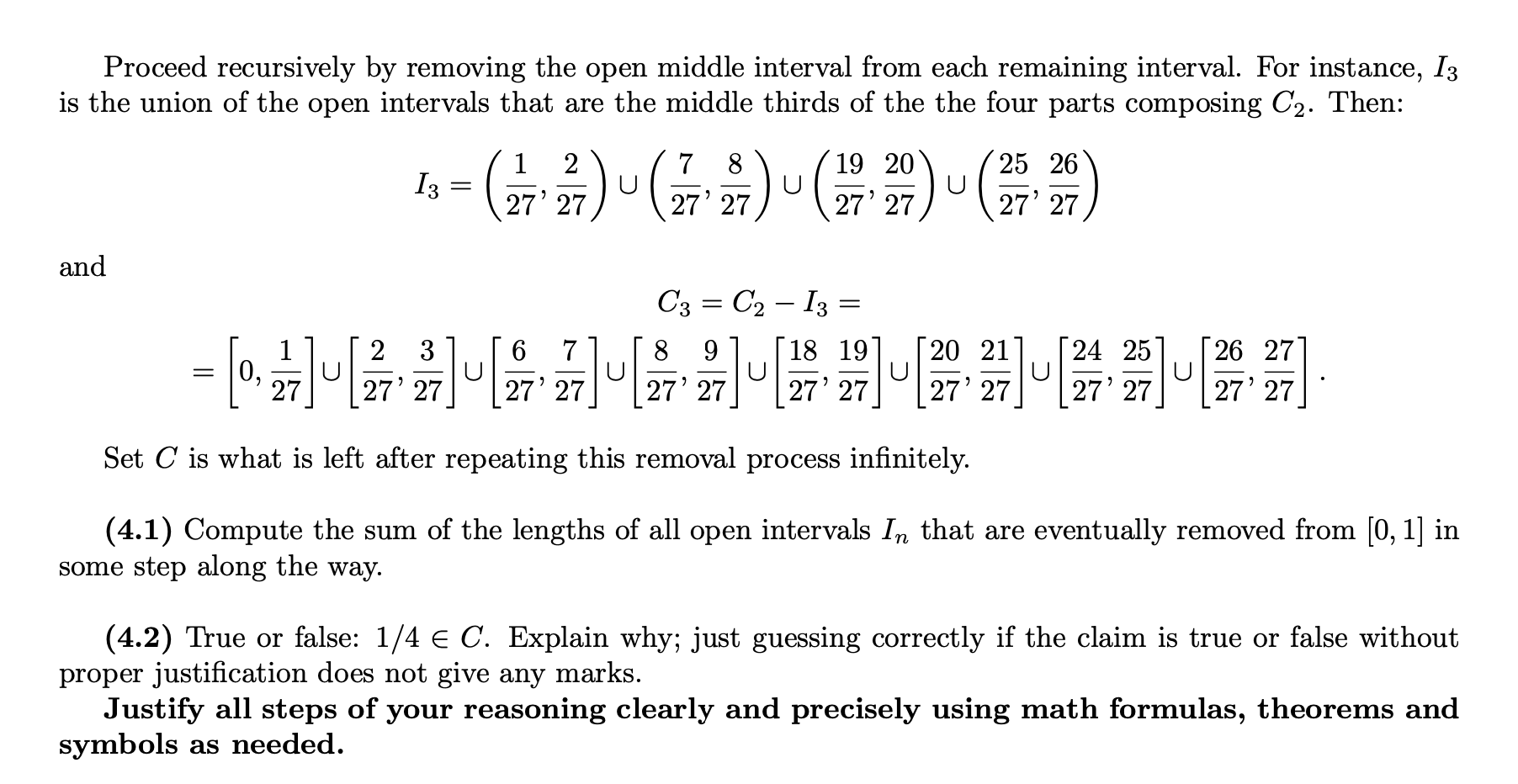
Problem 4 (40 marks total; with 10 marks for item 4.1, and 30 marks for item 4.2) Consider the subset C of the interval [0, 1] constructed as follows. Let Co = [0, 1]. For every n E {0, 1, 2, 3, . . . }, define: x E Cn Set C is defined by: too C = n On n=0 Alternatively, you may construct set C as follows. In the first step, remove from Co = [0, 1] the open interval /1 = (1/3,2/3). Then, C1 is the union of two disjoint intervals: C1 = Co - /1 = [0, 1/3] U [2/3, 1]. In the next step, remove the middle open interval from each one of the intervals [0, 1/3] and [2/3, 1]. That is, remove 12 = (1/9, 2/9) U (7/9, 8/9) from C1 to find: C2 = C1 - 12 = 0,Proceed recursively by removing the open middle interval from each remaining interval. For instance, 13 is the union of the open intervals that are the middle thirds of the the four parts composing C2. Then: 13 = 2 7 8 19 20 25 26 27' 27 U 27' 27 27' 27 " ) u ( 27' 27 and C3 = C2 - 13 = Set C is what is left after repeating this removal process infinitely. (4.1) Compute the sum of the lengths of all open intervals In that are eventually removed from [0, 1] in some step along the way. (4.2) True or false: 1/4 E C. Explain why; just guessing correctly if the claim is true or false without proper justification does not give any marks. Justify all steps of your reasoning clearly and precisely using math formulas, theorems and symbols as needed
Step by Step Solution
There are 3 Steps involved in it

Get step-by-step solutions from verified subject matter experts
 Study Help