







Question: Please see example below for what this should look like, thank you! ---------example--------------- Start with two signed decimal numbers and identify the multiplicand (first operand)
Please see example below for what this should look like, thank you!
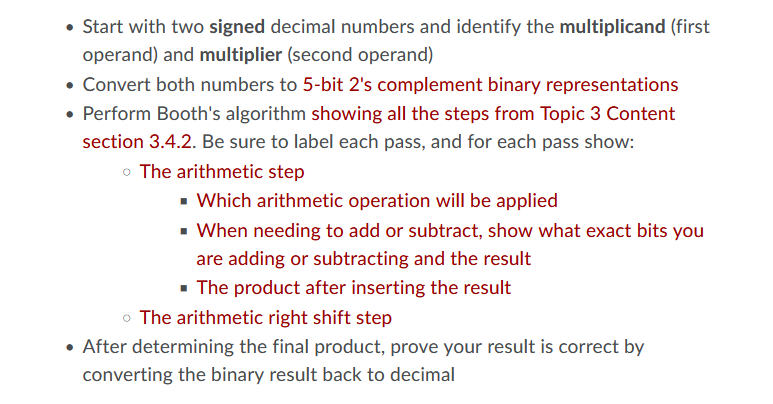
---------example---------------
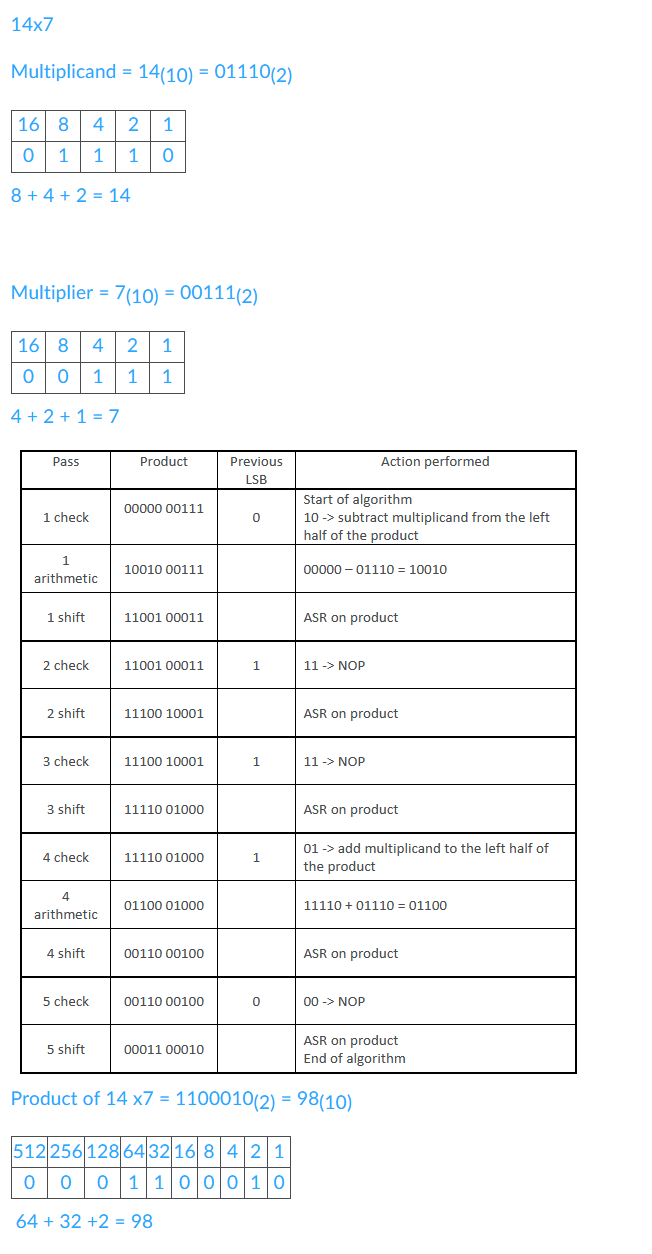
Start with two signed decimal numbers and identify the multiplicand (first operand) and multiplier (second operand) Convert both numbers to 5-bit 2's complement binary representations Perform Booth's algorithm showing all the steps from Topic 3 Content section 3.4.2. Be sure to label each pass, and for each pass show: The arithmetic step Which arithmetic operation will be applied When needing to add or subtract, show what exact bits you are adding or subtracting and the result . The product after inserting the result o The arithmetic right shift step After determining the final product, prove your result is correct by converting the binary result back to decimal 14x7 Multiplicand = 14(10) = 01110(2) 168 4 2. 1 0 1 1 1 0 8 + 4 + 2 = 14 Multiplier = 7(10) = 00111(2) 16 8 4 2 1 0 0 1 1 1 4 + 2 + 1 = 7 Pass Product Action performed Previous LSB 00000 00111 1 check 0 Start of algorithm 10 -> subtract multiplicand from the left half of the product 1 arithmetic 10010 00111 00000-01110 = 10010 1 shift 11001 00011 ASR on product 2 check 11001 00011 1 11> NOP 2 shift 11100 10001 ASR on product 3 check 11100 10001 1 11 -> NOP 3 shift 11110 01000 ASR on product 4 check 11110 01000 1 01 ->add multiplicand to the left half of the product 4 arithmetic 01100 01000 11110 + 01110 = 01100 4 shift 00110 00100 ASR on product 5 check 00110 00100 0 D0 -> NOP 5 shift 00011 00010 ASR on product End of algorithm Product of 14 x7 = 1100010(2) = 98(10) 512256128 64 32 16 8 4 2 1 0 0 011000110 64 + 32 +2 = 98 Start with two signed decimal numbers and identify the multiplicand (first operand) and multiplier (second operand) Convert both numbers to 5-bit 2's complement binary representations Perform Booth's algorithm showing all the steps from Topic 3 Content section 3.4.2. Be sure to label each pass, and for each pass show: The arithmetic step Which arithmetic operation will be applied When needing to add or subtract, show what exact bits you are adding or subtracting and the result . The product after inserting the result o The arithmetic right shift step After determining the final product, prove your result is correct by converting the binary result back to decimal 14x7 Multiplicand = 14(10) = 01110(2) 168 4 2. 1 0 1 1 1 0 8 + 4 + 2 = 14 Multiplier = 7(10) = 00111(2) 16 8 4 2 1 0 0 1 1 1 4 + 2 + 1 = 7 Pass Product Action performed Previous LSB 00000 00111 1 check 0 Start of algorithm 10 -> subtract multiplicand from the left half of the product 1 arithmetic 10010 00111 00000-01110 = 10010 1 shift 11001 00011 ASR on product 2 check 11001 00011 1 11> NOP 2 shift 11100 10001 ASR on product 3 check 11100 10001 1 11 -> NOP 3 shift 11110 01000 ASR on product 4 check 11110 01000 1 01 ->add multiplicand to the left half of the product 4 arithmetic 01100 01000 11110 + 01110 = 01100 4 shift 00110 00100 ASR on product 5 check 00110 00100 0 D0 -> NOP 5 shift 00011 00010 ASR on product End of algorithm Product of 14 x7 = 1100010(2) = 98(10) 512256128 64 32 16 8 4 2 1 0 0 011000110 64 + 32 +2 = 98
Step by Step Solution
There are 3 Steps involved in it

Get step-by-step solutions from verified subject matter experts
 Study Help