







Question: Please see image In many countries, armed forces rely both on volunteers and conscription for military service, For example, in Denmark, eligible men for military
Please see image
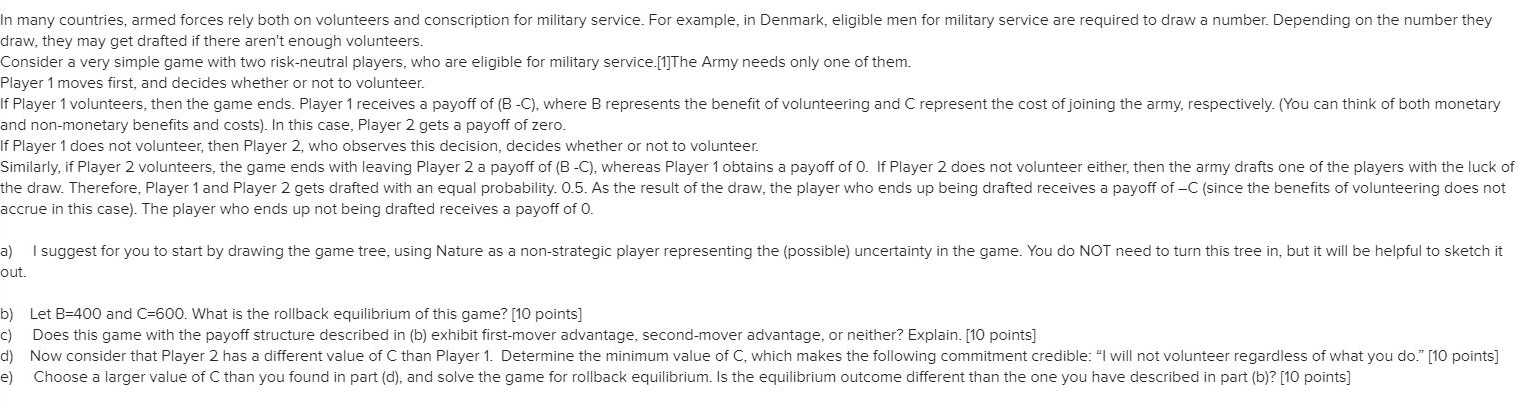
In many countries, armed forces rely both on volunteers and conscription for military service, For example, in Denmark, eligible men for military service are required to draw a number, Depending on the number they draw, they may get drafted if there aren't enough volunteers, Consider a very simple game with two riskJneutral players, who are eligible for military service.[1]The Army needs only one of them. Piayer1 moves rst, and decides whether or not to volunteer. If Player 1 volunteers, then the game ends. Playert receives a payoff of (E! C), where B represents the benet ofvolunteering and C represent the cost ofjoining the army, respectively. (You can think of both monetary and nonmonetary benets and costs), in this case, Player 2 gets a payoff of zero, If Player1 does not volunteer, then Player 2 who observes this decision, decides whether or not to volunteer. Simiiarly, if Player 2 volunteers, the game ends with leaving Player 2 a payofF oflEl 7C), whereas Player! obtains a payoff ofO. If Player 2 does not volunteer either, then the army drafts one ofthe players with the luck of the draw, Therefore, Player1 and Player 2 gets drafted with an equal probability. 0.5, As the result of the draw, the player who ends up being drafted receives a payoff ofC (since the benefits otvolunteering does not accrue in this case). The player who ends up not being drafted receives a payoff of 0, a) | suggest for you to start by drawing the game tree, using Nature as a nonestrategir: player representing the (possible) uncertainty in the game. You do NOT need to turn this tree in, but it will be helpful to sketch it out, b) Let BthO and C=600. What is the rollback equilibrium of this game? [10 points] c) Does this game with the payoff structure described in (b) exhibit rsternover advantage, secondmover advantage, or neither? Explain. [10 points} d) Now consider that Player 2 has a different value of C than Player 1, Determine the minimum value of C, which makes the following commitment credible: \"I will not volunteer regardless of what you do." [10 points] e) Choose a larger value of C than you found in part (d), and solve the game for rollback equilibrium, is the equilibrium outcome different than the one you have described in part (b)? [10 points]
Step by Step Solution
There are 3 Steps involved in it

Get step-by-step solutions from verified subject matter experts
 Study Help