







Question: Please see question below about model thresholds and payoff matrices. Horngren's Cost Account 17th Edition. Please give step by step instructions to answer all parts
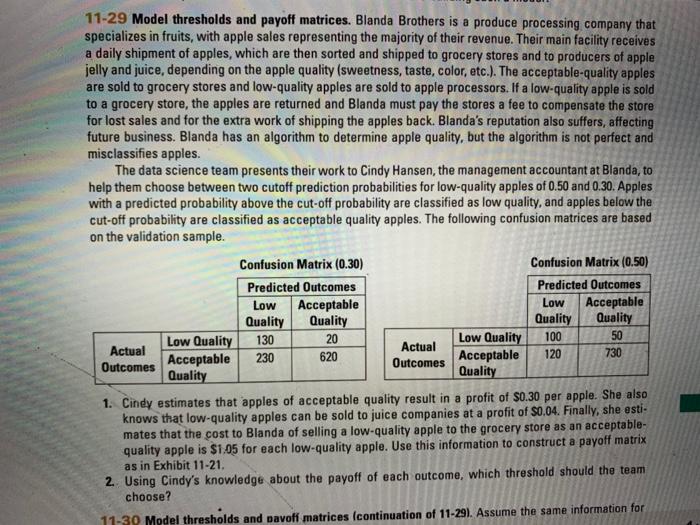
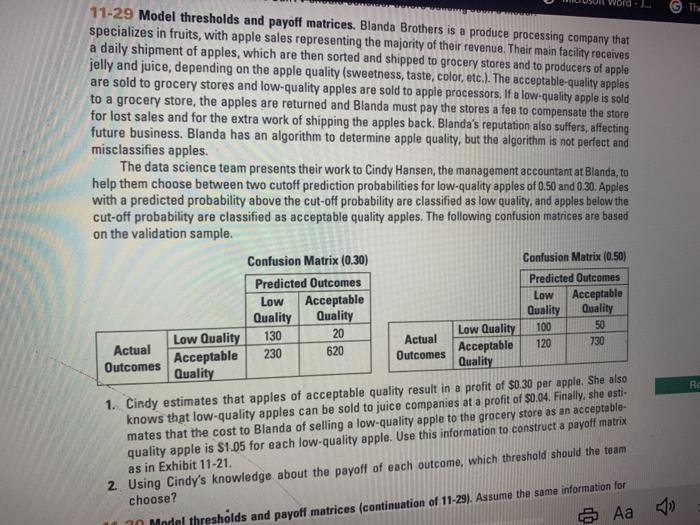
11-29 Model thresholds and payoff matrices. Blanda Brothers is a produce processing company that specializes in fruits, with apple sales representing the majority of their revenue. Their main facility receives a daily shipment of apples, which are then sorted and shipped to grocery stores and to producers of apple jelly and juice, depending on the apple quality (sweetness, taste, color, etc.). The acceptable-quality apples are sold to grocery stores and low-quality apples are sold to apple processors. If a low-quality apple is sold to a grocery store, the apples are returned and Blanda must pay the stores a fee to compensate the store for lost sales and for the extra work of shipping the apples back. Blanda's reputation also suffers, affecting future business. Blanda has an algorithm to determine apple quality, but the algorithm is not perfect and misclassifies apples. The data science team presents their work to Cindy Hansen, the management accountant at Blanda, to help them choose between two cutoff prediction probabilities for low-quality apples of 0.50 and 0.30. Apples with a predicted probability above the cut-off probability are classified as low quality, and apples below the cut-off probability are classified as acceptable quality apples. The following confusion matrices are based on the validation sample. Confusion Matrix (0.30) Confusion Matrix (0.50) Predicted Outcomes Predicted Outcomes Low Acceptable Low Acceptable Quality Quality Quality Quality Low Quality 130 20 Low Quality 100 50 Actual Actual 230 620 Acceptable 730 Acceptable Outcomes Outcomes Quality Quality 1. Cindy estimates that apples of acceptable quality result in a profit of $0.30 per apple. She also knows that low-quality apples can be sold to juice companies at a profit of $0.04. Finally, she esti- mates that the cost to Blanda of selling a low-quality apple to the grocery store as an acceptable- quality apple is $1.05 for each low-quality apple. Use this information to construct a payoff matrix as in Exhibit 11-21. 2. Using Cindy's knowledge about the payoff of each outcome, which threshold should the team choose? 11-30 Model thresholds and pavoff matrices (continuation of 11-29). Assume the same information for 120 The 11-29 Model thresholds and payoff matrices. Blanda Brothers is a produce processing company that specializes in fruits, with apple sales representing the majority of their revenue. Their main facility receives a daily shipment of apples, which are then sorted and shipped to grocery stores and to producers of apple jelly and juice, depending on the apple quality (sweetness, taste, color, etc.). The acceptable-quality apples are sold to grocery stores and low-quality apples are sold to apple processors. If a low-quality apple is sold to a grocery store, the apples are returned and Blanda must pay the stores a fee to compensate the store for lost sales and for the extra work of shipping the apples back. Blanda's reputation also suffers, affecting future business. Blanda has an algorithm to determine apple quality, but the algorithm is not perfect and misclassifies apples. The data science team presents their work to Cindy Hansen, the management accountant at Blanda, to help them choose between two cutoff prediction probabilities for low-quality apples of 0.50 and 0.30. Apples with a predicted probability above the cut-off probability are classified as low quality, and apples below the cut-off probability are classified as acceptable quality apples. The following confusion matrices are based on the validation sample. Confusion Matrix (0.30) Confusion Matrix (0.50) Predicted Outcomes Predicted Outcomes Low Acceptable Low Acceptable Quality Quality Quality Quality 50 20 100 130 Low Quality Low Quality Actual 730 Actual 120 230 620 Acceptable Acceptable Outcomes Outcomes Quality Quality RE 1. Cindy estimates that apples of acceptable quality result in a profit of $0.30 per apple. She also knows that low-quality apples can be sold to juice companies at a profit of $0.04. Finally, she esti- mates that the cost to Blanda of selling a low quality apple to the grocery store as an acceptable- quality apple is $1.05 for each low-quality apple. Use this information to construct a payoff matrix as in Exhibit 11-21. 2. Using Cindy's knowledge about the payoff of each outcome, which threshold should the team choose? 70 Model thresholds and payoff matrices (continuation of 11-29). Assume the same information for Aa 5) 11-29 Model thresholds and payoff matrices. Blanda Brothers is a produce processing company that specializes in fruits, with apple sales representing the majority of their revenue. Their main facility receives a daily shipment of apples, which are then sorted and shipped to grocery stores and to producers of apple jelly and juice, depending on the apple quality (sweetness, taste, color, etc.). The acceptable-quality apples are sold to grocery stores and low-quality apples are sold to apple processors. If a low-quality apple is sold to a grocery store, the apples are returned and Blanda must pay the stores a fee to compensate the store for lost sales and for the extra work of shipping the apples back. Blanda's reputation also suffers, affecting future business. Blanda has an algorithm to determine apple quality, but the algorithm is not perfect and misclassifies apples. The data science team presents their work to Cindy Hansen, the management accountant at Blanda, to help them choose between two cutoff prediction probabilities for low-quality apples of 0.50 and 0.30. Apples with a predicted probability above the cut-off probability are classified as low quality, and apples below the cut-off probability are classified as acceptable quality apples. The following confusion matrices are based on the validation sample. Confusion Matrix (0.30) Confusion Matrix (0.50) Predicted Outcomes Predicted Outcomes Low Acceptable Low Acceptable Quality Quality Quality Quality Low Quality 130 20 Low Quality 100 50 Actual Actual 230 620 Acceptable 730 Acceptable Outcomes Outcomes Quality Quality 1. Cindy estimates that apples of acceptable quality result in a profit of $0.30 per apple. She also knows that low-quality apples can be sold to juice companies at a profit of $0.04. Finally, she esti- mates that the cost to Blanda of selling a low-quality apple to the grocery store as an acceptable- quality apple is $1.05 for each low-quality apple. Use this information to construct a payoff matrix as in Exhibit 11-21. 2. Using Cindy's knowledge about the payoff of each outcome, which threshold should the team choose? 11-30 Model thresholds and pavoff matrices (continuation of 11-29). Assume the same information for 120 The 11-29 Model thresholds and payoff matrices. Blanda Brothers is a produce processing company that specializes in fruits, with apple sales representing the majority of their revenue. Their main facility receives a daily shipment of apples, which are then sorted and shipped to grocery stores and to producers of apple jelly and juice, depending on the apple quality (sweetness, taste, color, etc.). The acceptable-quality apples are sold to grocery stores and low-quality apples are sold to apple processors. If a low-quality apple is sold to a grocery store, the apples are returned and Blanda must pay the stores a fee to compensate the store for lost sales and for the extra work of shipping the apples back. Blanda's reputation also suffers, affecting future business. Blanda has an algorithm to determine apple quality, but the algorithm is not perfect and misclassifies apples. The data science team presents their work to Cindy Hansen, the management accountant at Blanda, to help them choose between two cutoff prediction probabilities for low-quality apples of 0.50 and 0.30. Apples with a predicted probability above the cut-off probability are classified as low quality, and apples below the cut-off probability are classified as acceptable quality apples. The following confusion matrices are based on the validation sample. Confusion Matrix (0.30) Confusion Matrix (0.50) Predicted Outcomes Predicted Outcomes Low Acceptable Low Acceptable Quality Quality Quality Quality 50 20 100 130 Low Quality Low Quality Actual 730 Actual 120 230 620 Acceptable Acceptable Outcomes Outcomes Quality Quality RE 1. Cindy estimates that apples of acceptable quality result in a profit of $0.30 per apple. She also knows that low-quality apples can be sold to juice companies at a profit of $0.04. Finally, she esti- mates that the cost to Blanda of selling a low quality apple to the grocery store as an acceptable- quality apple is $1.05 for each low-quality apple. Use this information to construct a payoff matrix as in Exhibit 11-21. 2. Using Cindy's knowledge about the payoff of each outcome, which threshold should the team choose? 70 Model thresholds and payoff matrices (continuation of 11-29). Assume the same information for Aa 5)
Step by Step Solution
There are 3 Steps involved in it

Get step-by-step solutions from verified subject matter experts
 Study Help