Question: ***Please send the anwser as picture form ( hand writing or screenshot, instead of text !! Thank you if you use notebook to anwser, you
***Please send the anwser as picture form (hand writing or screenshot, instead of text!! Thank you
if you use notebook to anwser, you can take a screenshoot for the anwsers and send the picture
Read the article entitled Growing Greenhouse, review the material covered in Chapter # 11 and
Chapter # 12 and answer the following questions:
1. Identify and briefly describe any three external forces that impact marketing decisions. Briefly
explain how Greenhouse is affected by each of these forces. Note that you only need to
provide one Greenhouse specific example for each of the three external forces that you have
identified.
2. What is Customer Relationship Management? With Greenhouses access to customer data,
explain how Greenhouse can effectively use CRM to attract, retain and extend the value of its
customers over the lifetime of the relationship.
3. What are the four basic functions of a package? Evaluate the effectiveness of Greenhouses
glass bottle packaging in fulfilling these four basic functions.
Provide your Name (First and Last), Student Number, Course Code, Section Number and
Assignment Title at the top of the page. Please ensure that you specify your assignment title as
Assignment # 5 Marketing Greenhouse. Please ensure that this information is centered at the top
of the first page. DO NOT use the Header Function.
Ensure your assignment is no longer than two pages, computer generated, single-spaced, error
free and submitted in MS Word file format. Please format your assignment into five paragraphs as
follows: Introduction, External Forces, CRM, Packaging and Conclusion. If your assignment is more
than one page in length, please paginate your assignment!
Do NOT include a cover page. Do NOT include a reference page. Please DO provide (in brackets)
the source and page numbers of where the information is from. For example, if you use information
from the textbook, you can reference it as follows: (Ferrell, Page 283). If you use information from
the article, you can reference it as follows: (Dunne, Page 17) Please use either Arial or Times New
Roman font style using font size 10, 11 or 12.
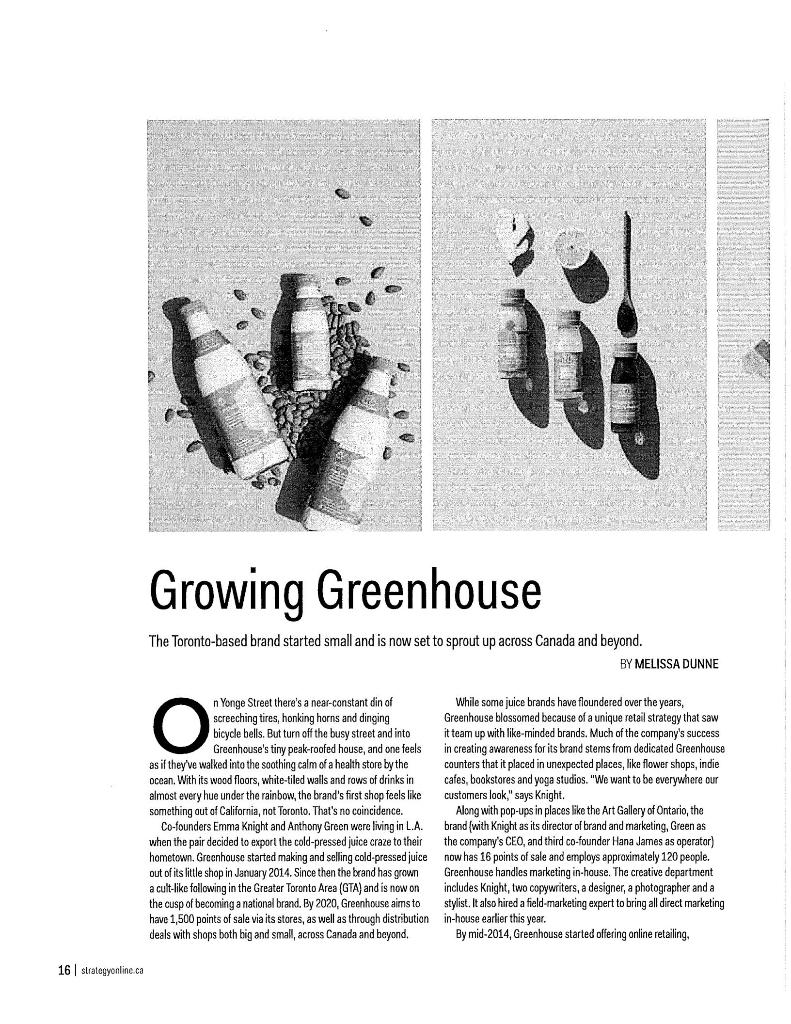
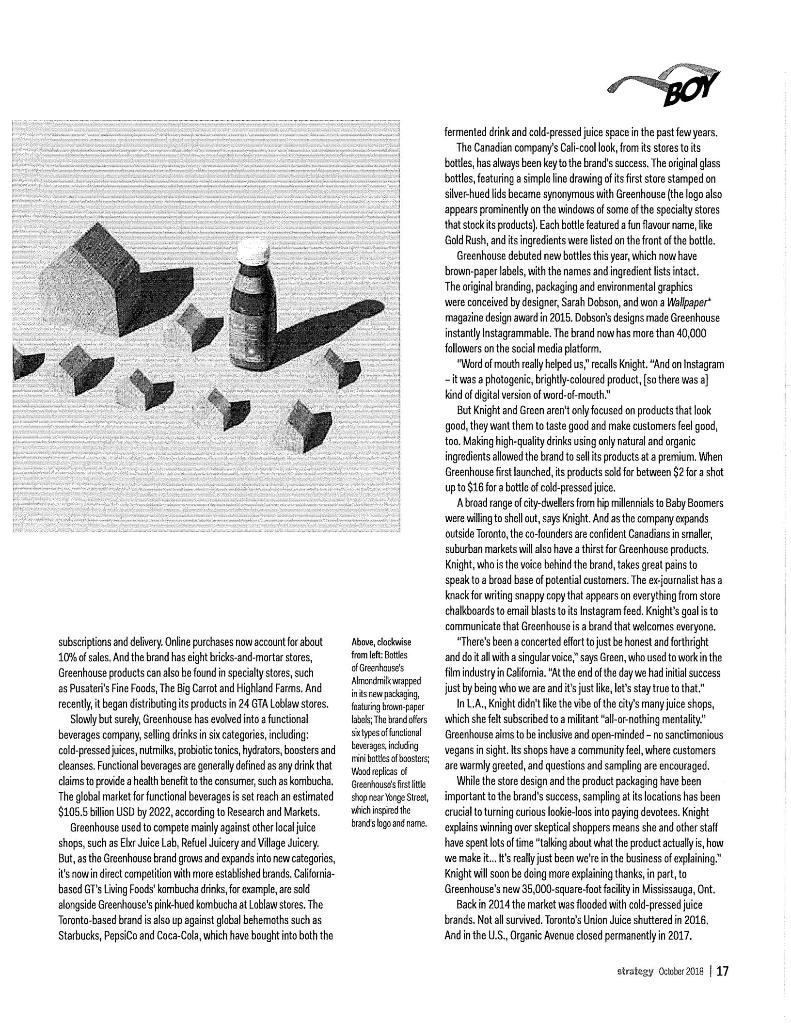
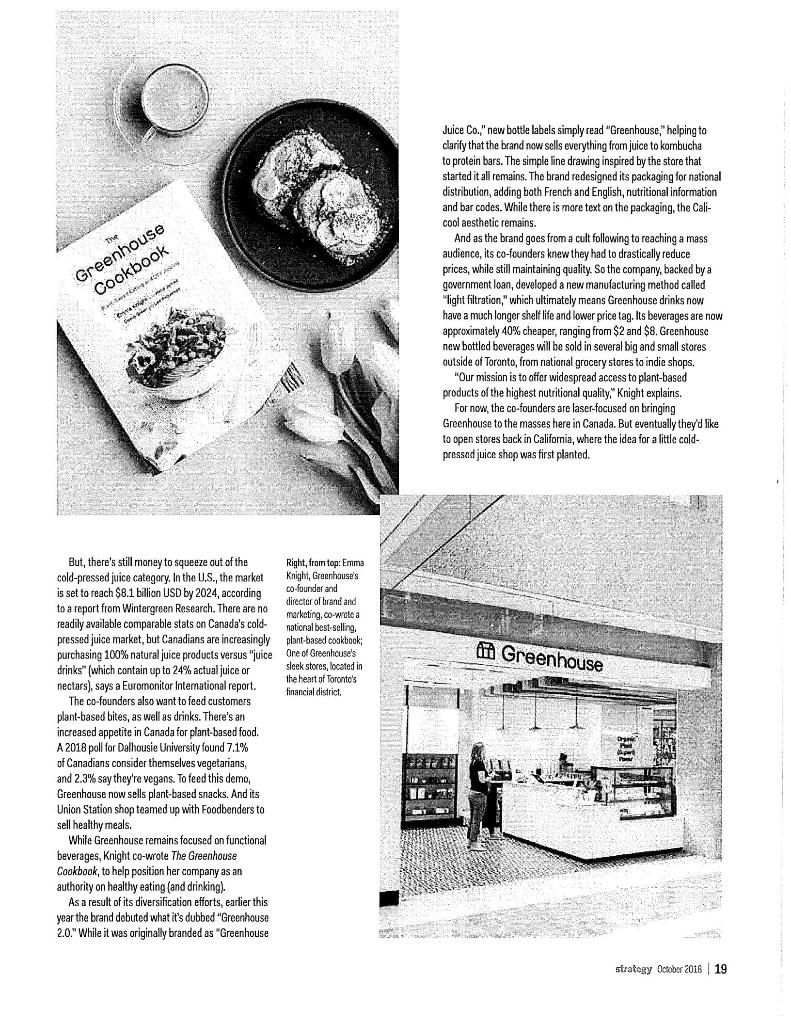
Growing Greenhouse The Toronto-based brand started small and is now set to sprout up across Canada and beyond. BY MELISSA DUNNE n Yonge Street there's a near-constant din of While some juice brands have floundered over the years, screeching tires, honking horns and dinging Greenhouse blossomed because of a unique retail strategy that saw bicycle bells. But turn off the busy street and into it team up with like-minded brands. Much of the company's success Greenhouse's tiny peak-roofed house, and one feels in creating awareness for its brand stems from dedicated Greenhouse as if they've walked into the soothing calm of a health store by the counters that it placed in unexpected places, like flower shops, indie ocean. With its wood floors, white-tiled walls and rows of drinks in cafes, bookstores and yoga studios. "We want to be everywhere our almost every hue under the rainbow, the brand's first shop feels like customers loak," says Knight something out of California, not Toronto. That's no th pop-ups in places like the Art Gallery of Ontario, the Co-founders Emma Knight and Anthony Green were living in L.A. brand (with Knight as its director of brand and marketing, Green as when the pair decided to export the cold-pressed juice craze to their the company's CEO, and third co-founder Hana James as operator) hometown, Greenhouse started making and selling cold-pressed juice now has 16 points of sale and employs approximately 120 people. out of its little shop in January 2014. Since then the brand has grown Greenhouse handles marketing in-house. The creative department a cult-like following in the Greater Toronto Area (GTA) and is now on includes Knight, two copywriters, a designer, a photographer and a the cusp of becoming a national brand. By 2020, Greenhouse aims to stylist. It also hired a field-marketing expert to bring all direct marketing have 1,500 points of sale via its stores, as well as through distribution in-house earlier this year. deals with shops both big and small, across Canada and beyond. By mid-2014, Greenhouse started offering online retailing, s no coincidence Along with 16 strategyonline.ca BOY that stocki fermented drink and cold-pressed juice space in the past few years, The Canadian company's Cali-cool look, from its stores to its bottles, has always been key to the brand's success. The original glass bottles, featuring a simple line drawing of its first store stamped on silver-hued lids became synonymous with Greenhouse (the logo also appears prominently on the windows of some of the specialty stores k its products). Each bottle featured a fun flavour narnie , like Gold Rush, and its ingredients were listed on the front of the bottle. Greenhouse debuted new bottles this year, which now have brown-paper labels, with the e names and ingredient lists intact. he original branding, packaging and environmental graphics were conceived by designer, Sarah Dobson, and won a Wallpaper magazine design award in 2015. Dobson's designs made Greenhouse instantly Instagrammable. The brand now has more than 40,000 followers on the social media platform. "Word of mouth really helped us." re "recalls Knight. "And on Instagram - it was a photogenic, brightly-coloured product, (so there was a] kind of digital version of word-of-mouth." But Knight and Green aren't only focused on products that look good, they want them to taste good and make customers feel good, too. Making high-quality drinks using only natural and organic ingredients allowed the brand to sell its products at a premium. When Greenhouse first launched, its products sold for between $2 for a shot up to $16 for a bottle of cold-pressed juice. Abroad range of city-dwellers from hip millennials to Baby Boomers were e willing to shell out , says Knight. And as the company expands outside Toronto, , the co-founders are confident Canadians in smaller, suburban markets v ets will also have a thirst for Greenhouse products. Knight, who is Dis the voice behind the brand takes great pains to speak to a broad base of potential custarmers. The ex-journalist has a knack for writing snappy copy that appears on everything from store chalkboards to email blasts to its Instagram feed. Knight's goal is to communicate that Greenhouse is a brand that welcomes everyone. "There's been a concerted effort to just be honest and forthright and do it all with a singular voice," says Green, who used to work in the film industry in California. "At the end of the day we had initial success just by being who we are and it's just like, let's stay true to that." In L.A., Knight didn't like the vibe of the city's many juice shops, which she felt subscribed to a militant "all-or-nothing mentality." Greenhouse aims to be inclusive and open-minded - no sanctimonious vegans in sight. Its shops have a community feel, where customers are warmly greeted, and questions and sampling a are encouraged. While the store design and the product packa important to the brand's success, sampling at its locations has been crucial to turning curious lookie-loos into paying devotees. Knight explains winning over skeptical shoppers means she and other staff haves e spent lots of time "talking about what the product actually is, how we make it... It's really just been we're in the business of explaining." Knight will soon be doing more explaining thanks, in part, to Greenhouse's new 35,000-square-foot facility in Mississauga, Ont. Back in 2014 the market was flooded with cold-pressed juice brands. Not all survived. Toronto's Union Juice shuttered in 2016, And in the U.S., Organic Avenue closed permanently in 2017. subscriptions and delivery. Online purchases now account for about 10% of sales. And the brand has eight bricks-and-mortar stores, Greenhouse products can also be found in specialty stores, such as Pusateri's Fine Foods, The Big Carrot and Highland Farms. And recently, it began distributing its products in 24 GTA Loblaw stores. Slowly but surely , Greenhouse has evolved into a functional beverages company selling drinks in six categories, including: cold-pressed juices, nutrnilks, probiotic tonics, hydrators, boosters and cleanses. Functional beverages are generally defined a as any drink that claims to provide a health benefit to the consumer, such as kombucha. The global market for functional beverages is set reach an estimated $105.5 billion USD by 2022, according to Research and Markets. Greenhouse used to compete mainly against other local juice shops, such as Eber Juice Lab, Refuel Juicery and Village Juicery But, as the Greenhouse brand grows and expands into new categories, it's now in direct competition with more established brands. California- based GT's Living Foods' kombucha drinks, for example, are sold alongside Greenhouse's pink-hued kombucha at Loblaw stores. The Toronto-based brand is also up against global behemoths such as Starbucks, PepsiCo and Coca-Cola, which have bought into both the Above, clockwise from left: Bottles of Greenhouse's Almondmilwrapped in its new packaging featuring brown paper labels: The brand offers six types of functional beverages, including mini bottles of boosters; Wood replicas of Greenhouse's first little shop near Yonge Street, which inspired the brands logo and name t packaging have been strategy October 2018 | 17 The Greenhouse Cookbook Juice Co." new bottle labels simply read "Greenhouse," helping to clarify that the brand now sells everything from juice to kombucha to protein bars. The simple line drawing inspired by the store that started it all remains. The brand redesigned its packaging for national distribution, adding both French and English, nutritional information and bar codes. While there is more text on the packaging, the Cali- cool aesthetic remains And as the brand goes from a cult following to reaching a mass audience, its co-founders knew they had to drastically reduce prices, while still maintaining quality. So the company, backed by a government loan, developed a new manufacturing method called light filtration," which ultimately means Greenhouse drinks now have a much longer shelf life and lower price tag. Its beverages are now approximately 40% cheaper, ranging from $2 and $8. Greenhouse new bottled beverages will be sold in several big and small stores outside e of Toronto, from national grocery stores to indie shops "Our mission is to offer widespread access to plant-based products of the highest nutritional quality," Knight explains. For now, the co-founders are laser-focused on bringing Greenhouse to the masses here in Canada. But eventually they'd like to open stores back in California, where the idea for a little cald- pressed juice shop was first planted. Es Garis A Greenhouse But, there's still money to squeeze out of the Right from top: Emma cold-pressed juice category . In the U.S., the market Knight, Greenhouse's is set to reach $8.1 billion USD by 2024, according co-founder and director of brand and to a report from Wintergreen Research. There are no marketing, co-wrote a readily available comparable stats on Canada's cold- national best-selling pressed juice market, but Canadians are increasingly plant-based cookbook purchasing 100% natural juice products versus "juice One of Greenhouse's drinks" (which contain up to 24% actual juice or sleek stores, located in nectars), says at a Euromonitor International report. the heart of Toronto's financial district The co-founders also want to feed customers plant-based bites, as well as drinks. There's an increased appetite in Canada for plant-based food. A 2018 poll for Dalhousie University found 7.1% of Canadians consider themselves vegetarians, and 2.3% say th ay they're vegans. To feed this demo, Greenhouse now sells plant-based snacks. And its Union Station shop teamed up with Foodbenders to sell healthy meals. While Greenhouse remains focused on functional beverages, Knight co-wrote The Greenhouse Cookbook, to help position her company as an authority on healthy eating (and drinking). As a result of its diversification efforts, earlier this year the brand debuted what it's dubbed "Greenhouse 2.0." While it was originally branded as "Greenhouse strategy October 2018 19









 Study Help