





Question: Please show a detailed method :) Consider the following simple model of the value of a financial asset in which a, b and care known
Please show a detailed method :) Consider thePlease show a detailed method :)

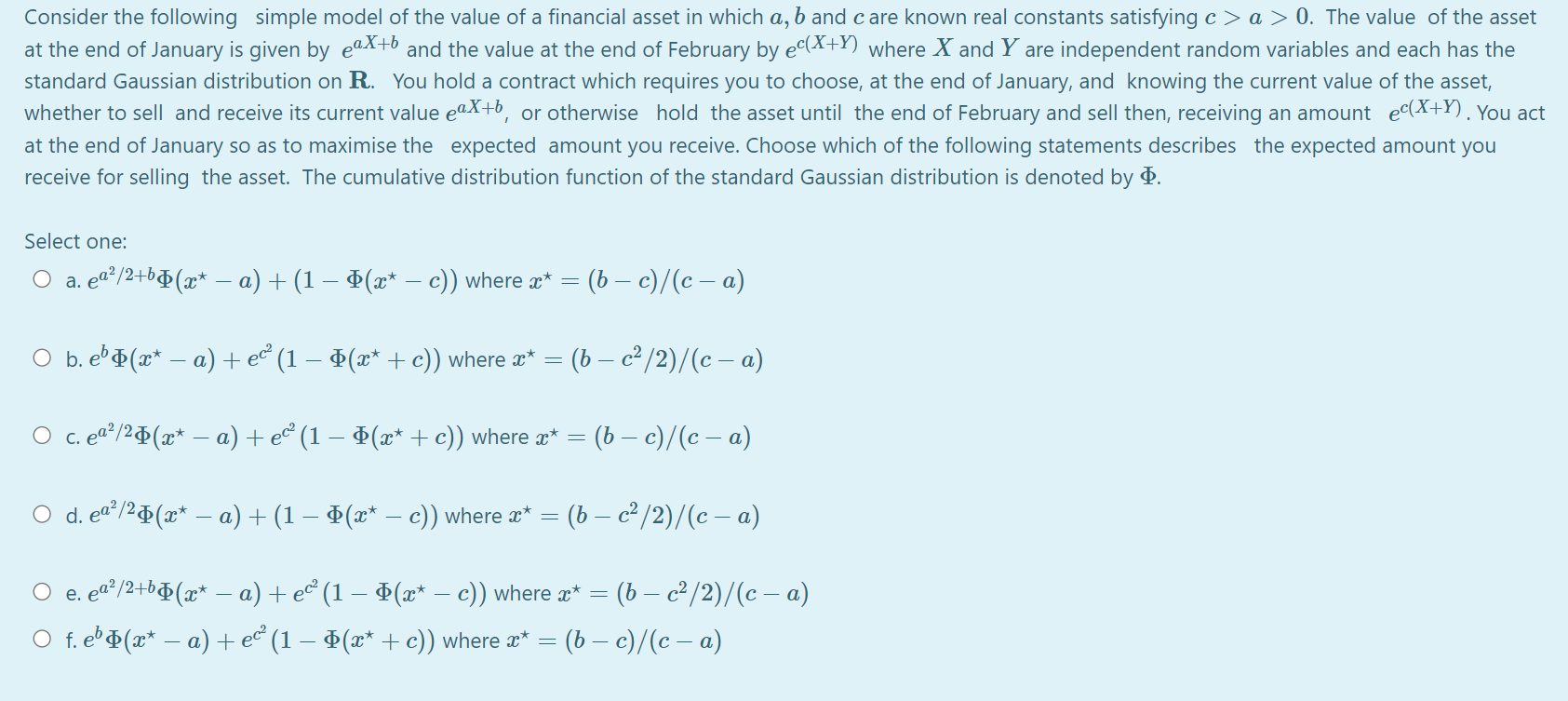
Consider the following simple model of the value of a financial asset in which a, b and care known real constants satisfying c> a > 0. The value of the asset at the end of January is given by eaX+6 and the value at the end of February by ec(X+Y) where X and Y are independent random variables and each has the standard Gaussian distribution on R. You hold a contract which requires you to choose, at the end of January, and knowing the current value of the asset, whether to sell and receive its current value eaX+b, or otherwise hold the asset until the end of February and sell then, receiving an amount ec(X+Y). You act at the end of January so as to maximise the expected amount you receive. Choose which of the following statements describes the expected amount you receive for selling the asset. The cumulative distribution function of the standard Gaussian distribution is denoted by 0. Select one: O a. ea?/2+b (z* a) + (1 0(2* c)) where x* = (b c)/(c a) O b.eb (x* a) + ec (1 $(x* + c)) where x* = (b c2/2/(c a) eq?/20(x* a) +ec (1 0(2* + c)) where * = (b c)/(c- a) O d. ea? /20(x* a) + (1 0(2* c)) where x* = (b c2/2)/(c- a) O e. ea? /2+b(* a) +ec (1 $(x* c)) where x* = (b c2/2)/(c a) O f. eb(* a) +ec (1 $(x* + c)) where x* = (b c)/(c - a) Consider the following simple model of the value of a financial asset in which a, b and care known real constants satisfying c> a > 0. The value of the asset at the end of January is given by eaX+6 and the value at the end of February by ec(X+Y) where X and Y are independent random variables and each has the standard Gaussian distribution on R. You hold a contract which requires you to choose, at the end of January, and knowing the current value of the asset, whether to sell and receive its current value eaX+b, or otherwise hold the asset until the end of February and sell then, receiving an amount ec(X+Y). You act at the end of January so as to maximise the expected amount you receive. Choose which of the following statements describes the expected amount you receive for selling the asset. The cumulative distribution function of the standard Gaussian distribution is denoted by 0. Select one: O a. ea?/2+b (z* a) + (1 0(2* c)) where x* = (b c)/(c a) O b.eb (x* a) + ec (1 $(x* + c)) where x* = (b c2/2/(c a) eq?/20(x* a) +ec (1 0(2* + c)) where * = (b c)/(c- a) O d. ea? /20(x* a) + (1 0(2* c)) where x* = (b c2/2)/(c- a) O e. ea? /2+b(* a) +ec (1 $(x* c)) where x* = (b c2/2)/(c a) O f. eb(* a) +ec (1 $(x* + c)) where x* = (b c)/(c - a)

Step by Step Solution

There are 3 Steps involved in it

1 Expert Approved Answer
Step: 1 Unlock blur-text-image

Question Has Been Solved by an Expert!

Get step-by-step solutions from verified subject matter experts

Step: 2 Unlock
Step: 3 Unlock

Students Have Also Explored These Related General Management Questions!