







Question: please show all steps! 7. [-14 Points] SERCP11 5.AE.005. EXAMPLE 5.5 Platform Diver GOAL Use conservation of energy to calculate the speed of a body
please show all steps!
![please show all steps! 7. [-14 Points] SERCP11 5.AE.005. EXAMPLE 5.5 Platform](https://dsd5zvtm8ll6.cloudfront.net/si.experts.images/questions/2024/10/67143110dbf0e_52867143110be0fa.jpg)
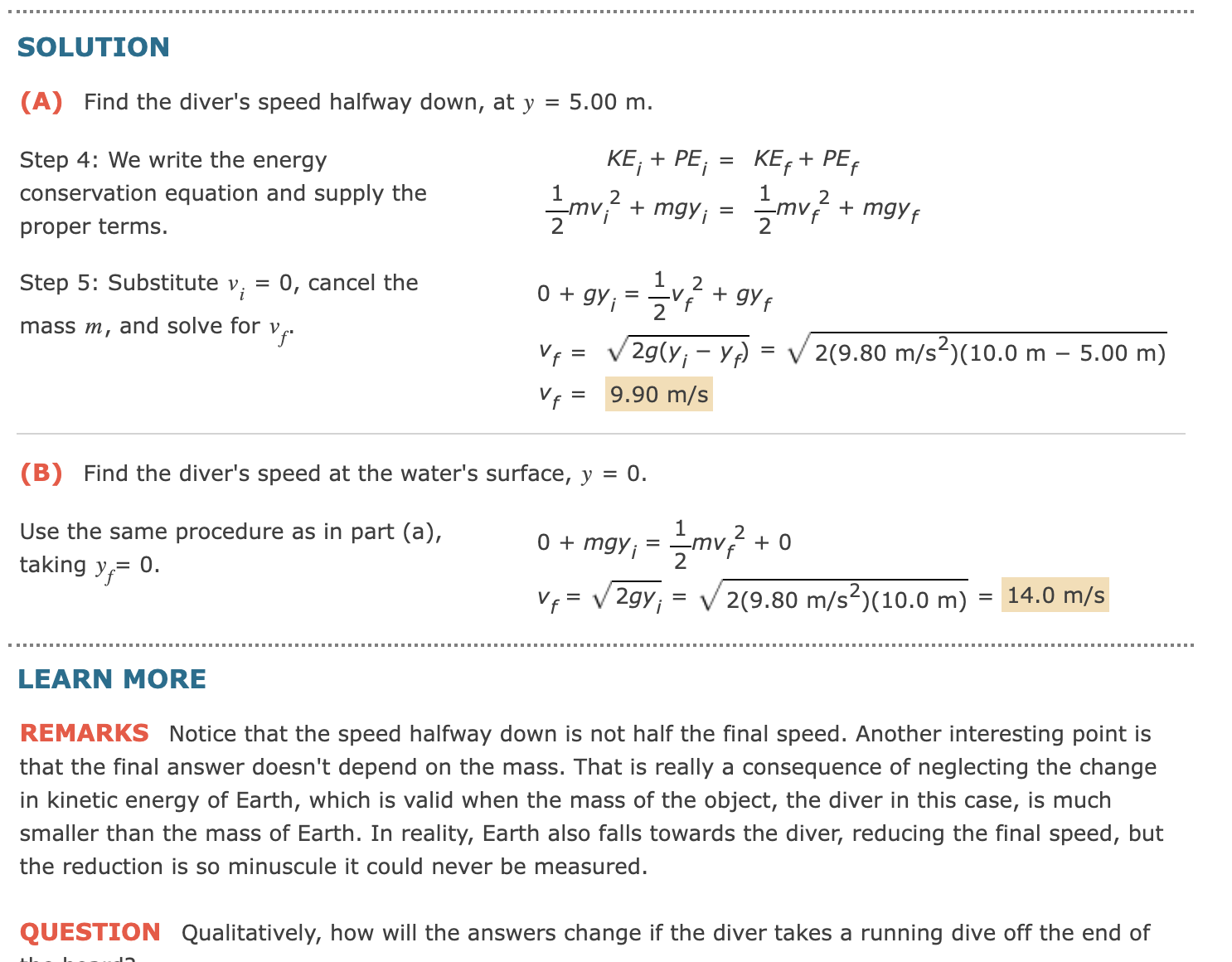
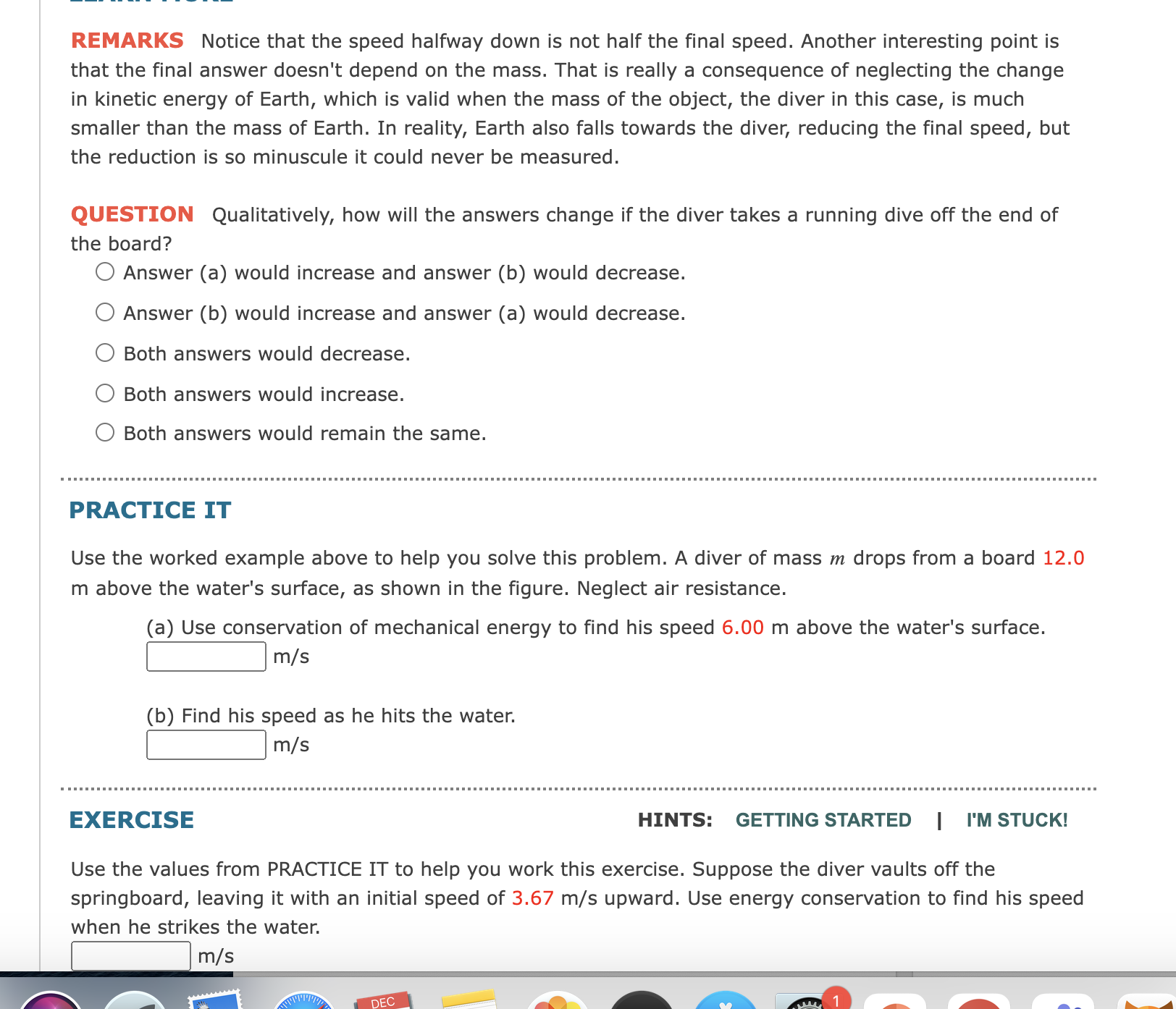
7. [-14 Points] SERCP11 5.AE.005. EXAMPLE 5.5 Platform Diver GOAL Use conservation of energy to calculate the speed of a body falling straight down in the presence of gravity. Consider the following figure. 10.0 m KEI-= 0 PEI: mgyl- 5.00 m m - l 2 KEf EMU," PROBLEM A diver of mass m drops from a board 10.0 m above the water's surface, as in the gure. Neglect air resistance. (a) Use conservation of mechanical energy to find his speed 5.00 m above the water's surface (b) Find his speed as he hits the water. STRATEGY Refer to the problem-solving strategy. Step 1: The system consists of the diver and Earth. As the diver falls, only the force of gravity acts on him (neglecting air drag), so the mechanical energy of the system is conserved, and we can use conservation of energy for both parts (a) and (b). Step 2: Choose y = 0 for the water's surface. Step 3: In part (a), y = 10.0 m and y = 5.00 m are the points of interest, while in part (b), y = 10.0 m and y = 0 m are of interest. SOLUTION (A) Find the diver's speed halfway down, at y = 5.00 m. Step 4: We write the energy KE, + PEIf = KEf + PEf conservation equation and supply the imvjz + mgy, = lmvfz + mgyf proper terms. 2 2 ' I = 1 Step 5. Substitute vi 0, cancel the 0 + gyi = 3va + gyf mass m, and solve for vf' v, = \\/2g(y, y,) = \\/ 2(9.80 m/52)(10.0 m 5.00 m) V; = 9.90 m/s (B) Find the diver's speed at the water's surface, y = 0. Use the same procedure as in part (a), 0 + mgy, = imvfz + 0 taking yf= 0. 2 V. = \\/ 293/,- = \\/ 2(9.80 m/sZ)(10.G m) = 14-0 m/s LEARN MORE REMARKS Notice that the speed halfway down is not half the final speed. Another interesting point is that the final answer doesn't depend on the mass. That is really a consequence of neglecting the change in kinetic energy of Earth, which is valid when the mass of the object, the diver in this case, is much smaller than the mass of Earth. In reality, Earth also fails towards the diver, reducing the final speed, but the reduction is so minuscule it could never be measured. QUESTION Qualitatively, how will the answers change if the diver takes a running dive off the end of I_ _ _ .__|-\\ REMARKS Notice that the speed halfway down is not half the final speed. Another interesting point is that the final answer doesn't depend on the mass. That is really a consequence of neglecting the change in kinetic energy of Earth, which is valid when the mass of the object, the diver in this case, is much smaller than the mass of Earth. In reality, Earth also fails towards the diver, reducing the final speed, but the reduction is so minuscule it could never be measured. QUESTION Qualitatively, how will the answers change if the diver takes a running dive off the end of the board? 0 Answer (a) would increase and answer (b) would decrease. 0 Answer (b) would increase and answer (a) would decrease. 0 Both answers would decrease. 0 Both answers would increase. 0 Both answers would remain the same. PRACTICE IT Use the worked example above to help you solve this problem. A diver of mass m drops from a board 12.0 m above the water's surface, as shown in the gure. Neglect air resistance. (a) Use conservation of mechanical energy to find his speed 6.00 m above the water's surface. |:l m/s (b) Find his speed as he hits the water. :1 m/s EXERCISE HINTS: GETTING STARTED | I'M STUCK! Use the values from PRACTICE IT to help you work this exercise. Suppose the diver vaults off the springboard, leaving it with an initial speed of 3.67 m/s upward. Use energy conservation to find his speed when he strikes the water
Step by Step Solution
There are 3 Steps involved in it

Get step-by-step solutions from verified subject matter experts
 Study Help