







Question: Please show all work. In class we stated that physical observables are represented by operators, which are linear and Hermitian (i.e. self-adjoint). The latter property
Please show all work.
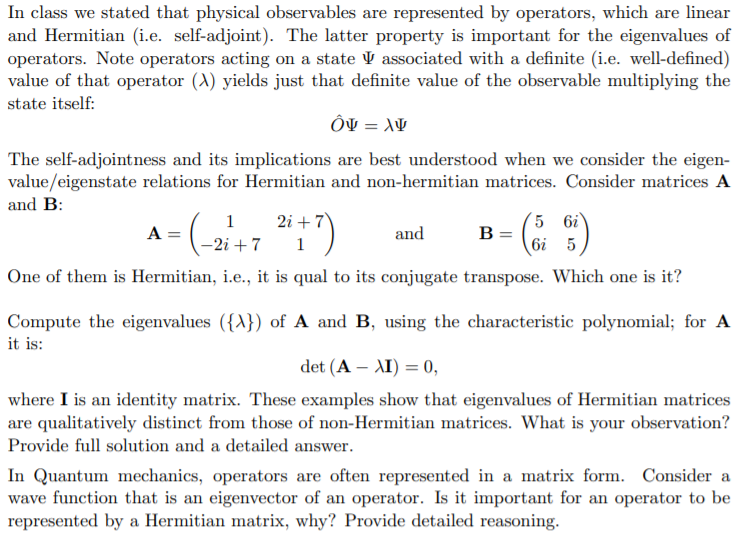
In class we stated that physical observables are represented by operators, which are linear and Hermitian (i.e. self-adjoint). The latter property is important for the eigenvalues of operators. Note operators acting on a state associated with a definite (i.e. well-defined) value of that operator () yields just that definite value of the observable multiplying the state itself: O^= The self-adjointness and its implications are best understood when we consider the eigenvalue/eigenstate relations for Hermitian and non-hermitian matrices. Consider matrices A and B : A=(12i+72i+71)andB=(56i6i5) One of them is Hermitian, i.e., it is qual to its conjugate transpose. Which one is it? Compute the eigenvalues ({}) of A and B, using the characteristic polynomial; for A it is: det(AI)=0, where I is an identity matrix. These examples show that eigenvalues of Hermitian matrices are qualitatively distinct from those of non-Hermitian matrices. What is your observation? Provide full solution and a detailed answer. In Quantum mechanics, operators are often represented in a matrix form. Consider a wave function that is an eigenvector of an operator. Is it important for an operator to be represented by a Hermitian matrix, why? Provide detailed reasoning
Step by Step Solution
There are 3 Steps involved in it

Get step-by-step solutions from verified subject matter experts
 Study Help