



Question: 1. Let A = {1,2, 5, 10}. Define R on A by xRy if and only if z is a divisor of y. %3D
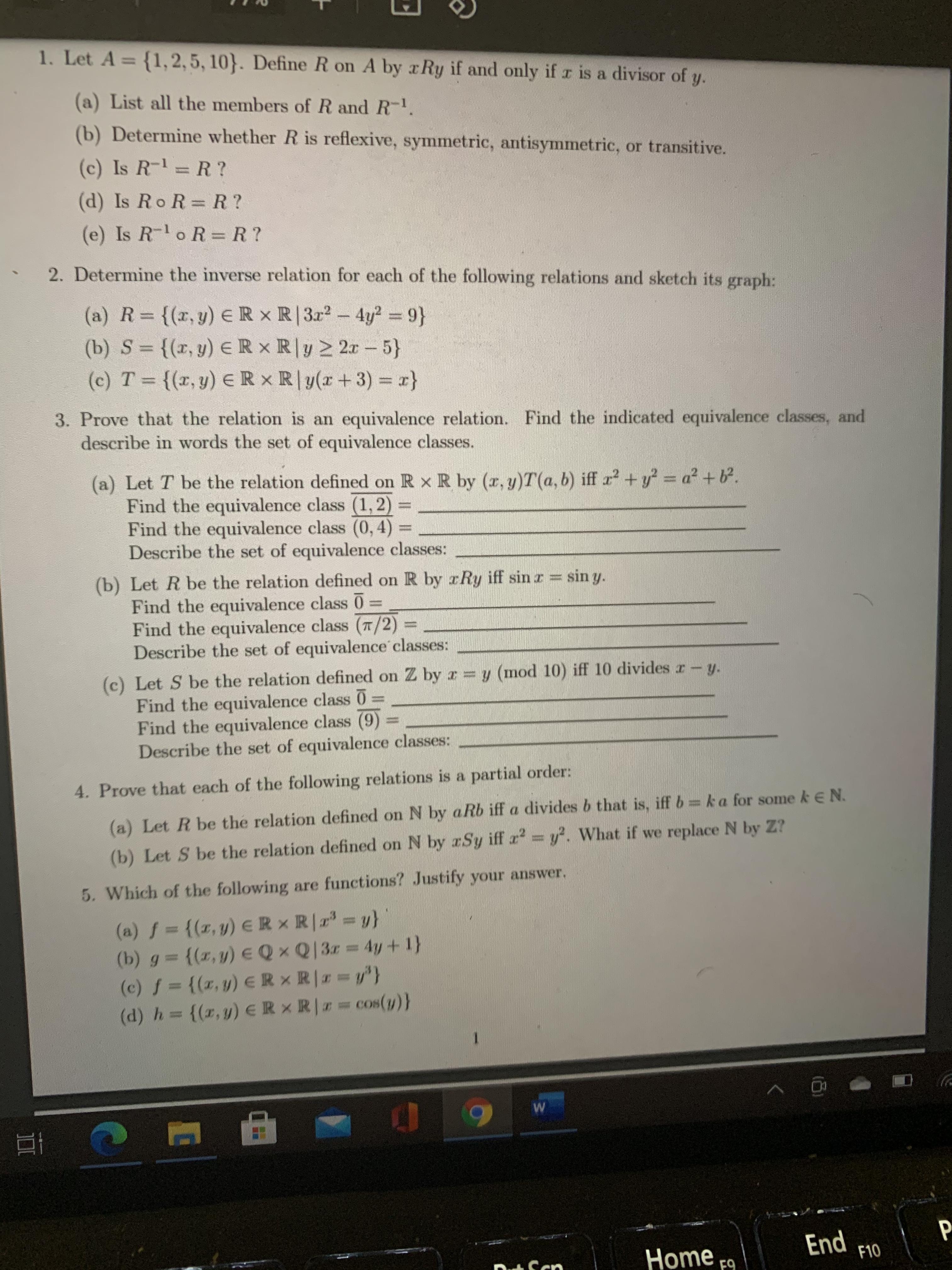
1. Let A = {1,2, 5, 10}. Define R on A by xRy if and only if z is a divisor of y. %3D (a) List all the members of R and R-. (b) Determine whether R is reflexive, symmetric, antisymmetric, or transitive. (c) Is R = R? %3D (d) Is Ro R=R? (e) Is R-oR= R? 2. Determine the inverse relation for each of the following relations and sketch its graph: (a) R= {(x,y) E R x R|3r2-4y? = 9} (b) S = {(r, y) ER X R|y 2 2x - 5} (c) T = {(1, y) E Rx R y(r+3) = r} %3D %3D %3D 3. Prove that the relation is an equivalence relation. Find the indicated equivalence classes, and describe in words the set of equivalence classes. (a) Let T be the relation defined on R x R by (r, y)T(a, b) iff a2 + y a + b. Find the equivalence class (1, 2) Find the equivalence class (0, 4) = Describe the set of equivalence classes: (b) Let R be the relation defined on R by rRy iff sin r = sin y. Find the equivalence class 0 = Find the equivalence class (T/2) 3D Describe the set of equivalence classes: %3D (c) Let S be the relation defined on Z by r y (mod 10) iff 10 divides r-y. Find the equivalence class 0= Find the equivalence class (9)%3D Describe the set of equivalence classes: 4. Prove that each of the following relations is a partial order: (a) Let R be the relation defined on N by aRb iff a divides b that is, iff b ka for some k E N. (b) Let S be the relation defined on N by rSy iff a y. What if we replace N by Z? 5. Which of the following are functions? Justify your answer. (a) f = {(z, y) E Rx R|r = y} (b) g= {(z,y) EQ Q[3x 4y+1} (c) f= {(x,y) ER x Ra y"} (d) h = {(x,y) ERXR=cOs(} %3D %3D %3D End P Home a F10 F9
Step by Step Solution
3.42 Rating (158 Votes )
There are 3 Steps involved in it

Get step-by-step solutions from verified subject matter experts